

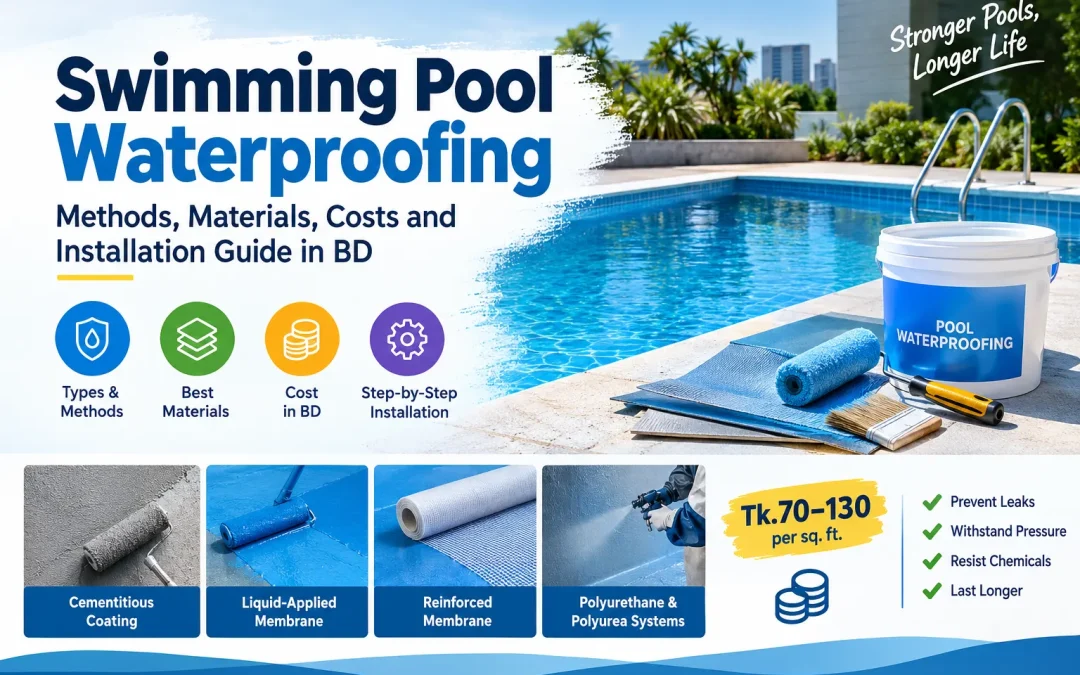
Swimming pool waterproofing seals a concrete pool shell with a waterproofing membrane: cementitious, liquid-applied, reinforced, or polyurethane. Installers work in 4 stages: surface preparation, crack repair, membrane application, and flood testing. BD market rates run Tk.70–130 per square foot.
Pool shells face positive water pressure from the pool and negative pressure from groundwater. Chlorine, salt, and settlement cracks attack unprotected concrete. A pool membrane bridges cracks, resists both pressure directions, and accepts tile adhesive, according to KÖSTER and Teknosel.
What Are the Types of Swimming Pool Waterproofing Systems?
Swimming pool waterproofing systems fall into 4 types: cementitious coatings, liquid-applied membranes, reinforced membranes, and polyurethane or polyurea systems. Each type differs in flexibility, crack-bridging capacity, substrate compatibility, and cost. Cementitious systems dominate tiled concrete pools; polyurethane systems suit high-movement surfaces.
| Type | Application method | Crack-bridging | Best use |
|---|---|---|---|
| Cementitious | Brush, roller, or trowel in 2–3 coats | Low (rigid) to medium (flexible 2-component) | Tiled concrete pools |
| Liquid-applied membrane | Roller, trowel, or spray | Medium to high | Tiled pools, repairs |
| Reinforced membrane | Liquid coats with embedded mesh or fabric, or sheets | High | Joints, movement zones |
| Polyurethane and polyurea | Spray or roller over primer | High | Rooftop and high-movement pools |
Cementitious Waterproofing
Cementitious waterproofing is a cement-based mortar mixed with polymers or crystalline additives and applied in 2–3 coats over concrete. Flexible two-component grades bridge cracks and resist positive and negative water pressure. Installers coat the shell; tiles bond directly to the cured layer.
Weber applies weberdry 110 FX in 3 layers and requires 1 week of curing before a flood test. Isomat’s AQUAMAT-ELASTIC forms a seamless, jointless membrane, carries CE marking under EN 14891 and EN 1504-2, and resists positive and negative water pressure. Crystalline grades such as Teknomer 200 EX penetrate the concrete and seal pores from within. Rigid cementitious mortars crack under movement, so pools use flexible two-component grades.
Liquid-Applied Membranes
Liquid-applied membranes are polymer coatings applied by roller, trowel, or spray that cure into a seamless, elastic film. They bridge cracks and accept tiles. TEC HydraFlex cures in 2–3 hours on concrete as young as 3 days.
Construction Chemicals Australia applies Liquid Flash in 2 coats to reach a 1.5 mm dry film thickness, then requires tile over the membrane to protect the adhesive from pool chemicals. The membrane cures for a minimum of 7 days at 23°C before the pool fills.
Reinforced Membranes
Reinforced membranes embed glass-fiber mesh or polyester fabric between liquid coats, or use geotextile and polymer sheets. The reinforcement raises tensile strength and spans moving cracks and joints. KÖSTER places glass-fiber mesh between the first and second layers.
Parature Reforma groups pool systems into 4 families: cementitious products, chlorinated-rubber paint, geotextile membrane, and polymeric membrane. Reinforcement adds one labor step: embed the mesh or fabric into the wet coat, then cover it with the next coat. Baumerk applies waterproofing tape to floor and wall corners before the main coating.
Polyurethane and Polyurea Systems
Polyurethane and polyurea systems are elastomeric membranes sprayed or rolled onto primed concrete. Polyurethane cures in hours; polyurea sets in minutes. Both form seamless, highly elastic films that bridge moving cracks and resist chemicals. They cost more.
Sika Bangladesh prices polyurethane systems at about Tk.130 per square foot, against Tk.70–80 for cement-based options, according to The Daily Star. The premium buys elasticity and fast cure. Specify immersion-rated grades and confirm chlorine resistance on the data sheet.
How to Choose the Right Waterproofing System?
Choose a pool waterproofing system by matching 7 factors: pool type, water pressure, crack movement, finish, substrate age, chemical exposure, and budget. Flexible cementitious membranes suit tiled concrete pools; polyurethane or reinforced systems suit rooftop pools and high-movement structures.
- Match the system to pool type: underground pools face groundwater pressure from outside, while rooftop pools face structural movement and thermal stress, as Volteco classifies them.
- Confirm pressure resistance: select a membrane rated for positive pressure from pool water and negative pressure from groundwater, because concrete shells face water from both sides (Teknosel).
- Verify crack-bridging: choose flexible or reinforced membranes, because new concrete shrinks and settles, and rigid mortar cracks and leaks under that movement.
- Check finish compatibility: select a membrane that bonds with tile adhesive for tiled pools, or one that accepts epoxy coating for painted pools, as Isomat pairs AQUAMAT-ELASTIC with EPOXYCOAT-S.
- Test the substrate: confirm new concrete has cured 28 days or reached a pH below 10 before membrane application (Construction Chemicals Australia, DRYLOK).
- Review chemical resistance: look for CE marking under EN 14891 or EN 1504-2 and data-sheet resistance to chlorine, salt, and electrolysis water treatment.
- Compare cost: weigh cementitious systems at Tk.70–80 per square foot against polyurethane systems at about Tk.130, then add labor and warranty.
| Scenario | Recommended system |
|---|---|
| New tiled concrete pool | Flexible two-component cementitious membrane |
| Pool with groundwater pressure | Negative-side cementitious or crystalline system |
| Rooftop or high-movement pool | Reinforced liquid membrane or polyurethane |
| Painted or epoxy-finished pool | Cementitious membrane plus epoxy coating |
| Budget-limited tiled pool | Cementitious system at Tk.70–80 per square foot |
How Do You Waterproof a Swimming Pool Step by Step?
Waterproof a swimming pool in 4 stages: inspect and prepare the concrete, repair cracks, joints, and penetrations, prime and apply the membrane in 2–3 coats, then detail, cure for 7 days, and flood test. Each stage finishes before the next begins.
Inspection and Surface Preparation
Inspection and surface preparation give the membrane a sound, clean base. Installers grind off dust, oil, and laitance, wash with fresh water, and map cracks, holes, honeycombing, and rust stains. New concrete cures 28 days before most membranes go on.
- Grind the surface with a grinder to remove dust, oil, laitance, and loose particles; wash with fresh water only (Weber).
- Inspect the walls and floor for rust-colored stains, which signal corroding rebar, and mark every crack, void, and honeycombed area for repair before any coating goes on.
- Confirm the concrete age: new concrete cures 28 days or reaches a pH below 10 before membrane application, according to Construction Chemicals Australia and DRYLOK.
- Level uneven walls and floors with a screed or render, then wet-cure it for at least 7 days (Sika method statement).
Crack, Joint and Penetration Repair
Crack, joint, and penetration repair seals every weak point before the main membrane goes on. Installers chisel damaged concrete, plug holes with fast-setting mortar, patch large voids with non-shrink mortar, form cove fillets at wall-floor joints, and seal pipe penetrations.
- Plug holes and small cracks with a fast-setting plugging mortar such as weberdry 150 BLC, keeping the patch moist for 15 minutes (Weber).
- Chisel out large holes and damaged concrete, wash with fresh water, and fill with a non-shrink thixotropic mortar such as weberep 331 TX at least 3 days before coating (Weber).
- Cut out honeycombed areas by removing all damaged concrete and laitance back to sound material, then rebuild the section with repair mortar (Weber).
- Install a cove fillet of waterproofing mortar at the wall-floor junction to prevent stress concentration in the membrane layers (KÖSTER).
- Seal pipe penetrations with flexible flange collars and sealant, and apply waterproofing tape over joints and corners before the main coat (KÖSTER, Baumerk).
Priming and Membrane Application
Priming and membrane application bond the waterproofing layer to concrete. Installers brush on a primer, such as Primax, then apply 2–3 membrane coats by roller, brush, trowel, or spray to the specified thickness, such as 1.5 mm dry film for Liquid Flash.
- Apply a primer to harden the substrate and reduce salt mobility before coating; KÖSTER uses Polysil TG 500 for this step.
- Mix two-component membranes to the data-sheet ratio, then apply the first coat by brush, roller, or trowel over the full shell without gaps or pinholes.
- Embed glass-fiber mesh between the first and second coats at joints and movement zones to improve crack resistance and bridge movement (KÖSTER).
- Apply the second and third coats after each previous coat dries, reaching the full specified thickness; Weber applies weberdry 110 FX in 3 layers.
- Wet-cure cementitious membranes for 3–5 days immediately after application to complete cement hydration and limit cracking (Sika Sikalastic-1 KMY method statement).
Detailing, Curing and Testing
Detailing, curing, and testing finish the waterproofing system. Installers seal joints, cure the membrane for 7 days at 23°C, then run a flood test that compares pool water loss against an evaporation control vessel. Losses above the control level signal a leak.
- Cure the membrane for 7 days before filling; Weber requires 1 week before a flood test and Construction Chemicals Australia sets 7 days at 23°C.
- Inspect the cured membrane for pinholes and gaps, and patch each defect with repair membrane, then let the patch cure before filling.
- Fill the pool slowly and set a test vessel of water beside it, then mark and record both water levels (TEC Specialty).
- Measure both levels again after several days; similar losses point to evaporation or wind, while larger pool losses point to a membrane leak (TEC Specialty).
- Drain the pool and repair the membrane when it loses significantly more water than the test vessel, then retest before tiling.
How Do You Waterproof Concrete, Tiled, and Existing Pools?
Waterproof a new concrete pool with a flexible cementitious or liquid membrane under the finish, a tiled pool with a membrane plus flexible tile adhesive, and an existing pool by draining, repairing, and recoating sound substrate.
Concrete Pools
Concrete walls alone do not seal a pool. Weber states that concrete or hollow-block walls need a full waterproofing system before the pool enters service. Teknosel explains that a concrete pool cannot fill first, shrink, drain, and then receive waterproofing, so builders apply elastic membranes that tolerate shrinkage. Choose a membrane that resists positive and negative water pressure, and apply it after the 28-day cure.
Tiled Pools
Tiled pools place the membrane under the tile finish. KÖSTER pairs its crack-bridging membranes with a flexible one-component tile adhesive, and Parature Reforma pairs cementitious waterproofing with epoxy grout for salt-electrolysis and seawater pools. Mapei links delamination and efflorescence to the membrane-first, render-second, tile-third sequence, so confirm the layer order with the manufacturer before work starts.
Existing Pools
Existing pools need a leak diagnosis first: run the test-vessel comparison to separate evaporation from leakage. TEC Specialty notes that leak repair is expensive and sometimes requires removing tile and adhesive. Drain the pool, remove loose tile and failed coatings, repair cracks, prime, and apply a bonded membrane. When groundwater pushes water through the shell from outside, use a negative-side system such as KÖSTER NB 1 Grey.
What Waterproofing Products and Material Quantities Does a Swimming Pool Need?
A swimming pool needs 6 product groups: primer, repair mortar, waterproofing membrane, reinforcement mesh or tape, tile adhesive, and grout. Quantity equals surface area (floor plus walls) times coats times the data-sheet consumption rate, plus 10% waste.
| Product group | Example products | Role |
|---|---|---|
| Primer | KÖSTER Polysil TG 500, Primax | Hardens substrate, bonds membrane |
| Repair mortar | weberdry 150 BLC, weberep 331 TX, KÖSTER WP Mortar | Fills holes, forms cove fillets |
| Membrane | AQUAMAT-ELASTIC, weberdry 110 FX, Sikalastic-1 KMY, TEC HydraFlex, Liquid Flash | Seals the shell |
| Reinforcement | Glass-fiber mesh, waterproofing tape | Bridges joints and corners |
| Tile adhesive | KÖSTER BD Flexible Tile Adhesive | Bonds tile to membrane |
| Grout | Morcemcolor Epoxy | Resists chemicals and salt |
Sika Bangladesh manufactures waterproofing materials at its Narayanganj factory, which opened in 2023, according to The Daily Star.
Follow 4 steps to calculate quantities:
- Measure the floor area and all wall areas in square feet or square meters, then add them for the total waterproofing surface, including steps, benches, and overflow channels.
- Read the consumption rate (kg per square meter per coat) on the product data sheet and multiply it by the number of coats the system requires.
- Add 10% for waste, corner overlaps, and rough concrete, which absorbs more product than smooth screeded surfaces, then round up to whole bags or drums.
- Order primer, repair mortar, mesh, tape, adhesive, and grout separately, because each product carries its own coverage rate per square meter.
Worked example: a 20 ft × 10 ft × 5 ft pool has a 200 sq ft floor and 300 sq ft of walls (2 × 20 × 5 plus 2 × 10 × 5). The total is 500 sq ft, or 46.5 m². Adding 10% gives 51 m². A membrane rated at 1.5 kg/m² per coat across 2 coats requires 51 × 1.5 × 2 = about 153 kg. The 1.5 kg/m² rate is an illustration; read the rate on your product’s data sheet.
How Much Does Swimming Pool Waterproofing Cost in BD?
Swimming pool waterproofing in Bangladesh costs about Tk.70–130 per square foot of surface. Cementitious systems run Tk.70–80; polyurethane systems run about Tk.130, per Sika Bangladesh pricing reported by The Daily Star. A 500-square-foot pool shell costs Tk.35,000–65,000 for waterproofing.
The Daily Star reports these rates for roof waterproofing; pool shells use the same material classes. Immersion-grade pool products price above roof-grade ones in some ranges, so collect a written quote that names the product.
| Pool size | Surface area | Cementitious (Tk.70–80) | Polyurethane (about Tk.130) |
|---|---|---|---|
| 15 × 8 × 4 ft | 304 sq ft | Tk.21,280–24,320 | Tk.39,520 |
| 20 × 10 × 5 ft | 500 sq ft | Tk.35,000–40,000 | Tk.65,000 |
| 30 × 15 × 5 ft | 900 sq ft | Tk.63,000–72,000 | Tk.117,000 |
4 factors drive the final quote:
- Labor: Applicator labor makes up 30–50% of total waterproofing cost because installers require specialized training for membrane mixing, application, and detailing (InfraLens).
- Surface preparation: Prep consumes about half of the job; budget equal cost for preparation and material, and prep cost varies 2–3 times with substrate condition (InfraLens).
- Warranty: A 10-year contractor warranty adds 15–20% to the quoted price, so compare warranty terms alongside price per square foot when reviewing bids (InfraLens).
- System type: Polyurethane systems cost about Tk.130 per square foot, while cementitious systems cost Tk.70–80, so system choice changes the budget directly (The Daily Star).
What Are the Common Waterproofing Swimming Pool Problems and Solutions?
Swimming pool waterproofing fails in 6 common ways: delamination, efflorescence, shrinkage and settlement cracks, rebar-corrosion cracks, leaking penetrations, and groundwater seepage. Match the repair to the cause.
- Delamination: Membrane, render, and tile layers debond from the substrate, and Mapei links this to a membrane placed beneath the levelling render; remove failed layers and reapply in the manufacturer’s sequence.
- Efflorescence: White crystalline stains form when water dissolves salts and evaporates at the surface; seal water-leaching paths and use calcium-free grout and adhesive (Hard Solutions).
- Shrinkage and settlement cracks: Curing shrinkage and uneven soil support crack rigid coatings; fill cracks with repair mortar and recoat with a flexible or reinforced membrane (Teknosel, Builder).
- Rebar-corrosion cracks: Cracks follow reinforcement lines and show rust when steel has inadequate concrete cover; chisel out damaged concrete, treat the steel, and patch with non-shrink mortar (Builder).
- Pipe penetrations and joints: Leaks start where pipes, fittings, and joints pass through the shell; reseal each point with flexible waterproofing such as KÖSTER KB-Flex 200 and KB-Fix 5.
- Groundwater seepage: Groundwater pushes water through the shell from outside; apply a negative-side system such as KÖSTER NB 1 Grey, or the KD System for pressurized water (KÖSTER).
A pool holds water only as well as its membrane does. Measure the shell, choose a flexible membrane rated for both pressure directions, and collect 3 written quotes that list product, coats, thickness, and warranty before work starts.
FAQs for Swimming Pool Waterproofing: Bangladesh (BD) Market
These FAQs focus on practical concerns of pool owners, contractors, property developers, hotels and swimming pool maintenance teams in Bangladesh. They avoid repeating the H2 topics from the previous content brief, including general waterproofing methods, product comparisons, installation steps, costs, and common waterproofing problems.
The questions follow your Rules.pdf guidelines: question-based headings, direct answers, short declarative sentences, specific contextual entities, and approximately 40-word answers immediately after each question.
Why does a swimming pool lose water faster during hot weather in Bangladesh?
Swimming pools lose water through evaporation, leakage, and splashing. High temperatures, direct sunlight, wind, and low humidity increase evaporation. Pool owners in Bangladesh can compare water loss against a controlled evaporation reference and inspect the pool shell, plumbing, and fittings when unexplained water loss continues.
Can heavy monsoon rain damage an underground swimming pool in Bangladesh?
Heavy monsoon rainfall can increase groundwater pressure around an underground swimming pool. Poor drainage and a rising water table can create hydrostatic pressure against the pool shell. An engineer should assess groundwater conditions, drainage, structural stability, and uplift risk before the pool is drained.
Does high groundwater in Dhaka affect swimming pool waterproofing?
High groundwater can affect underground swimming pools by increasing external water pressure and the risk of water ingress. Site-specific groundwater investigations help determine drainage requirements, structural resistance, and external waterproofing provisions. Pool designs in low-lying areas require particular attention to seasonal groundwater variation.
Can saline groundwater damage a concrete swimming pool in coastal Bangladesh?
Saline groundwater can expose concrete pool structures to chloride-related deterioration and affect the durability of embedded reinforcement. Coastal projects require suitable concrete specifications, protective systems, groundwater assessment, and compatible waterproofing materials. The design must address both water ingress and long-term reinforcement corrosion risks.
Does a rooftop swimming pool require additional protection against water leakage?
A rooftop swimming pool requires coordinated waterproofing, structural design, and drainage protection because leakage can damage the occupied spaces below. The design must address pool-shell watertightness, movement joints, penetrations, overflow drainage, and the surrounding roof assembly. A structural engineer should verify the additional water load.
Why does a swimming pool in a hotel or apartment building require detailed leak investigation?
Swimming pool leakage in hotels and apartment buildings can damage adjacent rooms, concrete slabs, electrical installations, and interior finishes. Investigators should examine the pool shell, pipework, drains, lights, joints, and surrounding structure to identify the source before specifying repairs.
Can swimming pool waterproofing materials withstand Bangladesh’s humid climate?
Swimming pool waterproofing materials must meet their specified application and service conditions in humid environments. High humidity, rain exposure, substrate moisture, and temperature affect the curing and adhesion of some systems. Contractors must follow the manufacturer’s technical data sheet for surface moisture, weather limits, and curing requirements.
How can pool owners identify leakage around swimming pool lights and pipe connections?
Leakage around pool lights and pipe connections often originates at penetrations, seals, fittings, or connected plumbing. A qualified technician can inspect these areas, conduct appropriate plumbing pressure tests, and use controlled leak-detection procedures. Electrical equipment must be isolated and handled safely during underwater fixture inspection.
Is swimming pool waterproofing necessary before installing imported tiles in Bangladesh?
Pool assemblies with imported tiles require a compatible waterproofing and tile-installation specification. Tile adhesive, grout, substrate preparation, movement joints, and the waterproof membrane must function as a coordinated system. The project specification and product manufacturers must confirm compatibility before tile installation begins.
How can Bangladesh pool contractors prevent waterproofing failure during the rainy season?
Pool contractors can reduce weather-related installation failures by controlling substrate conditions, protecting fresh applications from rain, and following specified curing requirements. Work scheduling must account for rainfall forecasts, surface moisture, temperature, and product limitations. Pool filling and subsequent construction stages must follow the approved system specification.
Can swimming pool waterproofing protect concrete against chlorine and other pool chemicals?
A suitable pool waterproofing system can resist the chemical exposure specified by its manufacturer. Chlorine, sanitizers, cleaning agents, and changing water chemistry affect coatings and finishes differently. Pool owners should verify chemical resistance, operating temperature limits, and compatibility with the planned water-treatment system.
What documents should a contractor provide after completing swimming pool waterproofing in Bangladesh?
A professional waterproofing handover should include product technical data sheets, application records, batch details, inspection results, and water-retention test documentation. Project records should also identify the installed system, curing period, approved repairs, warranties, and maintenance requirements. These documents support future inspections and accountability.