

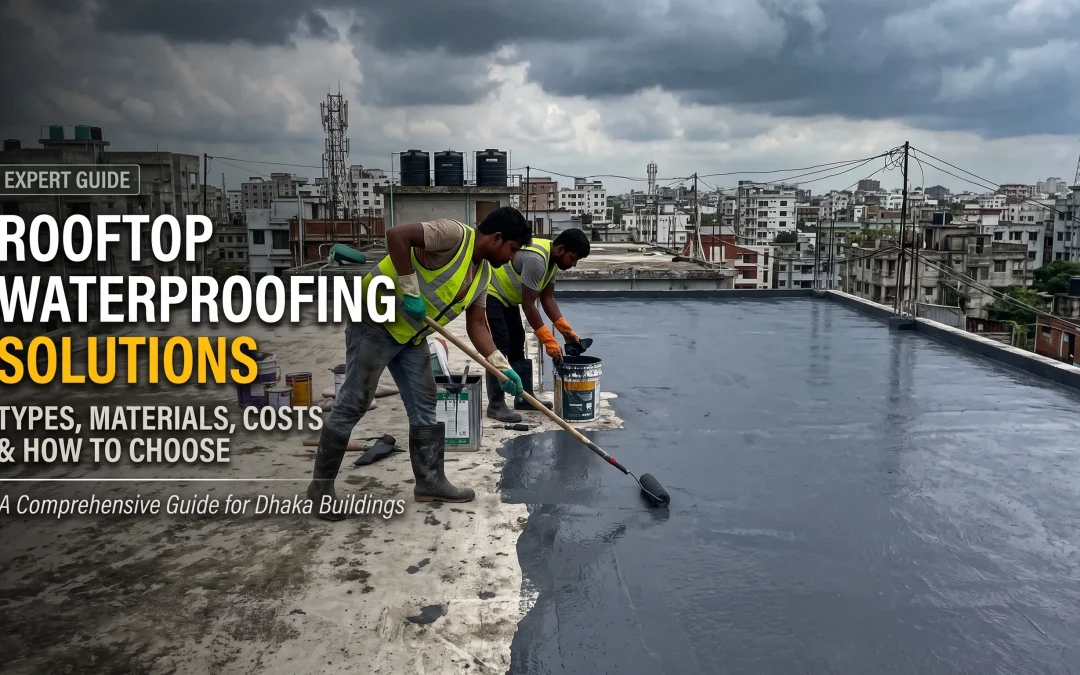
Rooftop waterproofing in Dhaka protects concrete roofs from monsoon rain, ponding water, cracking, and moisture damage. The right system depends on roof slope, substrate condition, drainage, UV exposure, foot traffic, and budget. Common options include liquid-applied membranes, sheet membranes, modified bitumen, and cementitious coatings, each with different performance and maintenance needs.
Concrete, flat, low-slope, metal, terrace, roof-deck, existing, and green roofs require different waterproofing approaches. A proper installation starts with inspection, drainage correction, surface cleaning, crack repair, priming, detailing, membrane application, protective coating, and final testing. Ponding water requires slope and drainage correction rather than waterproofing alone.
Material choice also affects cost, durability, flexibility, UV resistance, and maintenance. Polyurethane, polyurea, silicone, acrylic, TPO, PVC, EPDM, modified bitumen, and cementitious systems each suit different conditions. Common failures include leaks, cracks, blisters, failed seams, penetration leaks, ponding, and blocked drainage, while repair, restoration, waterproofing, or replacement depends on the roof’s condition.
For a Dhaka rooftop, inspect the roof before the monsoon, correct drainage and substrate defects, then select a compatible membrane for the roof’s exposure and use. Stop water at the roof surface before it becomes a problem inside the building.
What Is Rooftop Waterproofing?
Rooftop waterproofing is the application of a protective membrane or coating that blocks water from entering the concrete slab, insulation, and interior structure. It uses liquid, sheet, modified bitumen, or cementitious materials to seal cracks and joints against monsoon rain.
Purpose: Rooftop waterproofing serves three functions. It stops leaks that stain ceilings and damage wiring. It blocks water absorption that corrodes the reinforcement steel inside RCC slabs. It extends the roof’s service life by 10 to 25 years, depending on the membrane. A dry rooftop also lowers indoor humidity and cuts mold growth in the floors below.
Waterproofing vs Roof Coating: Waterproofing creates a continuous, water-blocking barrier built to resist hydrostatic pressure and standing water. Roof coating adds a thinner, mostly reflective or protective layer over a roof that is already sound. Every waterproofing membrane technically coats the roof, but not every coating waterproofs it against ponding water.
Waterproofing vs Roof Repair: Roof repair fixes one isolated defect: a crack, a torn membrane section, or a failed flashing joint. Waterproofing treats the entire roof as one connected system, sealing it against water before damage spreads or after it appears. Repair reacts to a problem. Waterproofing prevents one across the whole rooftop.
How to Choose the Right Rooftop Waterproofing Solution?
Choosing rooftop waterproofing means matching the membrane to roof slope, existing material, age, local climate, UV exposure, ponding water, foot traffic, and the condition of any existing membrane. Dhaka’s monsoon climate favors flexible, UV-stable, high-elongation systems over rigid, cement-only coatings.
- Roof Slope: Flat and low-slope roofs under a 1:50 pitch trap standing water and need fully bonded, seamless membranes such as polyurethane or polyurea instead of lapped sheet systems.
- Roof Material: Concrete (RCC) roofs need primers and crack-bridging membranes; metal roofs need rust-inhibiting, flexible coatings; wood decks need moisture-tolerant liquid membranes with vapor permeability.
- Roof Age: New RCC slabs need 28 days of curing before waterproofing starts, while roofs older than 10 years usually need crack repair and a bonding primer first.
- Climate: Dhaka receives roughly 2,066 mm of rain a year, concentrated between June and September, according to Bangladesh Meteorological Department data, so membranes must handle sustained saturation, not occasional showers.
- UV Exposure: Rooftops under direct tropical sun need UV-stable polyurethane, polyurea, or silicone systems, since unprotected acrylic and plain asphalt degrade faster under constant sunlight.
- Ponding Water: Areas holding water more than 48 hours need ponding-resistant membranes like polyurea or reinforced PVC, because standard acrylic coatings break down fast under constant immersion.
- Foot Traffic; Terraces and roof decks with regular foot traffic need trafficable, abrasion-resistant systems such as reinforced polyurethane or tile-finished cementitious coatings, not thin acrylic paint.
- Existing Membrane: Compatibility between the old and new membrane determines whether a contractor coats directly over the existing surface or strips it down to bare concrete first.
Types of Rooftop Waterproofing Systems
Four core rooftop waterproofing systems exist: liquid-applied membranes (polyurethane, polyurea, silicone, acrylic, hybrids), sheet membranes (TPO, PVC, EPDM), modified bitumen membranes (APP, SBS), and cementitious coatings. Each system differs in flexibility, UV resistance, seam count, and lifespan.
Liquid-Applied Membranes
Liquid-applied membranes cure into a seamless, fully bonded layer that follows the roof’s contours, pipes, and corners without a single joint. Five chemistries dominate this category.
- Polyurethane: Polyurethane membranes stretch up to 300% elongation and bond tightly to concrete, forming a seamless, watertight layer that resists cracking from building movement and thermal expansion.
- Polyurea: Polyurea cures within minutes, reaches 300%+ elongation, and outperforms most liquid systems on ponding water resistance, making it a top pick for flat Dhaka rooftops.
- Silicone: Silicone resists UV degradation and long-term ponding better than most coatings but bonds poorly to bare concrete, so installers usually apply it over an existing sound membrane.
- Acrylic: Acrylic is water-based, affordable, and breathable, but it has the lowest resistance to standing water among liquid membranes and needs reapplication every three to five years.
- Hybrid Systems: Hybrid polyurethane systems blend PU’s elasticity with added polymers for higher chemical resistance, giving terraces and podium decks a tougher, longer-lasting topcoat.
Sheet Membranes
Sheet membranes arrive pre-manufactured in rolls and get bonded, heat-welded, or mechanically fastened to the roof deck, which removes many on-site quality variables that liquid systems carry.
- TPO: TPO (thermoplastic polyolefin) sheets heat-weld into continuous seams, reflect up to 90% of solar radiation, and hold roughly 40% of the commercial low-slope roofing market, per NRCA survey data.
- PVC: PVC (polyvinyl chloride) membranes resist oils, chemicals, and fire better than TPO or EPDM, making them the standard choice near kitchen exhausts or factory chemical emissions.
- EPDM: EPDM (ethylene propylene diene monomer) rubber sheets flex well through temperature swings and cost less upfront, though the black surface absorbs heat instead of reflecting it.
Modified Bitumen Membranes
Modified bitumen combines asphalt with rubber or plastic polymers in reinforced sheets, then bonds to the roof deck using heat, cold adhesive, or a factory-applied self-adhesive backing.
- APP: APP (atactic polypropylene) modified bitumen resists heat and UV rays well, giving it a smooth, plastic-like surface suited to Dhaka’s intense pre-monsoon sun exposure.
- SBS: SBS (styrene-butadiene-styrene) modified bitumen stays flexible through shifting temperatures and absorbs building movement better than APP, making it the more common global specification.
- Self-Adhered: Self-adhered membranes install with a peel-and-stick backing, skip open-flame torches entirely, and cut installation risk on occupied buildings or tight rooftop spaces.
- Torch-Applied: Torch-applied membranes melt onto the substrate with a propane torch, producing the strongest inter-ply bond available, though they need trained crews and fire precautions.
Cementitious Waterproofing
Cementitious waterproofing mixes cement, polymers, and water-repellent additives into a trowel- or brush-applied coating that bonds directly to concrete without a primer coat. It forms a rigid, crystalline barrier that resists hydrostatic pressure, which is why it shows up on water tanks, terraces, and bathroom floors across Dhaka. Polymer-modified versions add flexibility to bridge hairline cracks, but standard cementitious coatings crack under real structural movement and work best on stable, low-traffic RCC roofs in older buildings.
Best Waterproofing Solutions by Roof Type
Each roof type demands a different rooftop waterproofing system. Concrete roofs need crack-bridging membranes, metal roofs need rust-inhibiting coatings, and green roofs need root-resistant barriers. Matching the material to the substrate prevents premature failure and voided warranties.
- Concrete: RCC concrete roofs pair best with polyurethane or polyurea liquid membranes reinforced with fabric at cracks, since these systems bond directly to cured concrete without any seams.
- Flat: Flat roofs need fully adhered, seamless systems like polyurea or reinforced PVC that handle standing water well, since lapped or mechanically fastened sheets leak at low-slope seams.
- Low-Slope: Low-slope roofs under a 1:50 pitch need tapered insulation plus a flexible membrane, since the built-in slope alone rarely moves water fast enough to stop ponding.
- Metal: Metal roofs need rust-inhibiting silicone or acrylic coatings applied after sealing every screw penetration and seam, since untreated fasteners remain the most common leak source.
- Roof Deck: Roof decks under pavers or tiles need a trafficable waterproofing membrane plus a protection board, since foot traffic and furniture puncture unprotected coatings quickly.
- Terrace: Terraces need UV-stable, foot-traffic-rated systems like polyurethane with a textured topcoat, since a bare liquid membrane turns slippery and degrades fast under direct sun.
- Existing Roof: Existing roofs need a compatibility check before recoating, since mismatched chemistries between old and new membranes cause blistering, so contractors often test-patch a small area first.
- Green Roof: Green roofs need a root-resistant membrane, usually modified bitumen or reinforced PVC, layered beneath the drainage board and growing medium to stop root penetration long-term.
Waterproofing a Flat Roof Step by Step
Flat roof waterproofing follows nine steps: inspect the surface, fix drainage, clean thoroughly, repair cracks, apply primer, detail joints and penetrations, install the membrane, add a protective topcoat, then inspect again before handover.
- Inspect the Roof: Check the entire surface for cracks, blisters, loose concrete, and old patch jobs, then mark every defect on a plan before cleaning or repair work starts.
- Fix Drainage: Clear drains, scuppers, and downspouts of debris, then confirm the roof slopes at least 1:50 toward the outlets so water never sits longer than 48 hours.
- Clean the Surface: Pressure-wash the roof to remove dirt, algae, and loose material, then let the concrete dry fully, since trapped moisture causes blisters under any membrane.
- Repair Cracks: Fill cracks and honeycombed concrete with polymer-modified mortar or a crack-filler paste, and grout expansion joints separately so the membrane bonds to a sound base.
- Apply Primer: Roll or spray a primer matched to the chosen membrane chemistry, since primer bonds the coating to concrete and stops pinholes from forming underneath it.
- Detail Critical Areas: Reinforce corners, pipe penetrations, drain outlets, and parapet joints with fabric or mesh embedded in the coating before the main membrane goes down.
- Install the Membrane: Apply the waterproofing membrane in the specified number of coats and thickness, working each layer in an alternating direction for full, even coverage.
- Add a Topcoat: Finish with a UV-protective or reflective topcoat that shields the membrane from direct sun and, on trafficked terraces, adds slip resistance underfoot.
- Final Inspection: Flood-test the roof or wait through one heavy rain, then check every seam, corner, and drain for leaks before signing off on the job.
How to Deal With Ponding Water?
Ponding water — standing water that lasts more than 48 hours after rain — comes from inadequate slope, blocked drains, or structural deflection. Fixing it means correcting drainage, adding slope with tapered insulation, and choosing a ponding-resistant membrane like polyurea.
Why It Happens: Ponding forms when a roof lacks the minimum 1:50 (¼ inch per foot) slope needed to move water toward a drain, or when drains sit too far apart to clear the roof area in time. Structural deflection from an aging deck, compressed insulation, or heavy rooftop equipment also creates low spots where water collects and stays.
Drainage: Clogged or undersized drains cause most ponding problems. Clearing debris every quarter, adding extra scuppers or siphonic drains on large roofs, and keeping gutters free of silt restores the flow path that water needs to leave the rooftop.
Slope: A roof needs at least a 1:50 pitch toward its drains. Tapered insulation boards or a fiber-reinforced skim-coat mortar rebuild that slope on existing roofs without demolishing the structure, redirecting water toward the outlets instead of the low spots.
Membrane Implications: Standing water degrades acrylic and standard cementitious coatings faster than polyurea, reinforced PVC, or fully adhered TPO, which tolerate constant immersion far better. Any roof with a known ponding zone needs a membrane rated for permanent water contact, not just occasional splash exposure.
Roof Waterproofing Materials Compared
Polyurea delivers the strongest overall performance across ponding resistance, flexibility, and lifespan, while cementitious coatings cost the least but crack under structural movement. The table below compares nine rooftop waterproofing materials across application, compatibility, UV resistance, ponding resistance, flexibility, installation, and maintenance.
| Material | Application | Roof Compatibility | UV Resistance | Ponding Resistance | Flexibility | Installation | Maintenance |
| Polyurethane | Liquid, roller or spray | Concrete, metal, wood | High | Moderate to high | High — up to 300% elongation | 1–2 days; needs primer | Low; recoat every 8–12 years |
| Polyurea | Liquid, spray | Concrete, metal, existing membranes | High | Very high | Very high — 300%+ elongation | Hours; fast cure, spray rig needed | Very low; 20–25 year lifespan |
| Silicone | Liquid, roller or spray | Existing sound membranes | Very high | High | Moderate | 1 day; poor bond to bare concrete | Low; dirt pickup cuts reflectivity |
| Acrylic | Liquid, roller or spray | Concrete, low-traffic terraces | Moderate | Low | Moderate | 1 day; multiple coats needed | Moderate; reapply every 3–5 years |
| TPO | Sheet, heat-welded | Flat and low-slope concrete decks | High | Moderate | Low; stiffens in cold | 1–3 days; skilled crew for seams | Low; inspect seams yearly |
| PVC | Sheet, heat-welded | Concrete, oil or chemical exposure | High | Moderate to high | Moderate | 1–3 days; skilled crew for seams | Low; most durable single-ply option |
| EPDM | Sheet, adhered or mechanical | Concrete, large flat roofs | Moderate | Moderate | High | 1–2 days; adhesive seams | Moderate; check seams yearly |
| Modified Bitumen (APP/SBS) | Torch or self-adhered sheet | Concrete, re-roofing over old bitumen | APP high; SBS moderate | Moderate | SBS high; APP moderate | 1–2 days; torch safety needed | Moderate; reseal seams periodically |
| Cementitious | Trowel or brush, cement-based | Concrete, water tanks, low-traffic terraces | High; inert to UV | Low to moderate | Low; rigid, cracks under movement | 1 day; no primer needed | Moderate; recoat every 5–7 years |
Common Roof Waterproofing Problems
The seven most common rooftop waterproofing problems are leaks, cracks, blisters, ponding water, failed seams, penetration leaks, and drainage failures. Each traces back to a specific cause — trapped moisture, structural movement, poor slope, or degraded material” that dictates the correct repair.
- Leaks: Leaks usually start at penetrations, parapet joints, or damaged flashing rather than the open membrane field, so an effective leak search targets those transitions first.
- Cracks: Cracks form from concrete shrinkage, structural settling, or thermal movement, and they telegraph through rigid coatings like cementitious layers faster than flexible liquid membranes do.
- Blisters: Blisters rise when trapped moisture or air expands under sun exposure, lifting the membrane off the substrate until the bubble ruptures and lets water in.
- Ponding: Ponding accelerates every other failure mode by keeping the membrane saturated, turning small defects into full leaks within a single Dhaka monsoon season.
- Failed Seams: Failed seams in sheet and modified bitumen membranes result from thermal cycling stress, poor welding, or aging adhesive, and they need patching or a full reseam.
- Penetrations: Pipe boots, vent collars, and AC unit mounts crack faster than flat membrane areas because they flex independently, so they need dedicated flashing and reinforcement.
- Drainage Failures: Blocked or undersized drains turn a well-installed membrane into a failure point, since sustained ponding outpaces what any coating chemistry can resist long-term.
Rooftop Waterproofing Cost Factors
Rooftop waterproofing cost depends on roof area, substrate condition, membrane type, surface preparation, accessibility, detailing complexity, labor rates, old roof removal, and warranty length. Cement-based coatings cost the least upfront; polyurea and PVC sheet systems cost more but last longer.
- Area: Total roof area sets the baseline material and labor quantity, and larger roofs often get a lower per-square-foot rate as fixed setup costs spread thinner.
- Substrate Condition: A roof with cracks, spalling concrete, or existing moisture damage needs extra repair work before any membrane goes on, which raises the total project cost.
- Membrane Type: Cementitious coatings cost the least per square foot; polyurethane and polyurea cost more upfront but need fewer recoats across a 15 to 20 year span.
- Preparation: Surface grinding, pressure washing, crack filling, and moisture testing add labor hours before installation even begins, and skipping this step shortens membrane life.
- Accessibility: Roofs reached only through narrow stairwells, tall parapets, or congested plots raise labor time and equipment cost compared to open, ground-level rooftops.
- Detailing: Roofs with many pipes, AC units, drains, and parapet corners need more reinforcement work per square foot than a simple, open, obstruction-free rooftop.
- Labor: Skilled application crews cost more than general labor, but poor installation voids warranties and causes early failures that cost far more to fix later.
- Existing Roof Removal: Stripping an incompatible old membrane down to bare concrete adds demolition, disposal, and extra labor cost compared to a direct recoat over sound material.
- Warranty: Longer manufacturer and installer warranties usually cost more upfront but shift the financial risk of premature failure away from the building owner.
When to Repair, Waterproof, Restore or Replace a Roof?
Repair fixes an isolated defect on an otherwise sound roof. Waterproofing treats a whole roof that is still structurally intact. Restoration renews an aging membrane before it fails completely. Replacement removes and rebuilds a roof that has passed its structural or membrane lifespan.
- Repair: Choose repair when damage stays isolated to one crack, one seam, or one penetration, and the rest of the roof still holds its waterproofing integrity.
- Waterproof: Choose full waterproofing when the roof has no membrane yet, or the current one has failed broadly enough that patch repairs no longer stop the leaks.
- Restore: Choose restoration when the membrane is aging but the concrete deck underneath remains sound, since a recoat renews protection without the cost of full removal.
- Replace: Choose replacement when the structural deck is compromised, the membrane has failed past economical repair, or recurring leaks keep returning despite multiple past fixes.
A Dhaka rooftop faces monsoon rain for four straight months every year. The right waterproofing system stops that water at the surface instead of letting it find its way into the slab. Get a roof inspection before the next monsoon season starts, not after the ceiling stains show up.
What is the best rooftop waterproofing solution for a concrete roof in Dhaka?
For a concrete rooftop in Dhaka, the suitable waterproofing system depends on surface condition, slope, drainage, and exposure. If the roof has cracks and ponding water, repair the substrate and drainage before applying a membrane. Liquid polyurethane, acrylic, cementitious, or bituminous membranes provide different waterproofing configurations for concrete roofs.
How can I stop rainwater from ponding on my Dhaka rooftop?
Ponding water requires drainage and slope correction before waterproofing. If rainwater remains on the roof after rainfall, inspect the existing slope, drain outlets, cracks, and low areas. Waterproofing alone does not replace drainage. Correct the surface and drainage system, then apply a compatible membrane designed for the rooftop substrate and exposure.
Which waterproofing is suitable for an old rooftop with cracks?
An old cracked rooftop requires substrate repair before membrane application. If cracks, loose concrete, damaged joints, or previous coating failures exist, repair these defects before waterproofing. Polyurethane, liquid-applied membranes, cementitious systems, or modified bitumen can serve different applications, but compatibility with the existing roof condition must be verified.
Is liquid waterproofing suitable for rooftops in Dhaka?
Liquid-applied waterproofing is suitable for roofs with complex surfaces, penetrations, joints, and irregular details. If the substrate is properly prepared, liquid membranes can form a continuous waterproofing layer around roof details. Polyurethane, polyurea, acrylic, and silicone systems have different properties, so the selected system must match the roof material and exposure.
How do I waterproof a Dhaka rooftop that leaks during monsoon rain?
First identify the leakage path, then repair the roof defects and install the appropriate waterproofing system. If leakage occurs around cracks, drains, joints, parapets, or penetrations, sealing only the visible interior stain does not solve the exterior water-entry point. Exterior waterproofing, proper drainage, and compatible detailing address the roof assembly.
Should I use bitumen or polyurethane for rooftop waterproofing?
Bituminous and polyurethane waterproofing systems serve different roof conditions and application requirements. Modified bitumen membranes provide layered membrane protection, while polyurethane systems provide flexible liquid-applied waterproofing. If the roof has complex penetrations or irregular geometry, liquid application provides continuous coverage; if a membrane sheet system is appropriate, bituminous waterproofing provides another configuration.
How often should a Dhaka rooftop waterproofing system be inspected?
Inspect the rooftop at least before and after the monsoon season and whenever leakage, cracking, ponding, or coating damage appears. Check drains, joints, parapets, penetrations, membrane surfaces, and repaired areas. If drainage is blocked or waterproofing is damaged, corrective maintenance should occur before prolonged rainfall causes additional deterioration.