

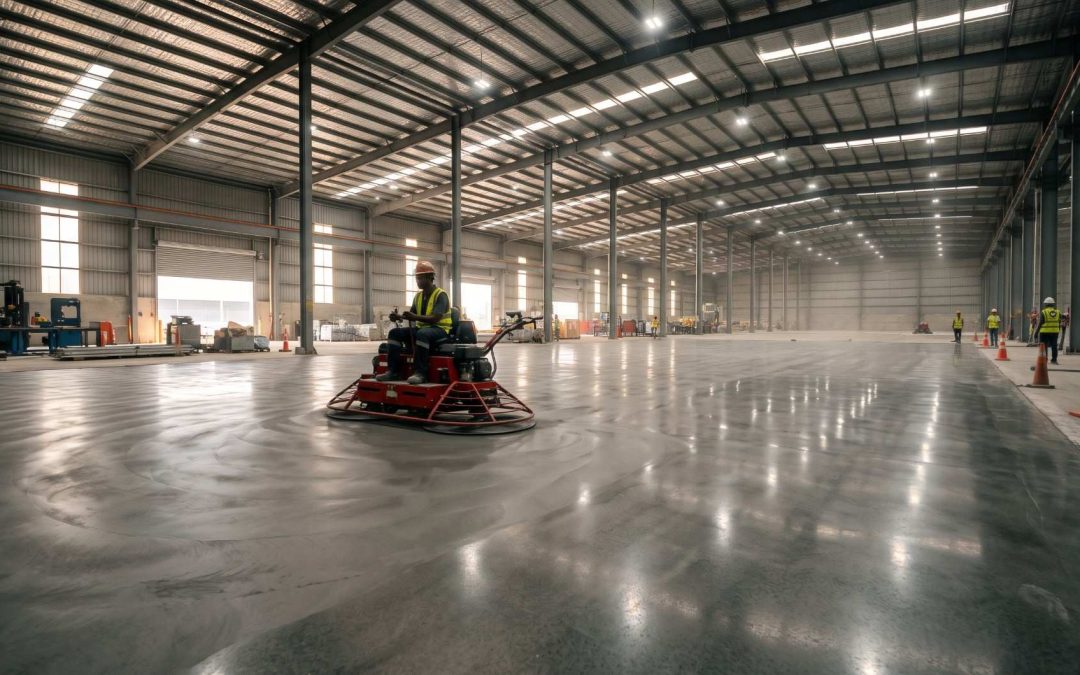
A non-metallic floor hardener is a dry-shake powder of graded mineral aggregate and cement binder that bonds into fresh industrial concrete. It raises abrasion and impact resistance, cuts dust, and never rusts in warehouses, factories, and workshops across Bangladesh.
The Technical Specifications and Performance section lists the data. The Price, Coverage, and Material Requirements section estimates bag counts. The final section collects your project details for a quote.
What Is a Non-Metallic Floor Hardener?
A non-metallic floor hardener is a one-part, pre-blended dry-shake powder made of cement, graded natural mineral aggregate, admixtures, and pigments. Installers broadcast it onto fresh concrete and trowel it in, forming a dense, wear-resistant, rust-free topping that bonds monolithically with the slab.
What Is the Mineral Aggregate Composition?
The aggregate is a graded blend of hard natural minerals with no iron content. Euclid’s Surflex, for example, uses quartz-silica. Sika classifies dry shakes into 3 groups: natural quartz, synthetic non-metallic mineral, and metallic alloy aggregate. Sika’s Chapdur BD data sheet records 8 to 9 on the Mohs hardness scale, which rates scratch resistance from 1 to 10.
What Does the Cementitious Binder Do?
The cementitious binder is portland cement that hydrates with water from the base concrete. Hydration consumes free water near the surface and lowers the local water-to-cement ratio, according to Sika. The binder locks the aggregate into a 2.5 to 3.0 mm layer at 5.0 kg/m² and cures together with the slab.
How Does the Treatment Work?
Installers broadcast the powder after bleed water, the water that rises to the fresh slab surface, evaporates or is removed. Slab moisture wets the powder. Floating and troweling then work the mix into the concrete, forming a dense, monolithic wearing layer 2.5 to 3.0 mm thick.
What Are the Key Benefits of Non-Metallic Floor Hardener for Industrial Concrete Floors?
Non-metallic floor hardener gives industrial concrete floors 9 core benefits: abrasion resistance, impact resistance, dust reduction, non-rusting aggregate, oil and grease resistance, cleaning ease, non-slip texture, cost efficiency, and durability. Each benefit protects slabs under forklifts, pallet jacks, and foot traffic.
- Abrasion resistance: Hard mineral aggregate resists wear from wheels and scraping. Fosroc’s Nitoflor Hardtop S specification states a 225% abrasion resistance improvement for concrete.
- Impact resistance: Dense, cement-bonded aggregate withstands rolling, sliding, percussion, and impact loads, according to MC-Bauchemie. Sika lists high impact resistance as a core Chapdur BD feature.
- Dust reduction: The dense, cement-bonded surface makes the floor dust-proof, according to Sika. Loose surface fines stay bound to the topping.
- Non-rusting aggregate: Mineral aggregate contains no iron, so the topping produces no rust staining. MC-Bauchemie states the non-rusting property enables wet-room and outdoor use.
- Oil and grease resistance: Sika lists increased resistance to oils and grease for Chapdur BD. The cement-bonded mineral layer suits workshops, garages, and service stations where lubricants spill.
- Cleaning ease: The dense topping is easy to clean, according to Sika. Rotary brushes, mechanical scrubbers, scrubber dryers, and high-pressure washers maintain the finish.
- Non-slip texture: MC-Bauchemie and Sunanda list non-slip, non-skid performance for their non-metallic hardeners, even during oil spillage, on both interior and exterior floors.
- Cost efficiency: Sika calls Chapdur BD a cost-effective surface hardener. MC-Bauchemie states Dreitop FH is very economical compared with epoxies and liquid plastics.
- Durability: The topping bonds monolithically with the slab. Sunanda lists improved service life for Polyabres floors, and Sika specifies Chapdur BD for floors under severe mechanical wear.
Where Do Industrial Facilities Use Non-Metallic Floor Hardener?
Industrial facilities use non-metallic floor hardener on 5 slab types: warehouses, manufacturing plants, logistics facilities, workshops, and commercial slabs. Sika specifies dry-shake hardeners wherever floors face severe mechanical wear, including parking lots, garages, and service stations.
- Warehouses: Forklift and pallet-jack wheel loads wear aisles and loading lanes; Sika lists warehouses as the first Chapdur BD use.
- Manufacturing plants: Factory floors face rolling loads, dropped parts, and machine vibration. Sika lists factories as a core Chapdur BD application.
- Logistics facilities: Distribution centers and storage yards run continuous truck and forklift traffic. Sika lists storage, logistics, and sales areas for its HardTop dry-shake solutions.
- Workshops: Workshop floors take oil, grease, and dropped tools. Non-metallic hardener adds oil resistance and a non-slip surface, as listed by Sika and MC-Bauchemie.
- Commercial slabs: Shopping malls, restaurants, museums, and public areas use colored, dust-proof dry-shake toppings, according to the Sika Chapdur BD data sheet.
- Parking areas: Parking lots, garages, and service stations face tire abrasion and fluid spills. Sika lists all 3 as Chapdur BD uses.
- Wet rooms and exterior slabs: Non-rusting aggregate suits wet rooms and exterior slabs, according to MC-Bauchemie and Euclid Chemical, for interior and exterior use.
What Are the Types of Floor Hardeners?
Floor hardeners fall into 2 main splits: non-metallic versus metallic aggregate, and dry-shake powders versus liquid densifiers. Dry shakes use quartz, synthetic mineral, or metallic aggregate; liquid densifiers use sodium silicate, siliconate, or lithium silicate chemistry.
How Do Non-Metallic and Metallic Floor Hardeners Differ?
Non-metallic hardeners use quartz or mineral aggregate and never rust, so they suit wet rooms and outdoor slabs. Metallic hardeners use graded iron or non-oxidizing alloy aggregate. Metalcrete states its high-metallic Metalplate Supreme gives up to 8 times the wear resistance of plain concrete and outwears natural aggregate shakes by up to 400%.
How Do Dry-Shake Hardeners Differ From Liquid Densifiers?
Dry-shake hardeners are cement-and-aggregate powders broadcast onto fresh concrete to build a 2.5 to 3.0 mm wearing layer. Liquid densifiers are silicate solutions sprayed on, which react with free lime in hardened concrete. Mapei confirms liquid densifiers suit new and existing floors and complement dry shakes.
| Feature | Non-metallic dry shake | Metallic dry shake | Liquid densifier |
| Main material | Quartz or mineral aggregate plus cement | Iron or non-oxidizing alloy aggregate plus cement | Lithium or sodium silicate solution |
| Rust risk | None | Iron grades oxidize; alloy grades do not | None |
| Applied to | Fresh concrete | Fresh concrete | Fresh or hardened concrete |
| Dosage example | 3.5 to 6.0 kg/m² (Sika Chapdur BD) | 5 to 7 kg/m² (Sikafloor ArmorTop) | One sprayed layer, per label |
What Are the Technical Specifications and Performance of Non-Metallic Floor Hardener?
Non-metallic floor hardener specifications cover mineral aggregate in cement binder, a 3.5 to 6.0 kg/m² application rate, 30 kg bags, natural grey standard color, and abrasion wear loss of about 1.70 mm. These values come from the Sika Chapdur BD data sheet, December 2025.
| Parameter | Value |
| Aggregate type | Natural mineral aggregate, graded and mixed with cement, admixtures, and pigments |
| Aggregate hardness | 8 to 9 on the Mohs scale |
| Abrasion resistance | About 1.70 mm wear loss (ASTM C131 / IS:1237, as stated on the data sheet) |
| Bulk density | 1.5 ± 0.1 kg/L at +27 °C |
| Application rate | Light duty 3.5 to 4.0 kg/m²; medium duty 4.5 to 5.0 kg/m²; heavy duty 5.5 to 6.0 kg/m² |
| Layer thickness | 2.5 to 3.0 mm at about 5.0 kg/m² |
| Packaging | 30 kg bag |
| Color | Natural concrete grey powder; shade varies with the base concrete |
| Shelf life | 12 months, stored sealed and dry at +10 °C to +30 °C |
| Application climate | Air and substrate +5 °C to +35 °C; relative humidity 30% to 98% |
| Foot traffic / full service | About 72 hours / about 7 days at +27 °C substrate |
| Concrete requirements | Slump 75 to 110 mm; minimum 20 N/mm² compressive strength; non-air-entrained |
How Does Abrasion Test Data Compare?
ASTM C779 measures concrete surface wear depth after a set test time. Metalcrete reports 1.2 mm at 60 minutes for its non-metallic trap-rock Floor TR Hardener and 0.30 mm for metallic Metalplate Supreme. Sika Bangladesh reports about 1.70 mm wear loss for Chapdur BD under a different test, so values do not compare directly.
Six documented limitations apply to non-metallic dry-shake hardeners, according to Sika and Fosroc data sheets:
- Avoid applying the powder in strong wind or dry conditions. Sika prohibits both because rapid surface drying prevents the powder from hydrating and bonding evenly.
- Expect color variation across the floor. Sika documents shade differences from variations in concrete water content and cement, and they continue through the drying period.
- Exclude air-entrained concrete. Sika states air-entrained concrete is not a suitable substrate for dry shake hardeners, and the slab requires 20 N/mm² minimum compressive strength.
- Monitor humidity extremes. Low relative humidity produces efflorescence, white salt deposits on the surface, while high humidity causes bleeding, slower curing, and longer finishing operations.
- Protect the surface from rain and contaminants after application, and place the product only with trained applicators, as Sika requires.
- Apply the specified dosage uniformly over the entire slab. Fosroc states uneven rates cause localized shade variation, and added water during finishing harms overall floor quality.
How Do You Apply and Cure Non-Metallic Floor Hardener?
Apply non-metallic floor hardener by broadcasting 60% of the powder onto fresh concrete after bleed water clears, floating, broadcasting the remaining 40%, floating again, troweling to finish, and wet-curing immediately with clean water. Sika Bangladesh specifies this 2-pass sequence.
- Screed and bullfloat the slab before bleed water emerges. Use a wooden bullfloat, because it opens the surface and avoids trapping water beneath the topping.
- Test readiness by pressing a thumb hard into the surface. Start broadcasting when the print measures 3 to 5 mm deep and no standing bleed water remains.
- Broadcast 60% of the powder evenly by hand, letting it sift through gloved fingers. Do not throw or shovel it, because uneven thickness causes shade variation.
- Wait until slab moisture darkens the powder, then float it in with a low-rpm power trowel fitted with float shoes, held perfectly flat.
- Broadcast the remaining 40% once the first layer is floated. Laticrete and Dry Chem specify a 2/3 and 1/3 split, so confirm the ratio on your product’s data sheet.
- Float the second layer the same way, then trowel with steel blades set at minimum angle. Raise the angle gradually as the surface tightens to remove marks and pinholes.
- Avoid burnishing colored floors. Finish just short of a burnish trowel finish, because blade friction discolors pigmented shakes, according to Metalcrete.
- Cure immediately after finishing with clean water; for chemical curing, consult Sika Technical Service. Polyhard prohibits saline or brackish water, relevant to coastal Bangladesh sites.
- Saw-cut construction, expansion, and floor joints only after 24 hours. Clean residual saw slurry without delay, then fill joints with an appropriate sealant per the floor design.
What Fresh Concrete Conditions Does the Slab Require?
The base concrete must be non-air-entrained, with a 75 to 110 mm slump (a workability measure) and minimum 20 N/mm² compressive strength, according to Sika Bangladesh. The slab is ready when a thumb pressed hard leaves a 3 to 5 mm print. Air and substrate temperatures must stay between +5 °C and +35 °C.
How Does Bleed Water Affect Timing?
Apply the powder after bleed water evaporates or an operator removes it with a dragged rubber hose or squeegee. Powder applied into bleed water traps water under the topping and weakens the bond. Sika’s MetalTop, Fosroc’s Nitoflor, and Polyhard data sheets all prohibit adding water to help incorporate the powder.
How Long Does Curing Take Before Traffic?
Sika Bangladesh lists foot traffic after about 72 hours and full service after about 7 days at a 27 °C substrate temperature. Sunanda’s Polyabres data lists foot traffic after 24 hours and other traffic after 1 week. Temperature, humidity, and concrete design strength change these times.
What Are the Price, Coverage, and Material Requirements of Non-Metallic Floor Hardener?
Floor hardener price in Bangladesh depends on the brand, 25 kg or 30 kg bag size, and dosage of 3.5 to 6.0 kg/m². Total cost equals area, times dosage, divided by bag weight, times bag price. Request a quote with floor area and traffic type.
Price per 30 kg bag: ৳ [insert current price]. Cost per square meter equals the bag price divided by the coverage per bag in the table below.
| Duty level | Dosage (kg/m²) | Coverage per 30 kg bag | Bags for 1,000 m² |
| Light duty | 3.5 to 4.0 | 7.5 to 8.6 m² | 117 to 134 |
| Medium duty | 4.5 to 5.0 | 6.0 to 6.7 m² | 150 to 167 |
| Heavy duty | 5.5 to 6.0 | 5.0 to 5.5 m² | 184 to 200 |
For 25 kg bags, divide 25 by the dosage to get coverage in square meters: 5.0 m² per bag at 5.0 kg/m².
What Does a 1,000 m² Project Require?
A 1,000 m² warehouse slab at medium duty (4.5 to 5.0 kg/m²) needs 4,500 to 5,000 kg, which equals 150 to 167 bags of 30 kg. Heavy duty at 5.5 to 6.0 kg/m² requires 5,500 to 6,000 kg, or 184 to 200 bags. Light duty requires 117 to 134 bags.
What Materials and Equipment Does the Job Require?
Each job requires the powder, wooden bullfloat, power trowels with float shoes and steel blades, rubber hose or squeegee, curing water or compound, and joint sealant. Applicators wear dust masks and gloves because the powder contains portland cement, which causes skin burns and irritation, according to Metalcrete.
What Are the Frequently Asked Questions About Non-Metallic Floor Hardener?
Buyers most often ask about product selection, traffic suitability, rust, dusting, existing concrete, curing, and maintenance. The 7 answers below cite manufacturer data sheets from Sika, Fosroc, MC-Bauchemie, Euclid, and Mapei.
How Do You Choose Between Non-Metallic and Metallic Floor Hardener?
Choose non-metallic hardener for wet areas, outdoor slabs, colored floors, and moderate-to-heavy duty wear, since the aggregate never rusts. Choose metallic hardener for the highest wear resistance in dry interior industrial slabs. Then set dosage by duty: 3.5 to 4.0 kg/m² light, 4.5 to 5.0 medium, 5.5 to 6.0 heavy.
Is Non-Metallic Floor Hardener Suitable for Forklift and Heavy Traffic?
Yes. Sika Bangladesh specifies Chapdur BD for floors under severe mechanical wear in warehouses and factories, with a heavy-duty dosage of 5.5 to 6.0 kg/m². Slab design, concrete strength of at least 20 N/mm², and correct finishing determine performance under forklifts. Metalcrete lists steel mills and metal shops as metallic-grade applications.
Does Non-Metallic Floor Hardener Rust?
No. The aggregate is natural mineral, such as quartz-silica, with no iron content, so the topping never rusts. Sika lists Chapdur BD as non-metallic and rust-free. Euclid states Surflex’s non-rusting materials permit outdoor as well as indoor use. MC-Bauchemie adds that this property enables wet-room use.
Does Non-Metallic Floor Hardener Stop Dusting?
Yes. Sika states Chapdur BD makes the floor dust-proof. The topping must be applied after bleed water clears and cured immediately after finishing. Dry Chem adds that a bond-and-cure compound, applied by roller or spray, prevents dust generation and completes protection.
Can You Apply Non-Metallic Floor Hardener on Existing Concrete?
No. Dry-shake hardener bonds only into fresh concrete during finishing, because it needs slab moisture to hydrate. Existing hardened concrete takes a lithium silicate liquid densifier instead, which reacts with free lime and suits new and existing floors, according to Mapei. Surfaces must be sound, clean, and free of oil, grease, and coatings.
How Long Does Floor Hardener Take to Cure?
Curing starts immediately after finishing with clean water. Sika Bangladesh lists foot traffic after about 72 hours and full service after about 7 days at 27 °C. Saw-cut joints after 24 hours. Cure times shift with temperature and relative humidity, and high humidity slows curing, according to Sika.
How Do You Maintain a Hardened Industrial Floor?
Remove spills immediately and clean the floor regularly with rotary brushes, mechanical scrubbers, scrubber dryers, or high-pressure washers, using suitable detergents and waxes, according to Sika. Regular cleaning keeps oil, grease, and dust from building up on the dense topping and preserves the finish.
How Do You Request a Technical Recommendation or Quote?
Request a technical recommendation or quote by sending 5 project details: floor area, concrete condition, traffic type, exposure, and project location. These details set the product grade, dosage in kg/m², bag count, and delivery plan for your Bangladesh site.
- State the floor area in square meters. Area multiplied by dosage gives total kilograms; for example, 1,000 m² at 5.0 kg/m² requires 5,000 kg, or 167 bags of 30 kg.
- Describe the concrete condition: fresh pour or existing slab, planned slump, compressive strength in N/mm², and air-entrainment status. Fresh non-air-entrained concrete with 20 N/mm² minimum strength qualifies for dry-shake application.
- Identify the traffic type: forklifts, pallet jacks, trucks, foot traffic, or machinery. Traffic decides light, medium, or heavy duty dosage from 3.5 to 6.0 kg/m².
- Specify the exposure: indoor, outdoor, wet room, rain, oil and grease, or chemical contact. Exposure decides between non-metallic, metallic, or liquid densifier treatment.
- Name the project location: district and site address. Location sets delivery logistics and the application climate, where air and substrate temperatures must stay between +5 °C and +35 °C.