

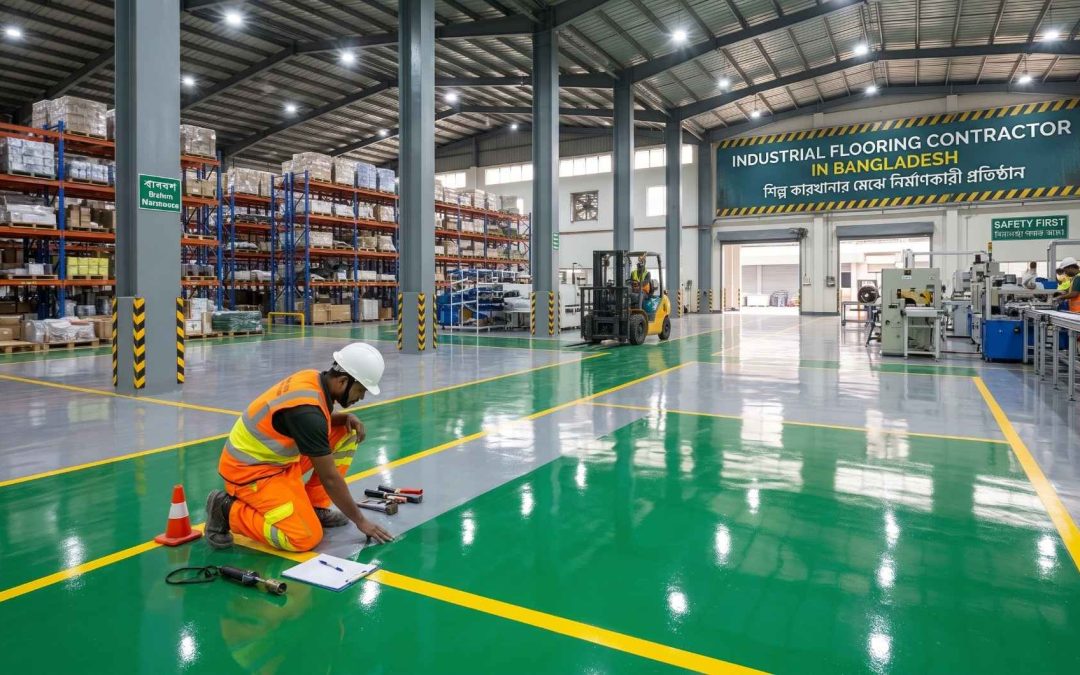
SS Corporation designs and installs industrial flooring systems for warehouses, manufacturing plants, food processing units, and pharmaceutical facilities across Bangladesh, using Fosroc Nitoflor epoxy, polyurethane, and ESD systems built for forklift traffic, chemical exposure, and strict hygiene standards. Every project pairs concrete preparation and repair with a protective coating matched to the floor’s daily workload, so the system holds up under the exact conditions it meets every shift.
Industrial floors fail for one of three reasons: the wrong system for the traffic load, poor concrete preparation underneath, or a coating that can’t handle the chemicals on-site. SS Corporation works as the authorized Berger Fosroc applicator in Bangladesh, so every floor runs on Nitoflor-branded epoxy, polyurethane, and ESD systems backed by manufacturer data sheets and technical support. Request a free site assessment for a flooring estimate specific to your facility.
Industrial Flooring Services
SS Corporation’s industrial flooring services cover five stages: new floor installation, protective coating application, concrete repair, floor resurfacing, and scheduled maintenance. Each stage uses Fosroc-engineered materials matched to traffic load, chemical exposure, and hygiene requirements for the specific facility.
- Install new flooring systems. Lay self-leveling epoxy, trowel-applied epoxy mortar, or polyurethane systems over prepared concrete for warehouses, factories, and processing plants that need a seamless working surface.
- Apply protective coatings. Coat existing concrete with chemical-resistant, abrasion-resistant epoxy or polyurethane to block moisture penetration and extend the life of the slab underneath.
- Repair damaged concrete. Patch spalled, cracked, or delaminated concrete with Fosroc repair mortars before any topping system goes down, since a flooring system only performs as well as the substrate beneath it.
- Resurface worn floors. Overlay pitted, dusting, or degraded industrial floors with a trowel-applied epoxy or urethane topping instead of a full slab replacement, cutting both cost and downtime.
- Maintain finished floors. Inspect installed systems on a schedule, reseal expansion joints, and refresh topcoats to push service life well past the 10-year mark.
Industrial Flooring Systems We Install
SS Corporation installs four main categories of industrial flooring: epoxy systems, urethane cement systems, MMA and polyurea resinous systems, and ESD flooring for static-sensitive environments. The right category depends on traffic load, chemical exposure, temperature swings, and whether the floor needs static control.
Epoxy Flooring and Epoxy Mortar
Epoxy flooring bonds to concrete as a two-component resin system and cures into a hard, seamless surface. Self-leveling epoxy, such as Fosroc Nitoflor SL1000, SL2000, SL3000, and SL4000, pours at 2-4 mm and levels itself across the slab. This creates a smooth, glossy floor for light-to-medium traffic areas such as warehouses, assembly floors, and office-adjacent production zones.
Epoxy mortar handles the heavier jobs. Trowel-applied systems such as Nitoflor HB200 UT, RT6000 UT, and FC400 UH mix epoxy resin with graded aggregate and install at 3-6 mm or thicker. That thickness gives the floor the compressive strength and impact resistance that forklifts, pallet jacks, and dropped tools demand. Epoxy coatings such as Nitoflor FC100, FC140, FC145, and FC150 apply thinner, under 1 mm, as a protective, easy-clean finish over sound concrete that doesn’t need extra build thickness.
Amine-cured epoxy resists chemicals better. Polyamide-cured epoxy flexes more and handles moisture better. A UV-stable polyurethane topcoat over epoxy prevents the yellowing and chalking that sunlight exposure causes near loading bay doors and skylights.
Urethane Cement Flooring
Urethane cement flooring, also called cementitious urethane, blends polyurethane resin with cement and fine aggregate into a trowel-applied system such as Nitoflor EPU2000, EPU3000, and Floorcrete PU. The cement content gives the floor higher compressive strength than standard epoxy. The urethane resin adds flexibility that absorbs thermal shock.
This system handles facilities that wash down with hot water or steam, including food processing plants, commercial kitchens, and dairy production floors. Urethane cement tolerates sustained temperatures up to roughly 120°C (250°F) and resists the organic acids, fats, and sugars that break down standard epoxy over time. Nitoflor PUW100, a lighter-duty polyurethane screed, suits kitchen and wash-down areas that need food-grade performance without the full mortar build.
MMA, Polyurea, and Other Resinous Systems
Methyl methacrylate (MMA) resin cures within one to two hours, even below freezing. That speed makes it the standard choice for cold storage facilities and plants that cannot absorb more than a few hours of downtime. MMA bonds over most existing floor types and resists both acids and alkalis without an added topcoat, since the resin doesn’t degrade under UV light.
Polyurea systems, including Fosroc Polyurea FLM in SS Corporation’s resinous flooring range, cure even faster and tolerate a wider temperature range during application than epoxy. Polyurea’s flexibility suits floors that see thermal cycling, vibration, or substrate movement, where a rigid epoxy system cracks instead of flexing. Facility managers specify MMA or polyurea when the production schedule cannot absorb a multi-day epoxy cure, or when ambient temperatures fall outside epoxy’s working range.
ESD Flooring and Specialized Surfaces
ESD (electrostatic dissipative) flooring controls static buildup in facilities handling sensitive electronics, flammable solvents, or explosive dust. Fosroc’s Nitoflor SL Conductive and Nitoflor SL3000 UT ESD systems fall into one of two resistance classes under ANSI/ESD STM7.1 test methods: conductive flooring, measuring below roughly 1 x 10⁶ ohms, and static dissipative flooring, measuring between roughly 1 x 10⁶ and 1 x 10⁹ ohms.
Conductive flooring suits areas where personnel wear static-control footwear and components carry very low static tolerance, such as semiconductor assembly. Dissipative flooring suits general electronics assembly and areas with mixed personnel traffic, since it drains static through a more controlled, gradual path to ground. Both classes pair with grounded footwear and workstation grounding straps to complete the static-control loop; flooring alone doesn’t control static without the rest of the system in place.
Industrial Flooring by Facility Type
Industrial flooring requirements change by facility type: warehouses need forklift-rated durability, manufacturing plants need chemical and impact resistance, food processing floors need thermal-shock and hygiene performance, and pharmaceutical floors need seamless, GMP-compliant surfaces. Each facility type pairs with a specific Nitoflor system built around its daily operating conditions.
Warehouses and Distribution Centers
Warehouse floors absorb constant forklift and pallet-jack traffic, with wheel loads concentrated on small contact points that stress the slab far more than foot traffic does. Heavy-duty epoxy mortar or a thick self-leveling system, such as Nitoflor HB200 UT or SL4000, handles the point loading and resists the rutting that thinner coatings develop under repeated wheel paths.
Distribution centers add sortation and picking zones with more dispersed traffic than a pure storage warehouse, so cleanability and slip resistance matter across a larger share of the floor. Joint protection matters just as much as the topping: unprotected control joints spall and crumble under forklift traffic first, before the field of the floor shows any wear at all.
Manufacturing Facilities
Manufacturing floors face heavy machinery vibration, dropped tools, and chemical spills from coolants, oils, and solvents in the same production shift. A chemical-resistant epoxy mortar, upgraded to a novolac epoxy formulation where acids or alkalis are part of daily operations, holds up against both the mechanical impact and the chemical exposure at once.
Machine foundation areas need higher compressive strength than walkways. Manufacturing floor specifications commonly vary the system thickness by zone rather than installing one uniform build across the entire plant. Line-marking and color-coded safety zones apply directly to the cured epoxy or urethane surface, adding workflow safety without a separate flooring layer.
Food Processing and Commercial Kitchens
Food processing floors stand up to fats, oils, blood, sugar, and the organic acids these byproducts create, plus the harsh, frequent cleaning chemicals used to sanitize the area. The FDA and USDA don’t certify specific flooring products, but their guidelines require food-contact-adjacent floors to be smooth, non-absorbent, slip-resistant, and easy to clean. Urethane cement systems such as Nitoflor EPU2000 and EPU3000 are built to meet that standard.
Thermal shock resistance matters as much as chemical resistance here, since hot-water and steam washdowns followed by refrigerated storage put the floor through repeated temperature swings that crack standard epoxy over time. Coved bases, formed with Nitoflor Coving U or Coving UT, eliminate the 90-degree wall-floor junction where bacteria and moisture collect, keeping the entire surface cleanable with no seams to trap residue.
Pharmaceutical and Healthcare Facilities
Pharmaceutical flooring operates under Good Manufacturing Practice (GMP) standards and, in cleanroom areas, ISO 14644 classification. Both call for a seamless, non-porous surface that resists microbial growth and sheds no particles into the controlled environment. Self-leveling epoxy systems such as Nitoflor SL2000 and SL3000 install with no grout lines or seams, closing off the cracks where contamination and bacteria would otherwise collect.
Clean rooms handling flammable solvents, or electronics-adjacent medical device production, add a static-control requirement on top of the hygiene requirement. That calls for the ESD variants covered above rather than standard epoxy. Coved skirting, sloped-to-drain detailing, and chemical resistance to routine disinfectants round out a pharmaceutical flooring specification.
How to Choose the Right Industrial Flooring System
Choosing the right industrial flooring system comes down to six factors: traffic type, chemical exposure, temperature range, cleaning protocol, slip resistance, and static control needs. Rank these factors by what the facility actually does each day, then match the system to the top two or three.
- Traffic type and load. Identify whether the floor carries foot traffic alone, forklifts and pallet jacks, or heavy machinery with point loads, since each traffic class demands a different system thickness.
- Chemical exposure. List every acid, alkali, solvent, oil, and cleaning agent the floor contacts regularly, then match the resin chemistry, upgrading to novolac epoxy for the harshest exposures.
- Temperature range. Account for both ambient temperature and process heat, including hot washdowns and freezer cycling, since thermal shock cracks a system chosen for chemical resistance alone.
- Cleaning protocol. Match the surface texture to the cleaning method, since steam cleaning, pressure washing, and dry sweeping each perform differently against a smooth versus textured finish.
- Slip resistance. Specify an anti-slip aggregate broadcast for any area exposed to water, oil, grease, or washdown runoff, balancing traction against ease of cleaning.
- Static control needs. Confirm whether electronics, flammable solvents, or explosive dust are present, since any of the three calls for conductive or dissipative ESD flooring instead of standard epoxy.
Our Industrial Flooring Installation Process
SS Corporation’s installation process runs in six stages: site assessment, concrete preparation, repairs, system installation, curing, and handover. The process follows ASTM F710 guidance for concrete floor preparation at every stage, from moisture testing through final inspection.
- Assess the site. Inspect the existing slab, test traffic patterns, and confirm chemical exposure and temperature conditions before recommending a system.
- Test the concrete. Run relative humidity testing under ASTM F2170 and pH testing under ASTM F710, since any epoxy or urethane system installed over a slab outside tolerance debonds early.
- Prepare the surface. Grind or shot-blast the concrete to the profile the chosen system requires, measured against the International Concrete Repair Institute’s Concrete Surface Profile (ICRI CSP) chart, removing laitance, old coatings, oil, and curing compounds down to sound concrete.
- Repair the substrate. Patch cracks, spalls, and low spots with Fosroc repair mortar, and correct any slope-to-drain issues before the topping system goes down.
- Install the flooring system. Apply the primer, then install the epoxy, urethane, or ESD system at the specified thickness, broadcasting anti-slip aggregate where the specification calls for it.
- Cure and hand over. Hold the floor out of service through the manufacturer’s cure window, then walk the finished floor with the client before handover.
Downtime planning drives the schedule as much as the system choice does. MMA and polyurea systems cure in hours. Standard epoxy mortar needs a multi-day cure before it takes full traffic, so facilities with tight shutdown windows need that distinction factored into the project timeline from the first site visit.
Industrial Flooring Cost and Project Scheduling
Industrial flooring cost depends on four factors: total square footage, existing substrate condition, the flooring system specified, and how much downtime the facility can allow. Larger projects lower the per-square-foot material cost through bulk pricing, while poor substrate condition and tight downtime windows both raise it.
Square footage sets the baseline, since material and labor both scale with area, though per-unit pricing typically drops as the project size grows. Substrate condition changes the prep scope: a slab with high moisture, extensive cracking, or old coating residue needs more grinding, patching, and moisture mitigation before any topping system goes down, adding directly to the project cost. System specification moves cost more than any other factor, since a thin protective coating, a mid-build self-leveling epoxy, and a thick trowel-applied mortar each use different material volumes and labor hours. Downtime tolerance shapes cost and schedule together: a facility that can shut down for a full weekend has more system options than one that needs the floor back in service within a single overnight shift, and fast-cure systems such as MMA or polyurea often cost more per square foot specifically because they buy back that time.
Project scheduling follows the same logic as cost. A single-coat protective system installs and cures in a few days. A full epoxy mortar rebuild with concrete repair runs one to two weeks, depending on square footage and cure requirements. Request a site visit for a project-specific estimate and schedule, since published per-square-foot ranges vary too widely by region, substrate condition, and system choice to apply directly to any one facility.
Industrial Flooring Projects and Case Studies
SS Corporation has completed industrial flooring and floor hardener projects across Bangladesh, including work for Rancon Auto Industries and Panna Group. Each project pairs Fosroc Nitoflor materials with the concrete preparation and repair work the slab needs before the topping goes down.
Recent completed work includes floor hardener installations at Rancon Auto Industries’ facilities in Bhawabinipur and Gazipur, a floor hardener project for Panna Group in Faridpur, and a concrete polishing project completed for an industrial client. The full project gallery, with site photos, is available on SS Corporation’s Projects page for facility managers evaluating past work before a new installation.
[Placeholder: add square footage, system installed, and completion timeline for each project above once that documentation is available, so every case study carries the same numeric specificity as the rest of this page.]
Why Choose Our Industrial Flooring Contractors?
SS Corporation has operated as a construction chemical distributor and applicator in Bangladesh for more than 16 years, and works as the authorized distributor of Berger Fosroc Limited, a joint venture between Berger Paints Bangladesh Ltd. and Fosroc International Ltd. formed on January 31, 2018. That authorization gives every flooring project access to Fosroc’s full Nitoflor product range, plus manufacturer-backed technical data.
SS Corporation runs on a three-part service model: supply, application, and engineering. The supply side stocks admixtures, surface treatments, grouts and anchors, repair materials, and the full Nitoflor flooring range. The application side installs and applies these systems directly, including industrial flooring, floor hardening, and PU and epoxy flooring. The engineering side provides construction-chemical consultation and design support, so a facility manager gets a system recommendation backed by both product data and site-specific engineering judgment, not a one-size-fits-all quote.
SS Corporation’s network reaches Dhaka, Savar, Narayanganj, Gazipur, Chattogram, Cox’s Bazar, Khulna, Sylhet, and Barishal, covering building construction, flyover, bridge, railway, and power plant projects alongside industrial flooring work.
A floor that fails costs more in downtime and reinstallation than the original installation ever saved. Request an industrial flooring estimate from SS Corporation today, and get a system built for the exact traffic, chemicals, and conditions your facility runs every day.
How long does industrial flooring installation take without stopping production?
Phased installation lets you keep operating. We section the facility, install and cure one zone within 2-4 days, then move to the next while traffic uses the finished areas. Full-plant epoxy mortar runs 1-2 weeks total; MMA or polyurea sections return to service the same day if the schedule can’t absorb longer closures.
Can we install epoxy or PU flooring during Bangladesh’s monsoon season?
High humidity above roughly 85% relative humidity blocks most epoxy systems from curing properly, causing a hazy or soft finish. We schedule standard epoxy installs for drier months and switch to moisture-tolerant Nitoflor systems or added ventilation and dehumidification for monsoon-season projects that can’t wait for the dry season.
Why do epoxy floors peel, bubble, or delaminate after installation?
Peeling and bubbling trace back to moisture trapped under the coating, usually from skipping the relative humidity test before installation. Oil, dust, or old sealer left on the concrete causes the same failure by blocking proper adhesion. Correct surface preparation under ASTM F710 prevents both failure modes before they start.
Can new flooring go directly over old tile, VCT, or a damaged slab?
Sound, well-bonded tile or VCT accepts a primer and new topping directly in some cases, cutting demolition time and cost. Loose tile, cracked slabs, or heavy delamination need full removal first, since any system installed over a failing substrate fails at the same point the substrate already has.
Which lasts longer, epoxy flooring or polyurethane (PU) flooring?
Properly specified, both systems last 10 to 15 years or more under normal industrial traffic. Epoxy wins on compressive strength and cost; PU wins on flexibility and thermal shock resistance. The choice comes down to the specific exposure, not a blanket durability difference between the two resin families.
How soon can forklifts and heavy machinery use the new floor?
Light foot traffic resumes within 24 hours for most epoxy systems; full forklift and machinery traffic needs 5 to 7 days for standard epoxy mortar to reach full cure strength. MMA and polyurea systems cut that wait to 2 to 4 hours, built specifically for facilities that can’t lose a week.
Does industrial flooring installation create dust or fumes that affect nearby operations?
Mechanical grinding during surface preparation generates concrete dust, controlled with vacuum-shrouded grinders and sectioned work zones to keep it off adjacent production lines. Solvent-free, 100% solids epoxy and Fosroc’s low-odor Nitoflor systems cut fumes during application, so most facilities keep neighboring areas running through the entire project.
Is industrial flooring worth the cost compared to leaving concrete bare?
Bare concrete dusts, cracks under point loads, and absorbs oil and chemicals permanently, driving cleaning costs up every month it stays uncoated. A properly specified flooring system costs more upfront but eliminates that recurring cleaning expense and adds 10 or more years of service life to the same slab.