

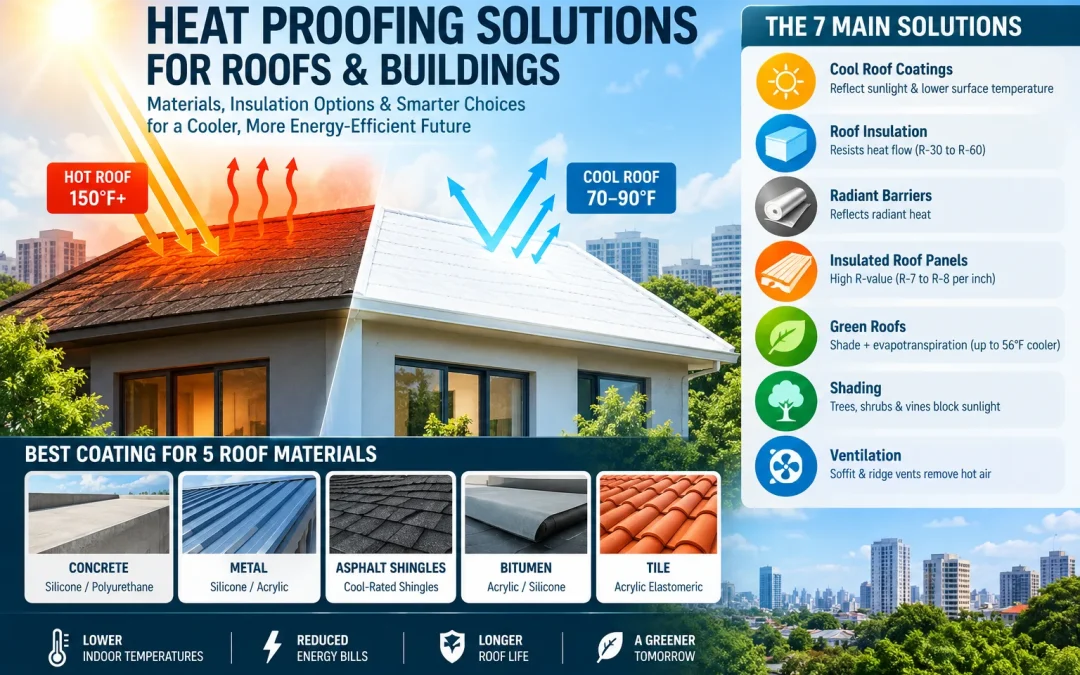
Roof heat proofing is the process of blocking solar heat from entering a building through the roof. Effective systems combine reflection with cool roof coatings, insulation with rigid foam or mineral wool, shading with trees, and ventilation with soffit and ridge vents.
According to Foxhaven Roofing, a roof surface reaches 150°F or higher when outside air hits 100°F. According to CompositePaint, a white reflective roof drops membrane temperature by 50 to 80°F on a summer afternoon. Insulation, radiant barriers, shade, and vents then block the heat that remains. This guide covers 7 solutions, the best coating for 5 roof materials, installation steps, costs, and service life.
How Does Roof Heat Enter a Building?
Roof heat enters a building through 3 mechanisms: radiation from the sun heats the roof surface, conduction moves that heat through roofing layers into the attic, and convection circulates hot attic air toward the ceiling and living space.
- Radiation: Solar energy arrives as ultraviolet rays, visible light, and infrared energy. Dark surfaces absorb more of it, and the absorbed energy becomes surface heat.
- Conduction: Heat moves through solid materials molecule to molecule. It travels from shingles or tiles into the deck, rafters, and attic air. Insulation resists this flow across the ceiling.
- Convection: Hot attic air rises and circulates, warming insulation, ductwork, and framing. Soffit and ridge vents move this air out of the attic. Vents remove the heat before it reaches the ceiling.
According to Foxhaven Roofing, a 150°F roof pushes attic temperatures to 130–140°F, while a cool roof keeps attic air much closer to outdoor levels. Attic heat then reaches the living space through ceiling insulation and air-conditioning ductwork, which raises cooling loads and energy bills.
What Are the Main Heat-Proofing Solutions?
The 7 main heat-proofing solutions are cool roof coatings, roof insulation, radiant barriers, insulated roof panels, green roofs, shading, and ventilation. Each solution blocks a different heat path: reflection, conduction, radiation, evaporation, solar exposure, or trapped hot air.
- Cool roof coatings: Reflective liquid membranes bounce sunlight away from the roof. White silicone coatings reach 0.80–0.88 initial solar reflectance and cost 1–5 per square foot installed.
- Roof insulation: Rigid foam, mineral wool, and fiberglass resist conductive heat flow. The U.S. Department of Energy recommends R-30 to R-60 attic insulation depending on climate zone.
- Radiant barriers: Aluminum foil layers reflect radiant heat from the underside of the roof deck. The U.S. Department of Energy estimates 5% to 10% cooling cost savings in hot climates.
- Insulated roof panels: Sandwich panels bond a polyisocyanurate foam core between 2 metal skins. Panels deliver R-7 to R-8 per inch and come in 2- to 6-inch thicknesses.
- Green roofs: Vegetation, soil, and drainage layers shade the membrane and cool air through evapotranspiration. The EPA reports surface temperatures up to 56°F lower than conventional roofs.
- Shading: Deciduous trees, shrubs, and vines block sunlight before it reaches the roof. The U.S. Department of Energy states a well-planned landscape reduces air-conditioning costs by 15% to 50%.
- Ventilation: Soffit intake vents and ridge exhaust vents flush hot air from the attic. Building code sets 1 square foot of vent area per 150 square feet of attic floor.
Layered systems work because each solution blocks a different heat path. Insulation and attic ventilation team with cool roofs to maximize heat gain reduction. R-value measures resistance to heat flow, and higher numbers insulate better. A radiant barrier is a highly reflective layer, usually aluminum foil, that reflects radiant heat instead of absorbing it. Evapotranspiration is the process where plants release water vapor, which removes heat from the air.
What Is the Best Way to Heat Proof a Roof?
Combine a rated cool roof coating, attic insulation, and ventilation. The coating reflects sunlight, insulation resists conducted heat, and soffit and ridge vents remove hot air. Add a radiant barrier in hot climates and shade trees on the south and west sides.
How Do Cool Roof Coatings Work?
Cool roof coatings work by raising solar reflectance and thermal emittance. Reflectance sends sunlight back into the sky, and emittance releases absorbed heat as infrared radiation. Both properties score from 0 to 1, and higher values produce a cooler roof surface.
- Solar reflectance (SR): The fraction of sunlight a surface reflects. White roofs score 0.60–0.90, while dark shingles reflect only 5% to 15% of sunlight.
- Thermal emittance (TE): The efficiency with which a surface releases absorbed heat as infrared radiation, measured from 0 to 1. A higher value lowers surface temperature.
- Solar Reflectance Index (SRI): A single score combining reflectance and emittance. A standard black surface scores 0 and a standard white surface scores 100.
ENERGY STAR criteria set the performance benchmark. Low-slope products require an initial solar reflectance of at least 0.65, and steep-slope products require at least 0.25. Aged values after 3 years must reach 0.50 and 0.15. The Cool Roof Rating Council (CRRC) publishes the rated reflectance and emittance for each product.
According to CompositePaint, a white reflective roof holds an initial solar reflectance near 0.85 and a thermal emittance near 0.90. The U.S. Department of Energy reports that cool roofs reduce annual air-conditioning energy use of a single-story building by up to 15%.
What Is the Best Roof Coating for Different Roof Materials?
Silicone suits metal and concrete roofs and handles ponding water, acrylic suits bitumen and concrete tile, and polyurethane suits high-traffic roofs. Asphalt shingles take cool-rated shingles instead of coatings. Match the coating chemistry to the substrate, slope, and drainage.
- Concrete: Silicone, polyurethane, and polyurea coatings suit concrete decks, according to Roof Guys. Patch cracks with polymer-modified repair material before coating.
- Metal: Silicone gives metal roofs the best waterproofing and leak protection, and acrylic adds UV protection at lower cost. Repair rust and seal seams before coating.
- Asphalt shingles: Skip coatings on existing shingles, because coatings trap moisture and slow drying after rain. Choose cool-rated shingles with a solar reflectance of 0.25 or higher instead.
- Bitumen: Acrylic and silicone coatings both suit modified bitumen. Let new bitumen age at least 90 days so excess oils dry off before priming or coating.
- Tile: Acrylic elastomeric coatings suit concrete tile, while factory cool-colored tiles reach higher solar reflectance than conventional tiles without any field-applied coating.
An elastomeric coating contains added polymers that make it less brittle and more adhesive. According to HowStuffWorks, elastomeric coatings act as a watertight membrane, while cementitious coatings require a roof that is already waterproofed. Cool roof coatings perform best on low-slope roofs in good condition. Ponding water is standing water that collects on a flat roof. Silicone is the only coating that withstands permanent ponding water.
Can You Coat Asphalt Shingles With Cool Roof Paint?
Professionals do not recommend coating existing asphalt shingles. The coating blocks normal drying after rain or dew, which lets water condense and collect under the shingles. Cool-rated shingles with a solar reflectance of 0.25 or higher deliver reflectivity without that moisture risk.
Heat-Resistant Roofing Materials
Clay, slate, concrete, metal, and insulated panels are the 5 heat-resistant roofing materials. Clay and concrete tiles last 50–100 years, slate lasts 75–200 years, metal lasts 40–70 years, and insulated panels add R-7 to R-8 per inch.
- Clay: Kiln-fired clay tiles reflect heat in sunny climates and last 50 to 100 years. They weigh more than metal, so structural checks come before installation.
- Slate: Natural slate lasts 75 to 200 years and resists moisture, fire, and temperature changes. It ranks as the longest-lasting option and costs more than clay or concrete.
- Concrete: Sand, cement, and water form concrete tiles that last 50 to 100 years. Light-colored concrete reflects heat, and the tiles weigh more than clay.
- Metal: Steel, aluminum, zinc, and copper roofs last 40 to 70 years and reflect solar heat instead of absorbing it. Factory cool coatings qualify some metal roofs as cool roofs.
- Insulated panels: Two metal skins sandwich a polyisocyanurate core that delivers R-7 to R-8 per inch. Panels come in 2- to 6-inch thicknesses and last 60-plus years.
Weight changes the structural plan. Stone-coated metal weighs about 150 pounds per square, while asphalt and concrete products weigh 350 to 1,100 pounds per square. Lifespan ranges above come from RoofSnap’s material comparison.
Roof Coating vs Insulation: What’s the Difference?
A roof coating reflects sunlight to keep the roof surface cool, while insulation resists heat flow through the roof assembly. Coatings cost 1–5 per square foot installed, and insulation performance scales with its R-value, measured per inch of thickness.
| Factor | Roof Coating | Roof Insulation |
| Primary job | Reflects sunlight and emits absorbed heat | Resists conducted heat flow |
| Heat path blocked | Radiation at the roof surface | Conduction through the roof or ceiling |
| Location | Top surface of the roof | Roof deck, rafters, or attic floor |
| Performance rating | Solar reflectance, thermal emittance, SRI | R-value |
| Installed cost | 1–5 per square foot | 0.75–2.25 per square foot for rigid foam board |
| Best fit | Low-slope roofs in good condition | Attics and roof decks, after air sealing |
Use both. The coating cuts the heat load on the roof surface, and insulation limits what conducts through. Air sealing comes first. According to Ridgeline Construction citing the Building Performance Institute, insulation over air leaks loses 30–50% of its effective R-value.
Heat Proofing Solutions for Homes vs Commercial Buildings
Homes favor cool shingles, tile, attic insulation, radiant barriers, and ventilation on steep roofs. Commercial buildings favor white membranes, silicone or acrylic coatings, insulated metal panels, and green roofs on low-slope roofs. Roof slope and structure decide the system.
| Factor | Homes | Commercial Buildings |
| Typical roof | Steep-slope shingle, tile, or metal | Low-slope or flat membrane, built-up, or metal |
| Reflectance target | Initial solar reflectance of 0.25 or higher | Initial solar reflectance of 0.65 or higher |
| Core solutions | Cool shingles or tile, radiant barrier, soffit and ridge vents | White membranes, silicone or acrylic coatings, green roofs |
| Insulation | Attic floor at R-30 to R-60 by zone | Insulated metal panels at R-14 to R-42 for 2- to 6-inch thicknesses |
| Added benefit | Shade trees cut air-conditioning costs 15% to 50% | Lower roof temperatures improve rooftop solar panel efficiency and HVAC performance |
How to Choose a Roof Heat-Proofing System
Choose a roof heat-proofing system by matching 5 factors: roof material and slope, climate zone, budget, roof condition, and structural load. Verify solar reflectance and emittance ratings, check R-value targets, and confirm warranty terms before you sign.
- Match the roof material and slope: Silicone suits ponding on low-slope decks, acrylic suits well-drained slopes, and cool-rated shingles or tile suit steep roofs. Check the substrate before choosing chemistry.
- Check the climate zone: Hot climates gain the most from cool roofs, with cooling cost reductions of 15% to 25% in ASHRAE zones 1 and 2.
- Compare lifecycle cost: Divide installed cost by service years. A $2.80 coating lasting 15 years costs $0.19 yearly per square foot; a $9.00 replacement lasting 25 years costs $0.36.
- Inspect the roof condition: Coat only sound roofs. Failed seams, rust, and structural damage require repair first, because coatings over damaged substrates fail early.
- Confirm ratings and warranty: Request CRRC-rated reflectance and emittance values, aged 3-year values, and the manufacturer’s film-thickness warranty terms. Acrylic manufacturers typically exclude ponding water from warranties.
Installation and Surface Preparation
Installing a cool roof coating follows 5 steps: inspect and repair the roof, pressure wash it, prime where required, apply 2 coats, and let the film cure. Surface preparation drives results because 90% of coating failures trace to poor prep.
According to Full Cover Roofing, 90% of coating failures trace to inadequate surface preparation.
- Inspect and repair: Remove debris with a broom, then check every seam, flashing, and fastener. Repair open seams, tears, and rust before washing.
- Pressure wash: Wash at 2,500 to 3,500 PSI with a fan tip, then let the roof dry completely. Moisture readings above 25% require extra drying time.
- Prime where required: Apply an acrylic primer under acrylic coatings and a silicone primer under silicone coatings. Let the primer cure fully before topcoating, because uncured primer causes adhesion failure.
- Apply 2 coats: Roll or spray 2 thin coats at the manufacturer’s coverage rate. Silicone systems target 22 dry mils, and each coat cures 4 to 24 hours.
- Cure and inspect: Most coatings reach full cure in 24 to 72 hours. Block foot traffic until then, and avoid coating when rain is forecast within 24 hours.
A residential flat roof of 1,000 to 1,500 square feet takes 4 to 8 hours for preparation and washing, plus 24 to 48 hours of drying. Insulation installs differ. Seal air leaks before laying insulation, and staple radiant barriers to the underside of the rafters and gable walls.
How Long Does Roof Coating Take to Dry and Cure?
Roof coatings require 4 to 24 hours between coats and reach full cure in 24 to 72 hours, according to Roofs.wiki. Humidity and thick coats slow curing, and some systems take 3 to 7 days. Keep foot traffic off the surface until the manufacturer’s cure time passes.
Maintenance and Expected Service Life
Cool roof coatings last 8 to 20 years and require twice-yearly inspections plus a recoat every 8 to 15 years. Clay and concrete tile last 50 to 100 years, slate 75 to 200, and metal 40 to 70. Washing restores reflectivity.
- Inspect twice yearly: Walk the roof in spring and fall. Check seams, flashing, vents, skylights, and transitions, because roof structures settle over time.
- Clean the surface: Wash off dirt, algae, and mildew every few years. Dirt buildup lowers solar reflectance, and unwashed north-facing low-slope areas grow algae.
- Repair early: Patch cracks, worn spots, and ponding areas as soon as you spot them. Early repair protects the membrane and extends the recoat interval.
- Recoat on schedule: Recoat every 10 to 15 years, or sooner when reflectivity drops. Most elastomeric systems receive a maintenance coat every 8 to 12 years.
According to Roofs.wiki, silicone and high-build systems reach 15 to 20 years, and acrylic elastomeric systems reach 10 to 15 years. Tile roofs require inspections for cracked and shifted tiles, moss removal, and gutter cleaning.
Advantages and Limitations of Cool Roofs
Cool roofs cut roof surface temperatures, lower cooling costs, reduce urban heat island effects, and extend roof life. Limitations include a winter heating penalty, reflectivity loss from dirt, recoating every 8 to 15 years, and substrate limits on shingles.
What Are the Advantages of Cool Roofs?
- Lower cooling costs: DOE research shows cool roofs reduce annual air-conditioning energy use of a single-story building by up to 15% in warm climates.
- Lower surface temperatures: Cool roof surfaces run cooler than conventional roofs, which reduces daily expansion and contraction that cracks waterproofing membranes. White coatings cut membrane temperatures by 50 to 80°F.
- Heat island relief: Cool roofs contribute to lower surrounding air temperatures, which reduces urban heat island effects in cities, according to ENERGY STAR.
- Equipment efficiency: Lower roof temperatures improve rooftop solar panel efficiency and extend HVAC equipment lifespan, according to Lawrence Berkeley National Laboratory.
- Fast installation: Cool roof coatings install faster than other solutions, deliver immediate benefits, and add no significant structural load, so buildings avoid major reinforcement.
What Are the Limitations of Cool Roofs?
- Winter heating penalty: Reflective roofs reduce winter solar gain, which raises heating demand in poorly insulated buildings. Winter penalties run smaller than summer savings in warm climates.
- Reflectivity loss: Dirt, algae, and weathering reduce solar reflectance over time. Cool-color shingles lose 15% to 25% of initial infrared reflectance within 3 years.
- Substrate limits: Coatings suit low-slope roofs in good condition. Coatings over existing asphalt shingles trap moisture, and acrylic manufacturers exclude ponding water from most warranties.
- Recoating cycles: Coatings require recoating every 8 to 15 years, and surface prep adds 30% to 50% of project cost. Each recoat renews reflectivity.
Heat proofing works best as a system. Reflect the sun with a rated coating, resist conducted heat with R-30 to R-60 insulation, shade the roof, and vent the attic. Start with a roof inspection, match the coating to your substrate, and a cooler roof pays you back every summer.
How Hot Does a Flat Concrete Roof Get in Dhaka?
Dhaka recorded 40.5°C, its highest in decades, and BMD classifies 40–42°C as a severe heatwave. According to Foxhaven Roofing, a roof surface reaches about 66°C when outside air hits 38°C. Most Dhaka buildings have flat roofs, so top-floor rooms gain the most heat.
How Much Does Roof Heat Proofing Cost in Dhaka per Square Foot?
Roof waterproofing systems in Dhaka cost Tk.70 to Tk.130 per square foot, according to The Daily Star. Cement-based options run Tk.70–80, while polyurethane systems run about Tk.130. White reflective polyurethane and acrylic membranes cool the roof deck and seal leaks in one application.
Can One Coating Handle Both Monsoon Leaks and Heat in Dhaka?
Yes. White reflective acrylic and polyurethane membranes seal leaks and reduce heat gain, according to The Daily Star. Dhaka has recorded 206 mm of rain in 24 hours, so apply coatings in dry weather with no rain forecast for 24 hours and pick UV-resistant membranes.
Which Heat Proofing Method Suits Corrugated Metal Roofs in Dhaka?
Corrugated metal roofs take reflective acrylic or silicone coatings, with rust repair and seam sealing first. Silicone delivers the best waterproofing for metal, according to Foxhaven Roofing. Factories upgrading roofs add insulated PIR panels, which deliver R-7 to R-8 per inch in 2- to 6-inch thicknesses.
Does Dhaka’s Humidity Change Which Roof Coating Works Best?
High humidity slows curing, especially for water-based acrylics, according to Hail King Pros, so Dhaka’s monsoon months extend cure time. Silicone is moisture-cured and withstands permanent ponding water, which suits flat roofs with poor drainage. Confirm moisture readings stay below 25% before coating.
Do Green Roofs Work in Dhaka?
Green roof surfaces run up to 31°C cooler than conventional roofs, according to the EPA. Published studies cover green roof thermal performance in Dhaka and barriers to adoption. Check waterproofing and structural load capacity first, because soil, drainage, and irrigation layers add weight.