

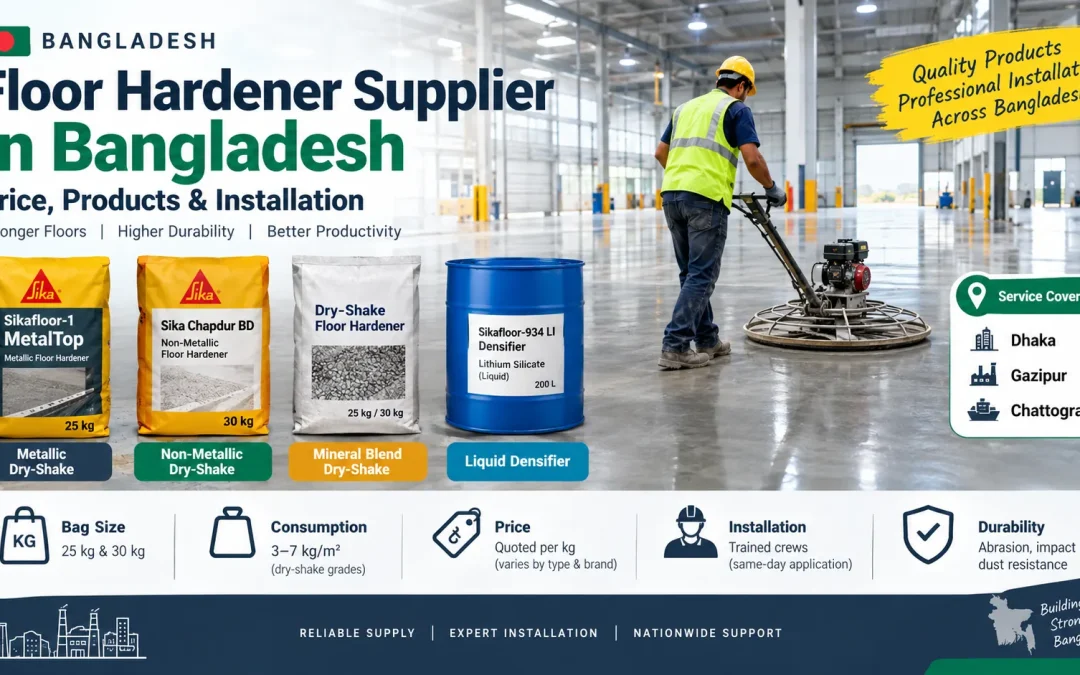
A floor hardener supplier in Bangladesh delivers metallic, non-metallic, dry-shake, and liquid densifier products in 25 kg and 30 kg bags. Dry-shake grades consume 3–7 kg/m², prices are quoted per kg, and trained crews install the product in Dhaka, Gazipur, and Chattogram.
What Floor Hardener Products Are Available in Bangladesh?
Bangladesh floor hardener products fall into 4 categories: metallic dry-shake, non-metallic dry-shake, mineral dry-shake blends, and liquid concrete hardener-densifiers. Dry-shake grades ship in 25 kg or 30 kg bags, and liquid densifiers ship in drums for new and existing concrete floors.
Metallic Floor Hardener
Metallic floor hardener is a pre-blended powder of cement and hard, non-corroding metallic aggregate. Sikafloor-1 MetalTop ships in 25 kg bags, has a bulk density of 2,500 kg/m³, and consumes 5–7 kg/m². Factories, workshops, and heavy-traffic prestige floors use it for maximum abrasion resistance.
Non-Metallic Floor Hardener
Non-metallic floor hardener combines cement, natural mineral aggregates, admixtures, and pigments. According to Sika Bangladesh Limited, Sika Chapdur BD ships in 30 kg bags, carries a 12-month shelf life, and consumes 3.5–6.0 kg/m². The surface is rust-free and dustproof, with coloured finishes available.
Dry-Shake Floor Hardener
Dry-shake floor hardener is a powder broadcast onto fresh, floated concrete and troweled into the surface. The result is a dense layer 2.5–3.0 mm thick at roughly 5 kg/m². Sika lists warehouses, factories, shopping malls, parking lots, garages, and service stations as standard uses.
Liquid Concrete Hardener and Densifier
Liquid concrete hardener penetrates the slab and reacts with free lime to form calcium silicate hydrate, which fills pores and cuts dusting. Sikafloor-934 LI Densifier is a lithium silicate blend mixed 1:1–3 with soft water. Lithium silicate leaves less efflorescence than sodium or potassium silicate.
What Is the Floor Hardener Price in Bangladesh?
Floor hardener price in Bangladesh depends on type, brand, bag size, and dosage. A BDStall listing shows BDT 1,250 for one floor hardener unit but marks it out of stock and omits pack weight. Total cost equals material (kg × rate) plus installation labor per square foot.
Floor Hardener Price per Kg and 25 Kg Bag
Price per kg equals bag price divided by bag weight. A BDT 1,250 bag of 25 kg equals BDT 50 per kg (worked example, not a quote). A 30 kg bag divides by 30. Request dated quotes in October 2026 terms from the supplier before budgeting. [Insert your current dated price table here.]
Floor Hardener Cost per Square Foot
Cost per square foot equals dosage per square foot multiplied by price per kg. One m² equals 10.764 sq ft. The table below uses the BDT 50/kg worked example.
| Duty level | Dosage (kg/m²) | kg per sq ft | Cost per sq ft at BDT 50/kg |
|---|---|---|---|
| Light duty | 3.5 | 0.33 | BDT 16 |
| Medium duty | 5.0 | 0.46 | BDT 23 |
| Heavy duty | 6.0 | 0.56 | BDT 28 |
| Metallic heavy duty | 7.0 | 0.65 | BDT 33 |
Material Cost vs Installation Cost
Material cost covers the hardener bags. Installation cost covers screed leveling, power floating, 2 shake passes, power troweling, curing, and joint cutting. Suppliers quote installation per square foot, separate from material. Request both figures itemized so the comparison between quotes stays accurate.
Factors Affecting Floor Hardener Prices
Six variables move the final quotation:
- Product type: metallic grades cost more per kg than non-metallic mineral grades because of the aggregate and the higher dosage.
- Brand: global brands with technical data sheets price above unbranded local blends, and the data sheet backs the rate.
- Dosage: heavy-duty floors consume 5.5–7 kg/m², which raises material cost 40–100% over light-duty floors.
- Colour: pigmented hardener adds cost over standard cement grey.
- Order volume: bulk orders lower the per-kg rate and the delivery cost per bag.
- Site location: transport from Dhaka to Gazipur, Chattogram, or remote districts adds freight to the quote.
Which Floor Hardener Is Best for Your Project?
The best floor hardener matches traffic type, load, and environment. Non-metallic dry-shake suits warehouses and wet areas at 3.5–6.0 kg/m². Metallic dry-shake suits forklift-heavy factories at 5–7 kg/m². Liquid lithium silicate densifier suits finished floors that need dust control.
Hardener for Warehouses and Factories
Warehouses and factories carry pallet jacks and forklifts, so medium-duty non-metallic dry-shake at 4.5–5.0 kg/m² is the standard specification. Sika Chapdur BD lists both warehouses and factories as uses. The surface stays non-dusting, which protects stored goods and machinery bearings from airborne cement dust.
Hardener for Heavy-Duty Industrial Floors
Heavy-duty industrial floors carry steel wheels, hard-wheeled trolleys, and dragged loads. Metallic dry-shake at 5–7 kg/m² delivers the highest abrasion and impact resistance. Sikafloor SynTop-410 specifies 6–8 kg/m² for heavy duty. Dosage above 5 kg/m² requires 2 shake passes.
Hardener for Parking Areas
Parking areas, ramps, and loading docks need non-slip, durable surfaces. Non-metallic dry-shake at 3.5–5.0 kg/m² gives a rust-free finish that tolerates rain and tire wear. Sika lists parking lots, garages, and service stations as uses. Brush or broom texture increases slip resistance on ramps.
How to Select the Right Hardener
Five steps match a hardener to a floor:
- Identify the traffic type: pedestrian, pallet jack, forklift, or steel-wheeled equipment, each with a different dosage band.
- Check the moisture exposure: wet or washdown areas call for non-metallic, rust-free grades.
- Choose the duty class: light at 3.5–4.0 kg/m², medium at 4.5–5.0 kg/m², heavy at 5.5–7.0 kg/m².
- Compare technical data sheets: confirm consumption, bag weight, shelf life, and storage temperature of 10–30 °C.
- Confirm the finish: select the colour, the trowel finish, and the joint layout before the pour.
What Is the Difference Between Metallic and Non-Metallic Floor Hardener?
Metallic floor hardener uses graded metallic aggregate for maximum abrasion and impact resistance at 5–7 kg/m². Non-metallic floor hardener uses mineral or synthetic aggregate, resists rust, and suits wet and general-traffic floors at 3–6 kg/m². Both bond monolithically with fresh concrete.
Differences in Composition
Metallic hardener contains Portland cement, crushed metallic aggregate, and admixtures, with a bulk density of 2,500 kg/m³. Non-metallic hardener contains Portland cement, natural mineral or synthetic aggregate, admixtures, and pigment. Sikafloor-2 SynTop reaches 2,250 kg/m³ after 28 days.
Abrasion and Impact Resistance
Metallic aggregate is harder than mineral aggregate, so metallic hardener resists scraping, dragging, and point impact better. Non-metallic hardener resists general wear from foot traffic, pallet jacks, and light forklifts. Select metallic for steel-wheeled traffic and non-metallic for mixed or moderate traffic.
Suitable Applications
Metallic hardener suits heavy engineering workshops, machine shops, and loading bays. Non-metallic hardener suits garment factories, warehouses, parking decks, food-processing areas, and wet zones, because the aggregate does not rust. Sika describes its non-metallic grades as rust-free and suitable for wet environments.
Cost and Maintenance Considerations
Metallic hardener costs more per kg and per square foot because of the aggregate and the higher dosage. Constant moisture rusts exposed metallic particles and stains the surface. Non-metallic hardener costs less and needs no special moisture protection. Both grades need sealed joints and regular scrubber cleaning.
How Is Floor Hardener Applied to Concrete Floors?
Floor hardener is applied as a dry-shake topping in 5 stages: surface preparation, dry-shake broadcast, power troweling, curing, and quality control. Application happens while the concrete is fresh, and crews finish the dry-shake layer within the same day as the slab pour.
Concrete Surface Preparation
Preparation starts with a level, compacted base and a concrete slab of consistent slump. Crews screed the slab to grade and power float it once. Bleed water must leave the surface before the shake begins. Never add water to a surface receiving dry-shake, according to Sika data sheets.
Dry-Shake Application
Application starts when the surface holds a boot imprint of about 3–5 mm. Crews broadcast roughly two-thirds of the total dosage by hand or spreader, then float it in. The second shake goes on at a right angle to the first, as the Ronabond MAQ data sheet specifies.
Power Trowel Finishing
Power troweling follows each shake once the powder absorbs moisture from the slab. Crews run 2–3 passes, raising blade pitch each time, to densify the surface and lock the hardener into the concrete. Sika bans application in strong wind or dry conditions.
Curing and Final Protection
Curing retains moisture for hydration of the dry-shake layer. Crews apply a curing compound or wet-cover the floor immediately after the final trowel pass and hold it 7 days. Joints get saw-cut within 24 hours and sealed with a flexible sealant such as Sikaflex.
Quality Control During Installation
Five checks confirm installation quality:
- Measure the dosage per bay: weigh the bags used against the area poured.
- Verify the timing: confirm the shake starts after bleed water clears.
- Inspect the trowel passes: count 2–3 passes with rising blade pitch.
- Record the curing start: log the time and method per bay.
- Check the finished surface: test for hollow spots, dusting, and colour variation.
How Much Floor Hardener Is Required per Square Foot?
Dry-shake floor hardener consumption is 3.5–6.0 kg/m² for non-metallic grades and 5–7 kg/m² for metallic grades. That equals 0.33–0.65 kg per square foot. A 1,000 sq ft floor (92.9 m²) takes 14–26 bags of 25 kg depending on duty.
Recommended Dosage per Square Metre
Sika Chapdur BD specifies 3.5–4.0 kg/m² for light duty, 4.5–5.0 kg/m² for medium duty, and 5.5–6.0 kg/m² for heavy duty. Sikafloor-1 MetalTop specifies 5–7 kg/m². Ronabond MAQ specifies 3–4 kg/m² moderate and 5–7 kg/m² heavy. Sika calls these figures theoretical.
How Many Bags Are Needed for 1,000 Square Feet?
1,000 sq ft equals 92.9 m². Multiply by the dosage and divide by bag weight, then round up.
| Duty level | Total hardener | 25 kg bags | 30 kg bags |
|---|---|---|---|
| Light (3.5–4.0 kg/m²) | 325–372 kg | 14–15 | 11–13 |
| Medium (4.5–5.0 kg/m²) | 418–465 kg | 17–19 | 14–16 |
| Heavy (5.5–6.0 kg/m²) | 511–557 kg | 21–23 | 18–19 |
| Metallic (5–7 kg/m²) | 465–650 kg | 19–26 | 16–22 |
Floor Hardener Material Cost Calculator
Four formulas give the material budget. Area in m² = square feet × 0.0929. Total kg = area × dosage. Bags = total kg ÷ bag weight, rounded up. Material cost = total kg × price per kg. Add 5% for slab irregularity, since Sika consumption figures exclude substrate conditions.
Is Floor Hardener Better Than Epoxy Flooring?
Floor hardener is better for abrasion resistance, monolithic bonding, and low cost on new concrete slabs. Epoxy flooring is better for chemical resistance, seamless hygiene surfaces, and decorative finishes. Choose by exposure: traffic wear favors floor hardener, chemical splash favors epoxy.
Cost Comparison
Floor hardener adds one material to the slab pour and uses the same crew and day. Epoxy adds a primer, 1–3 coats, curing time between coats, and a prepared dry substrate. Floor hardener therefore carries a lower installed cost per square foot on new slabs. Request both quotes in writing.
Durability and Chemical Resistance
Floor hardener becomes part of the slab, so it cannot peel or delaminate, and it resists abrasion for the life of the concrete. Epoxy forms a polymer film that resists acids, alkalis, and oils better than cementitious hardener. Chemical plants and laboratories specify epoxy.
Installation and Maintenance
Floor hardener installs during the slab pour and needs no recoating schedule. Maintenance uses rotary brushes or scrubber-dryers, as Sika specifies. Epoxy installs after the slab cures, needs moisture testing and surface grinding, and requires periodic recoating where wear exposes the concrete beneath.
Which Flooring System Should You Choose?
Choose floor hardener for warehouses, garment factories, parking decks, and manufacturing floors with forklift traffic. Choose epoxy for pharmaceutical, laboratory, and food-grade areas with chemical or hygiene demands. Choose both on mixed sites: hardener in production and storage zones, epoxy in chemical-handling zones.
Where Is Floor Hardener Used in Bangladesh Industries?
Floor hardener is used in 5 Bangladesh industrial settings: garment factories, warehouses and distribution centres, manufacturing plants, cold storage facilities, and parking areas with loading docks. Each setting selects a grade by traffic load, moisture, and dust-control requirements.
Garment Factories
Garment factories in Gazipur, Dhaka, and Chattogram run cutting, sewing, and finishing floors under constant trolley and foot traffic. Non-metallic hardener at 3.5–5.0 kg/m² delivers a dustproof surface that keeps lint and cement dust off fabric. Coloured grades mark walkways and work zones.
Warehouses and Distribution Centres
Warehouses and distribution centres run forklifts and pallet jacks across large slabs. Medium-duty hardener at 4.5–5.0 kg/m² resists wheel wear and removes cement dust from racked goods. Large-pour slabs use laser screeding and power floats for flatness across 1,000–5,000 sq ft bays.
Manufacturing Plants
Manufacturing plants carry machine bases, steel trolleys, and dragged pallets. Metallic hardener at 5–7 kg/m² resists scraping and point impact on production floors. Plants with coolant or wash-down areas use non-metallic grades there, because rust-free aggregate avoids staining.
Cold Storage Facilities
Cold storage floors face freeze-thaw movement, condensation, and forklift traffic. Non-metallic, rust-free hardener resists moisture staining on the slab surface. Contractors seal joints with flexible sealant and specify the hardener grade in line with the insulation and slab design for the chamber temperature.
Parking Areas and Loading Docks
Parking areas and loading docks take vehicle tire wear, rain, and impact from loading equipment. Non-metallic dry-shake gives a rust-free, non-slip finish on ramps and bays. Sika lists parking lots, garages, and service stations as standard applications for Chapdur BD.
How to Choose a Reliable Floor Hardener Supplier in Bangladesh?
A reliable floor hardener supplier provides technical data sheets, project references, stocked inventory, and installation support. Verify 4 signals before ordering: documented quality control, 3+ comparable projects, delivery lead time in days, and a written warranty covering product and workmanship.
Product Quality and Technical Data Sheets
A technical data sheet states consumption, bag weight, shelf life, bulk density, and storage conditions. Sika Chapdur BD lists a 12-month shelf life and 2.5–3.0 mm layer thickness. Reject suppliers who quote price without a data sheet, since documented quality control separates verified products from unverified claims.
Supplier Experience and Project References
Experience shows in completed floors of similar size and traffic. Ask for 3 references with area in sq ft, hardener grade, and site location. Visit one finished floor and inspect dusting, trowel marks, and joint condition. Suppliers handling bulk orders keep quality consistent across batches.
Product Availability and Delivery
Availability decides pour schedules, because dry-shake must reach site on the pour day. Confirm stock quantity in bags, delivery lead time, and delivery cost per route. Check bag dates: a 12-month shelf life under Sika’s 10–30 °C storage condition leaves limited time for old stock.
Warranty and Installation Support
A warranty must name the covered defects, the duration, and the remedy. Suppliers that provide site supervision, crew training, and post-delivery technical advice reduce failure risk. Sika states that its product is applied by trained applicators only, so confirm crew certification.
Where Does Floor Hardener Supply and Installation Service Cover in Bangladesh?
Floor hardener supply and installation services cover Dhaka, Gazipur, and Chattogram, the 3 largest industrial regions in Bangladesh. Services include material supply in 25 kg and 30 kg bags, site delivery, dry-shake installation, power troweling, curing, and joint sealing. S.S Corporation cover floor hardener service across Dhaka.
Floor Hardener Supplier in Dhaka
Dhaka concentrates warehouses, commercial buildings, and light industry. Supply here covers non-metallic and metallic dry-shake, liquid densifier, and curing compounds with same-week delivery from stock. Sika Bangladesh Limited operates its Dhaka head office on the Impetus Center, 242/B, 8th floor.
Gazipur hosts garment factories, textile mills, and manufacturing plants with large-area slabs. Industrial flooring here prioritizes high-volume dry-shake supply, crew deployment for continuous pours, and dust-free non-metallic finishes.
Floor Hardener Services in Chattogram
Chattogram combines port logistics, export processing zones, and warehouses. Services here cover heavy-duty slabs for container yards, cold storage, and distribution centres, with delivery from the port-side stock point.
What Is the Price of Floor Hardener in Bangladesh?
Floor hardener price in Bangladesh depends on type, brand, and bag size. A BDStall listing shows BDT 1,250 for one unit, out of stock, with no pack weight. Material cost runs BDT 16–33 per sq ft at a BDT 50/kg example rate. Request a dated quote.
Which Floor Hardener Is Best?
No single floor hardener is best for every floor. Metallic dry-shake at 5–7 kg/m² is best for steel-wheeled heavy-duty traffic. Non-metallic dry-shake at 3.5–6.0 kg/m² is best for warehouses, wet zones, and parking. Lithium silicate densifier is best for dust control on finished slabs.
What Is the Cost per Kilogram?
Cost per kilogram equals bag price divided by bag weight: BDT 1,250 ÷ 25 kg = BDT 50/kg in the worked example. Prices differ by brand and grade, so metallic grades quote higher than non-metallic grades. Confirm the current per-kg rate with a written quotation.
Can Floor Hardener Be Applied to an Existing Floor?
Dry-shake hardener applies to fresh concrete only, because it bonds during hydration. Existing cured floors receive liquid lithium silicate densifier instead, which penetrates the pores and reacts with free lime. LATICRETE’s Lion Hard data sheet confirms application on new and existing cured concrete.
Get a dated quote, a consumption estimate for your floor, and a technical data sheet from your floor hardener supplier before the next pour. Every bag counts at 3–7 kg/m².