

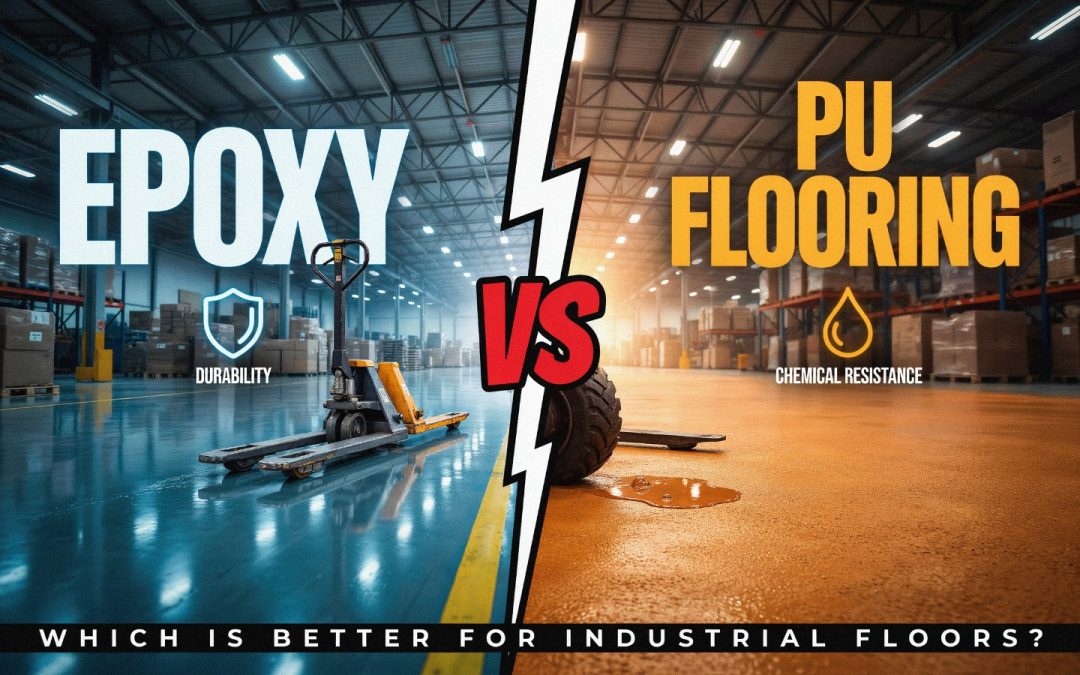
Epoxy and PU flooring protect industrial concrete floors, but they work best in different conditions. Epoxy provides high hardness, compressive strength, and cost efficiency, while PU provides flexibility, abrasion resistance, UV stability, and better resistance to thermal shock.
Epoxy suits warehouses, logistics centers, car parks, and dry manufacturing areas where floors face heavy loads and steady temperatures. PU suits food plants, cold storage, chemical facilities, and washdown areas where floors face heat, moisture, chemicals, or temperature changes.
Performance also depends on the specific demand. Epoxy handles forklifts and heavy static loads well, while PU handles impact, chemical exposure, freezing temperatures, hot-water washdowns, and UV exposure better. A hybrid epoxy-and-PU system combines epoxy’s strength with PU’s surface protection and can work well when one floor faces several hazards.
Cost and service life also affect the choice. Epoxy usually has a lower installation cost, while PU can offer longer service life in harsh environments because it needs fewer recoats. Urethane cement fits even more severe conditions, such as food processing and pharmaceutical plants with extreme heat, moisture, and chemical exposure.
Choosing the right floor requires you to check temperature, traffic, chemicals, moisture, UV exposure, hygiene needs, substrate condition, downtime, and lifecycle cost. Proper substrate preparation also plays a major role in preventing premature failure.
The best industrial floor is not the one with the strongest label, it is the one matched to the job. Check the conditions first, then choose epoxy, PU, or urethane cement with confidence.
Epoxy vs PU Flooring: What’s the Difference?
Epoxy flooring uses a rigid thermosetting resin that bonds tightly to concrete and resists compression, while PU (polyurethane) flooring uses a more flexible thermosetting polymer that resists impact, abrasion, and temperature swings. Epoxy suits stable, heavy-load areas; PU suits environments with thermal cycling or chemical washdowns.
Epoxy flooring is a two-part coating system made from an epoxy resin and a hardener that cross-link during application, curing into a hard, glass-like surface. Contractors apply epoxy at thicknesses from 10 to 125 mils depending on the traffic load, and the cured system bonds directly to a properly prepared concrete substrate.
PU flooring, also called polyurethane flooring, is a thermosetting polymer coating applied in thinner films, typically 3 to 8 mils as a topcoat or thicker as a standalone system. Polyurethane molecules form a looser cross-linked network than epoxy, which gives the cured floor elasticity, letting it flex with substrate movement and temperature change instead of cracking.
The chemistry drives the physical property gap between the two systems. Epoxy’s tight molecular cross-linking produces high compressive strength and rigidity but leaves the surface brittle under sudden impact or thermal shock. Polyurethane’s looser cross-linking sacrifices some compressive strength for flexibility, abrasion resistance, and UV stability that epoxy cannot match.
| Property | Epoxy Flooring | PU Flooring |
| Chemistry | Epoxy resin + hardener | Polyurethane resin + hardener |
| Rigidity | Hard, rigid | Flexible, elastic |
| Compressive strength | Higher | Lower |
| Typical thickness | 10–125 mils | 3–8 mils (topcoat) or thicker (standalone) |
| Best fit | Stable, heavy-load areas | Thermal cycling, washdown areas |
Epoxy vs PU Flooring: Key Differences Compared
Epoxy outperforms PU in hardness, compressive strength, and cost, while PU outperforms epoxy in impact resistance, abrasion resistance, chemical resistance, flexibility, UV stability, and thermal shock resistance. Maintenance stays similar for both once installed correctly on a prepared substrate.
The key differences between epoxy and PU flooring are given below.
| Attribute | Epoxy | Polyurethane (PU) |
| Hardness & compressive strength | Higher; withstands static loads and forklift traffic | Lower; trades hardness for flexibility |
| Durability & abrasion resistance | Good, but wears faster under constant rolling traffic | Superior; PU tests up to 2–3x more wear-resistant under ASTM D4060 |
| Impact & scratch resistance | Brittle; can crack or chip from dropped tools | Absorbs impact and resists scratching due to elasticity |
| Chemical resistance | Strong against oils, fuels, and battery acid | Broader resistance, including acids from food and dairy production |
| Flexibility | Rigid; low tolerance for substrate movement | High; flexes with expansion and contraction |
| UV resistance | Poor; ambers and yellows in sunlight | Excellent; holds color under UV exposure |
| Thermal shock resistance | Weak; cracks under rapid temperature swings | Strong; withstands hot-water washdowns and freezer cycling |
| Maintenance | Simple sweeping and mopping; recoat every 3–7 years | Simple sweeping and mopping; recoat every 10–15 years in harsh use |
Epoxy vs PU Flooring: Which Is Better for Different Industrial Environments?
Epoxy performs best in warehouses, manufacturing plants, and car parks where compressive strength and cost matter most. PU performs best in food processing plants, cold storage rooms, and chemical plants where thermal cycling, washdowns, or broad chemical exposure dominate daily operations.
The recommended flooring system for each industrial environment is given below.
- Warehouses perform best with epoxy flooring, since its high compressive strength handles static racking loads and constant forklift traffic at a lower material cost.
- Manufacturing plants perform best with epoxy in dry, stable production areas, switching to PU near presses, ovens, or equipment generating heat and vibration.
- Food processing facilities perform best with PU flooring, since its chemical resistance handles lactic, citric, and fatty acids from daily washdowns and spills.
- Cold storage and freezer rooms perform best with PU flooring, since its flexibility resists cracking during repeated freeze-thaw and thermal shock cycles.
- Chemical plants perform best with PU or urethane cement, since polyurethane resists a broader range of acids, alkalis, and solvents than epoxy.
- Automotive facilities perform best with epoxy flooring in assembly bays and PU in wash bays exposed to hot water and degreasers.
- Logistics centers perform best with epoxy flooring, since its rigidity and abrasion resistance handle continuous forklift and pallet-jack traffic economically.
- Car parks perform best with PU flooring, since its UV resistance and flexibility prevent yellowing and cracking from sunlight, weather, and vehicle movement.
Epoxy vs PU Flooring: Cost, Lifespan, and Long-Term Value
Epoxy costs $3 to $12 per square foot installed and lasts 5 to 10 years in industrial use, while PU flooring costs $5 to $12 per square foot and lasts 10 to 15 years under thermal or chemical stress. Lower recoat frequency gives PU a lower total cost of ownership in harsh environments.
| Cost Factor | Epoxy | PU (Polyurethane) |
| Installed cost per sq ft | $3–$12 | $5–$12 |
| Material vs. labor split | Materials 30–40%, labor 60–70% | Materials 35–45%, labor 55–65% |
| Typical industrial lifespan | 5–10 years | 10–15 years |
| Recoat interval (harsh use) | Every 3–7 years | Every 10–15 years |
| Maintenance cost | Low; routine cleaning | Low; routine cleaning |
Initial installation cost favors epoxy, since its simpler chemistry and wider contractor availability keep material and labor pricing lower across most projects. Material costs rise for both systems when a facility requires specialty formulations, such as anti-static epoxy or high-build PU for chemical plants.
Total cost of ownership favors PU flooring in demanding environments. A facility running nightly high-temperature washdowns can spend $49,000 on epoxy over 6 years, including two recoats, against roughly $40,000 for PU over 10 years with zero recoats — a direct result of PU’s superior thermal shock and chemical resistance offsetting its higher upfront price.
Epoxy vs PU Flooring: Which Performs Better Under Heavy Loads, Chemicals, and Extreme Temperatures?
Epoxy performs better under heavy static loads and forklift traffic, while PU performs better under heavy impact, broad chemical exposure, hot-water washdowns, freezing temperatures, thermal shock, and UV exposure. Facility conditions, not preference, should drive the material selection between the two.
The performance comparison across these demanding conditions is given below.
- Forklifts and heavy machinery favor epoxy flooring, since its high compressive strength resists indentation and rutting from concentrated static and rolling loads.
- Heavy impact favors PU flooring, since its elasticity absorbs dropped tools and equipment instead of cracking or chipping the surface.
- Chemical exposure favors PU flooring in food, dairy, and pharmaceutical settings, since it resists a wider range of acids and caustics than epoxy.
- Hot-water washdowns favor PU or urethane cement, since epoxy softens and loses adhesion under repeated exposure to steam and high-temperature water.
- Freezing temperatures favor PU flooring, since its flexibility prevents the brittle cracking that epoxy develops in freezer and cold-storage conditions.
- Thermal shock favors PU flooring by a wide margin, since its molecular flexibility lets it expand and contract without delaminating from concrete.
- UV exposure favors PU flooring, since it resists yellowing and degradation in sunlight, while epoxy ambers within months of outdoor or skylight exposure.
Can You Apply PU Over Epoxy? Understanding Hybrid Flooring Systems
Contractors can apply a polyurethane topcoat over a cured epoxy base coat, creating a hybrid system that combines epoxy’s compressive strength with PU’s UV stability, chemical resistance, and abrasion resistance. This hybrid approach is standard practice across heavy industrial and food-grade flooring installations.
A hybrid system builds an epoxy base coat first, typically 20 to 60 mils thick, to establish compressive strength and bond to the concrete substrate. Installers then apply a thin PU topcoat, usually 2 to 5 mils, over the cured epoxy to add UV resistance, abrasion resistance, and chemical protection the epoxy alone cannot provide.
Facilities use hybrid systems because epoxy alone yellows under UV light and wears faster under constant abrasion, while PU alone lacks the compressive strength needed for heavy static loads. Combining both layers offsets each material’s weakness with the other’s strength, producing a floor that resists forklift traffic, chemical spills, and sunlight in a single system.
The main limitation of a hybrid system is surface preparation between coats. Installers must mechanically abrade the cured epoxy to remove surface gloss before applying the PU topcoat, since a smooth, glossy epoxy surface prevents proper adhesion and causes the topcoat to peel. Extra labor and cure time between coats also raise installation cost compared to a single-system floor.
A hybrid system makes more sense than either material alone when a facility faces both heavy mechanical loads and UV or chemical exposure in the same space — a loading dock with skylights, a manufacturing floor with acid spills, or a warehouse with large open bay doors letting in sunlight.
Epoxy vs PU vs Urethane Cement: Which Industrial Flooring System Is Right for You?
Epoxy suits stable, heavy-load environments at the lowest cost. PU suits environments with thermal cycling, UV exposure, or broad chemical contact. Urethane cement suits severe-duty environments combining extreme heat, moisture, and chemical exposure, such as food and pharmaceutical processing floors.
- Epoxy delivers the highest compressive strength and lowest installed cost, making it the standard choice for warehouses, logistics centers, and dry manufacturing floors.
- PU delivers flexibility, UV stability, and broad chemical resistance, making it the standard choice for cold storage, car parks, and light chemical exposure areas.
- Urethane cement delivers the highest thermal shock resistance and moisture tolerance, making it the standard choice for commercial kitchens, breweries, and pharmaceutical plants.
| System | Best Application | Key Strength |
| Epoxy | Warehouses, logistics, dry manufacturing | Compressive strength, low cost |
| PU (polyurethane) | Cold storage, car parks, automotive wash bays | Flexibility, UV resistance, broad chemical resistance |
| Urethane cement | Food processing, breweries, pharmaceutical plants | Thermal shock resistance, moisture tolerance |
Urethane cement flooring combines polyurethane resin with Portland cement and graded aggregate, installed at 1/4 to 3/8 inch thickness — far thicker than either epoxy or standard PU coatings. This composite structure bonds to concrete at the molecular level and withstands steam cleaning, caustic washdowns, and constant thermal cycling that would delaminate a standard epoxy or PU coating.
How to Choose the Right Industrial Flooring System
Choosing the right industrial flooring system depends on nine factors: operating temperature, traffic load, chemical exposure, moisture and washdown frequency, UV exposure, hygiene requirements, substrate condition, installation downtime, and budget against lifecycle cost. Matching these factors to a specific material prevents premature floor failure.
The factors for choosing the right industrial flooring system are given below.
- Assess operating temperature, since consistent ambient conditions favor epoxy while thermal cycling between hot and freezing favors PU or urethane cement.
- Calculate traffic and load, since heavy forklift and rolling-load traffic favors epoxy’s compressive strength over PU’s lower load capacity.
- Map chemical exposure, listing every acid, solvent, and cleaning agent the floor will contact, since PU resists a broader chemical range than epoxy.
- Measure moisture and washdown frequency, since daily hot-water or steam washdowns favor PU or urethane cement over standard epoxy systems.
- Check UV exposure, since floors near open doors, skylights, or outdoor areas need PU’s UV stability to avoid epoxy’s yellowing.
- Confirm hygiene and regulatory requirements, since food, pharmaceutical, and healthcare facilities often mandate seamless, chemical-resistant PU or urethane cement systems.
- Inspect substrate condition, since cracked, moist, or uneven concrete needs repair and moisture testing before either system can bond properly.
- Plan installation downtime, since epoxy typically needs 5 to 7 days to fully cure while PU topcoats return to service faster.
- Weigh budget against lifecycle cost, since a lower-cost epoxy floor recoated every 3 to 7 years can cost more than PU over a decade.
Is PU flooring better than epoxy for industrial floors?
PU flooring is not universally better than epoxy; each performs better under different conditions. PU wins in facilities with thermal cycling, UV exposure, or broad chemical contact, such as food plants and cold storage. Epoxy wins in stable, heavy-load environments like warehouses and logistics centers where cost and compressive strength matter most.
What is the main disadvantage of epoxy flooring?
The main disadvantage of epoxy flooring is brittleness under impact and thermal shock. Epoxy’s rigid, tightly cross-linked structure cannot flex with substrate movement or rapid temperature change, causing it to crack, chip, or delaminate. Epoxy also ambers and yellows under UV exposure, limiting its use in sunlit or outdoor areas.
Can polyurethane be applied over an existing epoxy floor?
Polyurethane can be applied over an existing epoxy floor, forming a hybrid system that combines epoxy’s compressive strength with PU’s UV stability and chemical resistance. Installers must mechanically abrade the cured epoxy surface first to remove gloss, since a smooth surface prevents the PU topcoat from bonding properly.
Which is more resistant to chemicals, epoxy or PU flooring?
PU flooring resists a broader range of chemicals than epoxy, including lactic, citric, and other food-grade acids common in dairy and beverage production. Epoxy resists oils, fuels, and battery acid effectively but degrades faster under prolonged exposure to the acidic and caustic chemicals typical of food processing environments.
Which flooring lasts longer, epoxy or polyurethane?
Polyurethane flooring lasts longer than epoxy in demanding industrial conditions, typically 10 to 15 years against epoxy’s 5 to 10 years. PU’s flexibility and chemical resistance reduce the cracking, delamination, and recoating that shorten epoxy’s service life under thermal cycling, heavy chemical exposure, or frequent washdowns.
How long does an industrial epoxy or PU floor take to cure?
Industrial epoxy floors reach full cure in 5 to 7 days, with light foot traffic possible after 24 to 48 hours. PU topcoats reach full cure in 3 to 5 days, with surface dry time of 4 to 8 hours and return to service within 24 to 48 hours.