

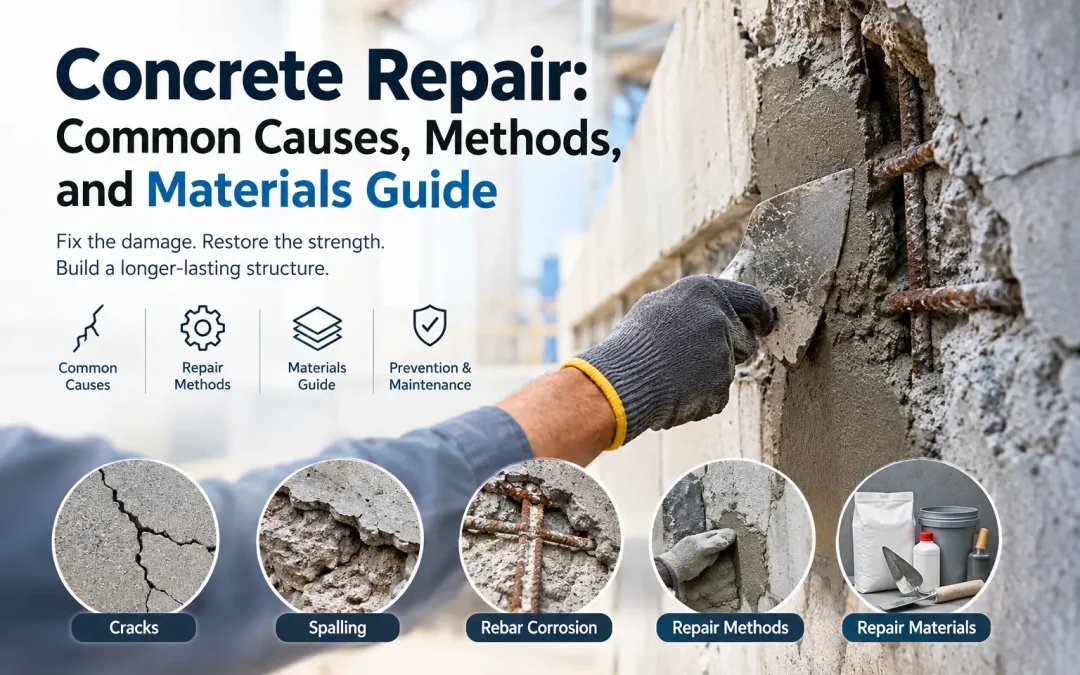
Concrete repair restores damaged concrete and helps structures remain safe, useful, and durable. It addresses problems such as cracks, spalling, and surface wear while also treating the causes behind the damage. Moisture, freeze-thaw cycles, rebar corrosion, chemical attack, heavy loads, temperature changes, and poor construction can weaken concrete over time.
Concrete damage appears in several forms, including cracks, spalling, scaling, delamination, crumbling, joint deterioration, and structural deterioration. Each type shows different signs and requires a suitable repair approach. Proper assessment helps you determine whether the damage is cosmetic or structural before work begins.
Common repair methods include routing and sealing, epoxy injection, patching, resurfacing, dry-pack repair, full-depth repair, and structural strengthening. Repair materials include repair mortar, polymer-modified mortar, epoxy resin, hydraulic cement, quick-setting cement, crack sealants, bonding agents, rebar, and dowels. The right combination depends on the damage, exposure, repair depth, and structural needs.
A proper repair follows a clear process. You assess the damage, find its cause, remove unsound concrete, clean and prepare the surface, treat exposed reinforcement, apply the correct repair material, and finish and cure the repaired area. Careful method selection helps prevent repeat damage and improves repair life.
Concrete repair also depends on prevention and regular maintenance. Proper mix design, adequate curing, good drainage, protective sealers, reinforcement protection, routine inspections, and early crack maintenance help extend concrete service life. Small repairs can prevent larger and more costly problems later.
Fix the cause, choose the right method, and protect the repair because strong concrete starts with smart maintenance.
What Is Concrete Repair?
Concrete repair is the process of restoring cracked, spalled, or deteriorated concrete to a safe, functional, structurally sound condition using materials like repair mortar, epoxy, and hydraulic cement to rebuild strength and stop water intrusion.
Concrete repair covers every method used to fix damaged concrete and return it to a safe, functional state, from surface patching to full structural rebuilding. The scope ranges from cosmetic touch-ups on driveways to load-bearing fixes on bridges and parking structures. Repair always targets the visible damage and its root cause together.
Concrete needs repair because water, chemicals, temperature swings, and mechanical stress gradually break down its strength and the protective cover over embedded steel. Small cracks let in moisture that corrodes rebar, and that corrosion expands and cracks the concrete further. Repair stops this cycle before it turns into a full replacement.
Cosmetic repair fixes surface issues like scaling, discoloration, and shallow spalls that do not affect load-carrying capacity, using thin resurfacing or patching materials. Structural repair restores lost strength in load-bearing elements through epoxy injection, full-depth patching, or added reinforcement. Confusing the two wastes money on cosmetic work when a structural fix is the real need.
Repair fixes an isolated area of damage, such as a single crack or spall, and returns that section to service. Restoration takes a broader approach, addressing deterioration across an entire structure along with its underlying causes, like widespread corrosion or chemical attack. Restoration projects often combine several repair methods with protective coatings for long-term durability.
What Causes Concrete to Crack and Deteriorate?
Concrete cracks and deteriorates from seven main causes: moisture and water ingress, freeze-thaw cycles, rebar corrosion, chemical attack, overloading, thermal movement, and poor mix design, curing, or workmanship. Each cause weakens the matrix or the reinforcement inside it.
Moisture and Water Ingress
Water enters concrete through pores, cracks, and joints, then carries chlorides and sulfates deep into the matrix. Trapped moisture triggers corrosion, freeze-thaw cracking, and chemical attack from the inside out. On parking structures and sidewalks, ponding water raises internal moisture content and cuts years off service life. Drainage and sealers block this entry point.
Freeze-Thaw Cycles
Water inside concrete pores freezes and expands by about 9 percent, generating internal pressure that exceeds the material’s tensile strength. Each freeze-thaw cycle enlarges microcracks, and repeated cycles produce scaling, cracking, and crumbling on the surface. Concrete becomes vulnerable once saturation passes roughly 85 percent. Air-entrained mixes reduce this damage by giving ice room to expand.
Rebar Corrosion
Chlorides and carbon dioxide break down the protective layer around embedded steel, and rust forms as a result. Corrosion products occupy two to ten times the volume of the original steel, so the expanding rust cracks and spalls the surrounding concrete. Corrosion accelerates with age, which makes routine inspection critical for reinforced structures.
Chemical Attack
Sulfates, acids, and alkalis react with the cement paste and produce expansive compounds that crack and weaken concrete. Sulfate attack forms crystals that expand within the matrix, while acids dissolve calcium compounds outright. Alkali-silica reaction between reactive aggregate and cement alkalis creates a gel that swells and fractures the surface from within.
Overloading and Structural Stress
Loads beyond a structure’s design capacity stress concrete past its tensile limit and open structural cracks. Vehicle traffic on undersized slabs, added building floors, and heavy equipment on unreinforced floors all trigger this stress. Structural cracks widen under repeated loading and demand engineering evaluation before any repair work begins.
Thermal Movement
Concrete expands and contracts with temperature swings, and restrained movement builds internal stress that cracks the surface. Daily heat cycles and seasonal extremes both contribute, especially in slabs without adequate control joints. Correctly spaced expansion joints absorb this movement and keep thermal stress from concentrating into a single, damaging crack.
Poor Mix Design, Curing, and Workmanship
A high water-cement ratio, inadequate curing, and rushed finishing all weaken concrete before it ever faces the elements. Insufficient curing lets moisture escape too fast, which stops hydration early and cuts final strength. Poor consolidation traps air voids, and these defects turn into cracking, scaling, and dusting within months of placement.
What Are the Common Types of Concrete Damage?
The common types of concrete damage are cracks, spalling, scaling, delamination, crumbling, joint deterioration, and structural deterioration. Each type has a distinct cause, depth, and repair approach, so identifying the type correctly comes before choosing a fix.
Cracks
Cracks are linear fractures that form when concrete stress exceeds its tensile strength. Hairline cracks under 0.3 millimeters are usually cosmetic, while wider cracks often signal structural movement, settlement, or corrosion pressure. Crack width, depth, and pattern together determine whether sealing, injection, or structural repair is the correct fix.
Spalling
Spalling is the chipping, flaking, or breaking away of the concrete surface, often exposing aggregate or rebar underneath. Corrosion of reinforcing steel drives most spalling, since rust expands two to six times the original steel’s volume and pushes the cover off. Freeze-thaw cycles, fire damage, and alkali-silica reaction account for the rest.
Scaling
Scaling is shallow flaking of the top mortar layer, usually limited to a few millimeters deep. Freeze-thaw cycles and de-icing salts drive water into the surface, and expanding ice pops off thin scales of paste to expose the aggregate underneath. Poor finishing and inadequate air entrainment make scaling worse over time.
Delamination
Delamination is a hidden horizontal separation between layers of concrete that forms below the surface and sounds hollow when tapped. Corrosion-induced cracks around adjacent rebar link together and create this fracture plane. Because the damage stays invisible from above, sounding surveys or infrared scans are needed to map its true extent.
Crumbling
Crumbling occurs when concrete loses its binding strength and breaks apart into loose fragments or powder under light pressure. Weak mix design, chemical attack, and advanced freeze-thaw damage are the leading triggers. Once crumbling spreads past the surface layer, the affected concrete must be removed rather than patched over.
Joint Deterioration
Joint deterioration is the breakdown of expansion and control joints from debris buildup, sealant failure, or heavy traffic loads. Highway engineering standards define joint spalling as cracking or chipping within 0.6 meters of a joint. Failed joints let water and incompressible material into the slab, which accelerates spalling nearby.
Structural Deterioration
Structural deterioration is damage severe enough to reduce a member’s load-carrying capacity, including exposed rebar, section loss, and wide diagonal cracks in beams or columns. This damage requires an engineer’s assessment before repair, since patching alone cannot restore lost strength. Left unaddressed, it raises the structure’s collapse risk over time.
What Are the Common Methods of Concrete Repair?
The common methods of concrete repair are routing and sealing, epoxy injection, patching, resurfacing, dry-pack repair, full-depth repair, and structural strengthening. Each method matches a specific crack width, damage depth, and structural condition.
Routing and Sealing
Routing and sealing widens a crack into a V-shaped groove with a saw or grinder, then fills it with a flexible sealant like polyurethane or polysulfide. This method suits non-structural, stable cracks in flatwork and works well where ongoing thermal movement would break a rigid repair apart. It stays fast and low cost.
Epoxy Injection
Epoxy injection fills dormant structural cracks as narrow as 0.05 millimeters by pumping low-viscosity epoxy resin through ports spaced along the crack under controlled pressure. The cured epoxy bonds stronger than the surrounding concrete and restores load transfer across the crack. It fails on active, moving cracks, since cured epoxy stays rigid.
Patching
Patching removes unsound concrete around a defect and replaces it with a cement-based or polymer-modified repair mortar. Crews chip out material to sound concrete, clean the cavity, apply a bonding agent, then trowel the patch to match the surrounding surface. Patching suits potholes, spalls, and small structural cavities a few inches deep.
Resurfacing
Resurfacing applies a thin overlay, typically 3 to 20 millimeters thick, across an entire slab to restore a worn or scaling surface. Crews clean and profile the substrate, then spread a polymer-modified topping that bonds to the old concrete. This method fixes widespread cosmetic damage faster and cheaper than full slab replacement.
Dry-Pack Repair
Dry-pack repair packs a stiff, low-slump mortar of roughly one part cement to two and a half parts sand into a cavity by hand, tamping each layer to force out air and bond tightly. It suits deep, narrow holes from form ties or bolts, but it fails on thin or through-slab cracks.
Full-Depth Repair
Full-depth repair removes concrete across the entire slab thickness, then rebuilds the section with new concrete, dowels, and reinforcement tied into sound material. Crews use this method when deterioration, cracking, or joint spalling extends through the slab rather than staying near the surface. It restores full structural continuity to the slab.
Structural Strengthening
Structural strengthening adds capacity to a weakened member using carbon fiber reinforced polymer wraps, steel plates, or supplemental rebar and shotcrete jackets. Engineers apply this method after corrosion, overloading, or design errors reduce load-carrying capacity below code requirements. It restores strength without full demolition and reconstruction of the member.
What Materials Are Used for Concrete Repair?
Concrete repair uses repair mortar, polymer-modified mortar, epoxy resins, hydraulic cement, quick-setting cement, crack sealants, bonding agents, and rebar or dowels. Material choice depends on crack width, moisture exposure, load, and required cure speed.
Repair Mortar
Repair mortar is a cement-based patching compound designed to bond tightly to existing concrete and match its strength and appearance. Contractors use it to fill spalls, potholes, and edge damage from a few millimeters to several inches deep. Most formulas cure fast enough to reopen a surface to traffic within hours.
Polymer-Modified Mortar
Polymer-modified mortar blends cement with acrylic or latex polymers to boost flexibility, bond strength, and resistance to moisture and freeze-thaw cycling. The added polymer lets thinner repairs flex with the substrate instead of cracking at the bond line. Contractors choose it for vertical, overhead, and high-traffic repairs where standard mortar fails.
Epoxy Resins
Epoxy resins are two-component adhesives that cure into a rigid, high-strength bond used for structural crack injection and heavy-duty patching. Cured epoxy exceeds the tensile and compressive strength of the surrounding concrete, but it loses strength at high temperatures and cannot flex with active cracks. It demands a dry, clean substrate.
Hydraulic Cement
Hydraulic cement expands slightly as it sets, which lets it plug leaks and seal holes even under active water pressure. Plumbers and contractors use it to stop flowing water in walls, pipes, and foundations within minutes of mixing. It is not a structural repair material on its own, so larger cavities need reinforcement.
Quick-Setting Cement
Quick-setting cement reaches an initial set in as little as 45 seconds to a few minutes, which lets crews close small holes and stop active leaks fast. It sacrifices some long-term strength and workability for that speed. Contractors reserve it for emergency repairs and small anchor or bolt-hole work, not large structural patches.
Crack Sealants
Crack sealants are flexible, elastomeric compounds like polyurethane and polysulfide that stay pliable after curing and move with the concrete. Products rated for movement up to 50 percent of the joint width resist re-cracking in climates with wide temperature swings. Sealants suit active, non-structural cracks and control joints, not load-bearing repairs.
Bonding Agents
Bonding agents are latex, acrylic, or epoxy-based liquids applied to a prepared substrate to chemically link old concrete to new repair material. Without a bonding agent, thin patches often delaminate under traffic or freeze-thaw cycling because the bond line stays weak. Contractors brush or spray the agent on just before placing the patch.
Rebar and Dowels
Rebar and dowels are steel reinforcing bars embedded in a repair to restore load transfer and tie new concrete to the existing structure. Crews expose sound rebar during removal, clean corrosion from it, and splice in new bars where section loss is severe. Dowels also connect adjoining slabs across full-depth joint repairs.
How Is Concrete Repair Done?
Concrete repair follows seven core steps: assess the damage, identify its cause, remove unsound concrete, prepare the surface, treat exposed reinforcement, apply the matched repair material, then finish and cure it for full strength.
- Assess the damage by measuring crack width, depth, and pattern, and checking for hollow spots, spalling, or exposed rebar to gauge how severe the deterioration really is.
- Identify the underlying cause, whether it’s moisture intrusion, freeze-thaw cycling, corrosion, overloading, or poor original construction, since treating symptoms without fixing the cause guarantees the damage returns.
- Remove damaged and unsound concrete back to a solid, sound substrate using a chisel, jackhammer, or grinder, testing the edges with a hammer to confirm firmness.
- Prepare and clean the surface by removing dust, oil, and loose debris with a wire brush, compressed air, or pressure washer to create a bondable substrate.
- Treat exposed reinforcement by removing rust with grit-blasting or a wire brush, then coat the steel with an anti-corrosive primer before covering it with fresh material.
- Apply the appropriate repair material, matching mortar, epoxy, or hydraulic cement to the crack width, depth, and load requirements identified during the assessment step.
- Finish and cure the repair by matching the surrounding texture, then keep the patch moist and protected from traffic for the material’s full cure period.
How Do You Choose the Right Concrete Repair Method?
Choosing the right concrete repair method depends on crack type and severity, whether damage is structural or cosmetic, moisture exposure, repair depth and area, and material compatibility, weighed against the true cost of repair versus replacement.
- Evaluate crack type and severity by measuring width, checking whether it’s active or dormant, and noting if it runs through the full slab depth.
- Determine surface versus deep damage by checking whether damage stays on the surface, like scaling, or reaches deep into the concrete, like spalling near rebar.
- Classify structural versus nonstructural damage first, since load-bearing cracks need engineering review while cosmetic cracks need only sealing or patching.
- Check moisture and water conditions at the site, because active leaks demand hydraulic cement while dry cracks accept epoxy or polyurethane sealants instead.
- Match repair depth and area to the method, since dry-pack suits small deep holes while resurfacing covers wide, shallow damage across a slab.
- Confirm material compatibility by matching the new material’s strength, shrinkage, and thermal expansion to the existing concrete, or the patch will debond and crack again.
- Weigh repair against replacement by comparing damage extent, structural risk, and cost, since concrete with crumbling beyond the surface often needs replacement instead.
Use the table below to match visible damage to its cause, method, and material.
| Damage Type | Common Cause | Recommended Method | Material |
| Hairline cracks (under 0.3 mm) | Shrinkage, thermal movement | Routing and sealing | Polyurethane or polysulfide sealant |
| Dormant structural cracks | Overload, settlement | Epoxy injection | Low-viscosity epoxy resin |
| Surface spalling | Rebar corrosion, freeze-thaw | Patching | Polymer-modified repair mortar |
| Scaling | Freeze-thaw cycles, de-icing salts | Resurfacing | Thin polymer overlay |
| Bolt holes, small cavities | Form ties, anchors | Dry-pack repair | Stiff cement-sand mortar |
| Full-depth slab damage | Joint failure, deep deterioration | Full-depth repair | New concrete with dowels |
| Reduced load capacity | Corrosion, design error | Structural strengthening | CFRP wrap or steel plate |
How Can You Prevent Concrete Damage and Extend Its Life?
Preventing concrete damage starts with a proper mix design, adequate curing, controlled drainage, protective sealers, reinforcement protection, routine inspection, and prompt crack maintenance, since catching small problems early stops moisture and corrosion before they spread.
- Design the mix properly with a low water-cement ratio and air entrainment, since a well-proportioned mix resists freeze-thaw damage and chemical attack far longer.
- Cure new concrete adequately for at least seven days using wet burlap, curing compound, or plastic sheeting, since proper hydration determines its long-term strength.
- Control drainage and moisture by sloping surfaces away from slabs and clearing gutters, since standing water is the single biggest driver of freeze-thaw damage.
- Apply protective coatings and sealers every two to five years to block water, chlorides, and de-icing salts before they reach the concrete’s pores.
- Protect embedded reinforcement with adequate concrete cover and corrosion-inhibiting admixtures, since rust expansion is the leading cause of cracking and spalling in structures.
- Schedule routine inspections at least once a year to catch cracks, joint failures, and drainage problems while repairs are still small and inexpensive.
- Maintain cracks promptly by sealing them as soon as they appear, since even hairline openings let in water that freezes, expands, and widens the damage.
- Follow a preventive maintenance plan that combines cleaning, resealing, joint upkeep, and prompt small repairs to extend the concrete’s service life by years.
How do I know if a concrete crack needs repair?
A crack needs repair when it exceeds 0.3 millimeters wide, keeps growing, runs through the full slab, or lets water reach the rebar. Hairline cracks under that width are typically cosmetic and can be monitored instead of repaired right away.
Can cracked concrete be repaired without replacing it?
Cracked concrete gets repaired without replacement in most cases, using routing and sealing for surface cracks or epoxy injection for structural ones. Replacement becomes necessary only when crumbling, spalling, or section loss extends through most of the slab’s depth.
What is the best material for repairing concrete cracks?
Epoxy resin works best for structural, dormant cracks because it cures stronger than the surrounding concrete and restores load transfer across the break. For active cracks that keep moving, polyurethane or polysulfide sealant performs better since it stays flexible after curing.
How long does a concrete repair typically last?
A properly executed concrete repair typically lasts 10 to 20 years, depending on the material used, exposure conditions, and whether the original cause of damage was fixed. Repairs that ignore an ongoing cause, like continued water intrusion, often fail within 2 years.
Can I repair concrete myself, or should I hire a professional?
Homeowners repair small, cosmetic cracks and surface spalls with off-the-shelf patching compounds and sealants. Structural cracks, exposed rebar, and repairs on load-bearing elements require a licensed contractor or engineer, since the wrong material choice or preparation makes the repair fail.
How long does repaired concrete take to cure?
Most concrete repair materials reach an initial set within a few hours and gain enough strength for light traffic within 24 to 48 hours. Full cure and maximum strength typically take 7 to 28 days, matching the timeline of new concrete.
Concrete repair works when the fix matches the cause, not just the crack you see on the surface. Measure the damage, treat the root cause, pick the material built for that exact job, and the repair holds for years instead of months.