

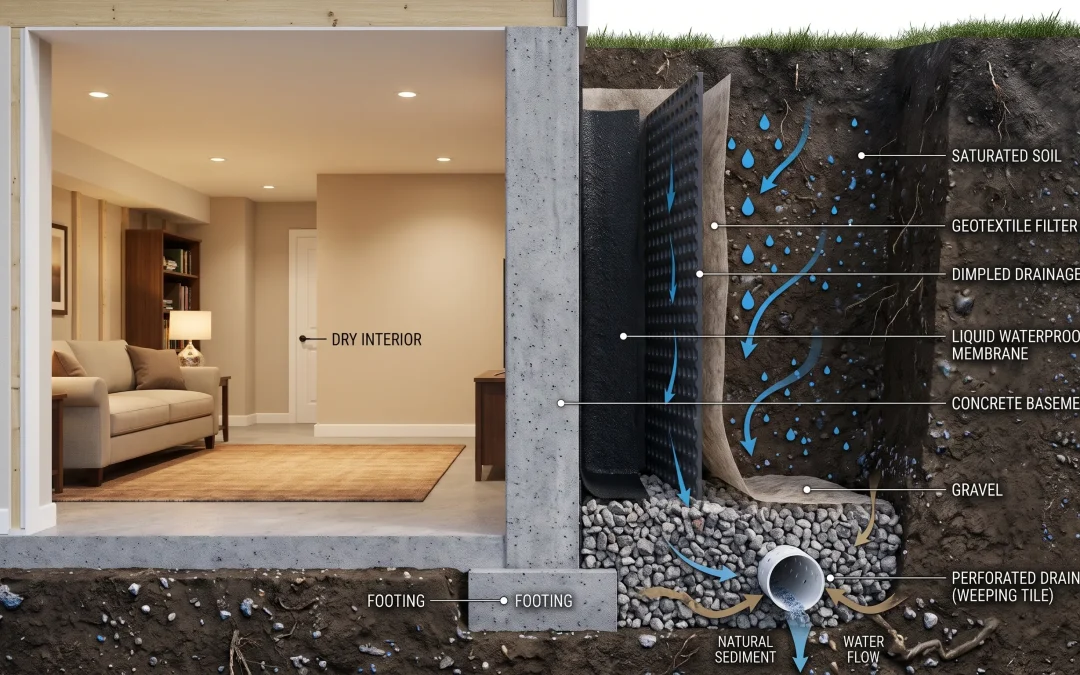
Basement waterproofing in Bangladesh blocks groundwater and monsoon seepage with an external membrane, joint waterstops, drainage, and a sump pump. New basements use positive-side membranes. Existing basements use crystalline coatings and PU injection grouting to resist hydrostatic pressure.
Understanding Basement Waterproofing in Construction
Basement waterproofing is the design and installation of membranes, coatings, joint seals, and drainage that stop water and moisture from entering below-grade walls and floor slabs. It protects concrete, steel reinforcement, and interior finishes from groundwater, capillary moisture, and soil gases.
What is basement waterproofing?
Basement waterproofing is the set of techniques and materials that prevents water from penetrating the basement of a house or building. A basement is one or more floors that sit completely or partially below the ground floor.
Why is waterproofing essential for underground structures?
Waterproofing is essential because groundwater exerts hydrostatic pressure on basement walls and slabs, and moisture corrodes reinforcement. Leaks also damage electrical systems, finishes, and stored goods. Corrosion eventually destroys the structural integrity of the concrete.
Waterproofing versus damp-proofing
Damp-proofing blocks soil moisture and capillary vapor. Waterproofing blocks liquid water under hydrostatic pressure. Damp-proofing fails once groundwater pushes against the wall, so basements in saturated soil require full waterproofing. Oak Ridge National Laboratory states that a damp-proof coating does not stop water under hydrostatic pressure.
| Feature | Damp-proofing | Waterproofing |
| Stops soil moisture and vapor | Yes | Yes |
| Resists hydrostatic pressure | No | Yes |
| Typical materials | Bituminous coating, polyethylene sheet | Sheet and liquid membranes, crystalline systems, PU |
| Suitable site | Dry sites with low water table | Sites with groundwater, poor drainage, or finished basements |
Oak Ridge recommends waterproofing for sites with anticipated water problems, poor drainage, or finished basement space.
Why Basement Waterproofing Is Important in Bangladesh
Basement waterproofing is important in Bangladesh because monsoon rainfall above 2,000 mm a year saturates soil, groundwater rises against below-grade walls, and the resulting hydrostatic pressure forces water through joints and cracks. Dhaka’s reclaimed marshland increases the risk.
High groundwater conditions
High groundwater keeps the water table close to basement levels in Bangladesh’s low-lying delta, especially during monsoon. A basement slab below that water table sits under constant pressure and requires full tanking. Low-lying geography and a tropical climate make water infiltration a major challenge for Bangladeshi buildings.
Monsoon rainfall and soil saturation
Monsoon rain saturates the soil around a basement and raises the water table within days. Saturated backfill pushes lateral pressure on walls and uplift pressure on slabs, and every crack, joint, and penetration becomes a leak path. Annual rainfall in Bangladesh averages over 2,000 mm.
Hydrostatic pressure on basement walls
Hydrostatic pressure grows with depth: each meter of water head adds 9.81 kPa. A 3 m deep basement below the water table carries about 29 kPa at the slab level, and walls resist that load every monsoon. Hydrostatic pressure increases with depth, so deeper water exerts higher pressure.
When groundwater rises above the bottom of the foundation, it pushes upward and can make the foundation partially buoyant. Structural design checks flotation, and waterproofing resists the water that reaches the concrete.
Common basement leakage problems
Basement leaks in Bangladesh come from 6 sources: cold joints, expansion joints, cracks, pipe penetrations, form-tie holes, and honeycombed concrete. Construction joints and details cause most leaks in concrete structures.
- Cold joints: Joints form where new concrete meets hardened concrete. Water travels along the interface under pressure unless a waterstop blocks the path.
- Expansion joints: Movement joints open and close with temperature and load. Rigid fillers crack, and unprotected gaps leak during monsoon.
- Cracks: Shrinkage and settlement cracks in walls and slabs let water seep through. Active cracks need PU injection, and structural cracks need epoxy.
- Pipe penetrations: Sleeves for water, sewer, and electrical lines break concrete continuity. Gaps around them leak without a sealed flange or hydrophilic strip.
- Form-tie holes: Holes left by formwork ties run through the full wall thickness. Each one needs plugging with non-shrink mortar or a sealing cone.
- Honeycombs: Poorly compacted concrete leaves voids and porous zones. Cutting out and patching with polymer-modified mortar restores watertight concrete.
Different Types of Basement Waterproofing Systems
Basement waterproofing systems fall into 8 types: external positive-side membranes, bituminous torch-on membranes, bentonite membranes, polyurethane liquid membranes, cementitious coatings, crystalline systems, integral admixtures, and injection grouting. Positive-side systems suit new construction. Negative-side systems suit repairs.
| System | Application side | Best use | Main limit |
| Positive-side membrane | Exterior | New walls and rafts | Needs excavation access |
| Torch-on bituminous | Exterior | Rafts, walls | Requires trained flame applicators |
| Bentonite | Exterior | Walls, slabs | Degrades with soil contaminants |
| PU liquid membrane | Exterior or interior | Complex details | Needs dry substrate and thickness control |
| Cementitious coating | Either side | Interior, tanks, pits | Cracks under movement |
| Crystalline | Either side | Repairs, below-water zones | Needs sound concrete |
| Integral admixture | Within concrete | New raft and walls | Does not seal joints |
| Injection grouting | Through cracks | Active leaks | Water finds new paths |
External positive-side membrane waterproofing
External positive-side membrane waterproofing places a continuous barrier on the soil-facing side of basement walls and under the raft before backfilling. It stops water before it reaches the concrete and resists hydrostatic pressure better than any other method. The membrane sits between the water source and the structure. IS 3067 states that waterproofing performs best on the water-facing side.
Manufacturers offer 2 membrane forms: prefabricated sheet and fluid-applied. Blindside membranes apply the membrane to the positive side on zero-lot-line projects. Dhaka plots built to the boundary line require blindside systems.
Bituminous torch-on membranes
Bituminous torch-on membranes are SBS or APP modified bitumen sheets, typically 3 to 4 mm thick, heat-fused to a primed substrate. Bangladeshi suppliers import them for basement rafts and walls from Turkey, Spain, and Russia. Fountech lists imports from Turkey, Spain, and Russia.
Self-adhesive HDPE bitumen membranes arrive as 1.5 mm sheets in 1 m by 20 m rolls for roofs, floors, and underground basements. Torch application requires trained crews, fire control, and sealed laps.
Bentonite waterproofing membranes
Bentonite waterproofing membranes sandwich sodium bentonite clay between geotextiles or panels. The clay swells on contact with water and forms a dense gel seal against the concrete. Corrosive chemicals in soil break down bentonite, which rules it out on contaminated sites.
Contractors also pump sodium bentonite slurry into the soil against existing foundations, which avoids excavation at lower cost. A soil and groundwater chemistry test precedes bentonite specification.
Polyurethane liquid membranes
Polyurethane liquid membranes are seamless coatings applied in 2 to 3 coats until the dry film reaches the specified thickness. They bridge hairline cracks, bond to concrete, and wrap around pits, corners, and pipe details. An Indian standards handbook lists 1.0 to 1.5 mm in 2 to 3 coats for PU liquid membranes. Basement specifications follow the manufacturer’s data sheet, which often requires more thickness.
Bangladeshi suppliers such as Insha Chemicals stock polyurethane waterproofing coatings for basement and retaining wall use.
Cementitious waterproofing coatings
Cementitious waterproofing coatings are polymer-modified cement slurries applied by brush or spray, usually in 2 coats. They bond rigidly to concrete and suit water tanks, lift pits, and interior wall treatments, but they crack where structures move. Basement wall waterproofing is a listed use for resin-and-cement products such as BASF MasterSeal.
Crystalline waterproofing systems
Crystalline waterproofing systems use reactive chemicals that penetrate concrete pores and grow insoluble crystals when moisture is present. Applied as slurry or mortar, they seal capillary pores and hairline cracks from either side of a wall. Crystalline mortars penetrate concrete pores and form a crystalline structure from the interior.
Integral concrete waterproofing admixtures
Integral concrete waterproofing admixtures are added to the concrete mix at batching and reduce permeability. They fall into 3 classes: densifiers, water repellents, and crystalline admixtures. These systems turn the concrete itself into a water barrier.
Injection grouting systems
Injection grouting pumps polyurethane, epoxy, or acrylic resin into cracks, joints, and voids to stop leaks. Hydrophilic PU foam seals flowing water, and low-viscosity epoxy bonds structural cracks. PU injection foam expands 5 to 25 times its volume on contact with water.
Basement Foundation Waterproofing Methods
Basement foundation waterproofing treats 6 components: raft foundation, basement walls, floor slab, construction joints, expansion joints, and pipe penetrations. Each component receives a matched detail: membrane under the raft, membrane on walls, and waterstops or sealants at every joint and penetration.
Raft foundation waterproofing
Raft foundation waterproofing lays a membrane over lean concrete blinding before the raft pour, then laps it up the wall formwork. Sheets overlap by the manufacturer’s minimum, and the raft concrete resists hydraulic pressure without defects. The Amphibia handbook specifies a minimum 5 cm overlap on lean concrete blinding.
Perforated pipes beneath the raft lower the groundwater table and relieve hydrostatic head. Dewatering wells serve the same purpose during construction.
Basement wall waterproofing
Basement wall waterproofing applies primer, membrane, and a protection layer to the external wall face from footing level to 15 cm above ground level. Retaining walls receive the membrane before backfilling. Vertical damp-proof layers extend at least 15 cm above ground level.
Basement floor slab waterproofing
Basement floor slab waterproofing combines a membrane beneath the slab with joint layouts that control cracking. Slabs are cast in bays or continuous strips with induced contraction joints, so cracks form in planned, protected positions. Minimum floor and wall thickness depends on basement depth and water table height.
Construction joint waterproofing
Construction joint waterproofing installs a waterstop across every joint where fresh concrete meets hardened concrete. PVC waterstops measure 102 to 305 mm (4 to 12 inches) wide, and hydrophilic strips swell on contact with water to close the gap. A waterstop is embedded in the concrete and obstructs water passage through the joint.
Expansion joint waterproofing
Expansion joint waterproofing uses PVC center-bulb waterstops and flexible sealants that stretch and compress with building movement. Mild steel, galvanized steel, and bentonite strips fail here because they cannot accommodate movement. Steel waterstops lack the elongation that expansion joints require.
Pipe penetration waterproofing
Pipe penetration waterproofing seals the gap around sleeves and conduits with a puddle flange, hydrophilic strip, or non-shrink grout, then covers the detail with membrane. Each penetration requires a detail matched to pipe geometry and expected movement. Pipes, sleeves, and conduits interrupt concrete continuity and create leakage paths.
Basement Drainage and Water Management
Basement drainage reduces water pressure instead of only blocking it. Perimeter drains, drainage boards, French drains, and sump pumps collect groundwater around the structure and discharge it away. Oak Ridge National Laboratory defines 3 lines of defense: surface drainage, subsurface drainage, and wall waterproofing.
Perimeter drainage systems
Perimeter drainage runs a 4-inch (100 mm) perforated pipe in a gravel bed at footing level around the basement, sloped toward a sump or outfall. The pipe intercepts groundwater before it builds pressure on the walls. Drain tile is a 4-inch perforated pipe set in a gravel bed at the footing and sloped to daylight or a sump.
French drains and drainage boards
A French drain is a gravel-filled trench with a perforated pipe that redirects groundwater away from a structure. A drainage board is a dimpled sheet fixed to the wall that protects the membrane and guides water down to the footing drain. A drainage board shields the membrane and lets water fall to the footing drain.
Sump pits and sump pumps
A sump pit collects drainage water below the slab, and a sump pump ejects it through a discharge line away from the building. Test the pump twice a year by pouring water into the pit, and replace it every 7 to 10 years. Pour water slowly into the pit until the pump switch activates. Replace the pump every 7 to 10 years even when it appears to work.
Groundwater pressure management
Groundwater pressure management lowers the water table around a basement with perforated pipes, dewatering wells, and pumps, which relieves the raft and walls of hydrostatic head. Designers pair it with a membrane. Membrane and perforated pipe arrangements lower the groundwater table to relieve the raft.
Basement Waterproofing Installation Process
Basement waterproofing installation follows 6 steps: site inspection and groundwater assessment, surface preparation, primer and membrane installation, joint and corner treatment, protection board and backfilling, and inspection with testing. The Daily Star reports that skipping cleaning, repairs, or priming almost guarantees problems.
Site inspection and groundwater assessment
Site inspection and groundwater assessment record water table depth, soil type, basement depth, and soil chemistry before material selection. Engineers log the highest monsoon water level, because that level sets the design hydrostatic head. Material selection considers water table level, hydrostatic head to resist, aggressive chemicals, and required internal dryness.
Surface preparation and concrete repair
Surface preparation removes laitance, oil, dust, and loose concrete, repairs honeycombs and cracks with polymer-modified mortar, and forms rounded internal corners. A sound, clean substrate lets the primer bond. Contractors cut out defective concrete to sound material and level the surface within the membrane manufacturer’s tolerance.
Primer and membrane installation
Primer and membrane installation starts with a primer coat that seals pores, followed by the membrane in full contact with the substrate. Liquid membranes cure in 2 to 3 coats to the specified thickness, and sheets overlap by the manufacturer’s minimum. PU liquid membranes apply in 2 to 3 coats. The Amphibia system requires 5 cm minimum overlap.
Joint and corner treatment
Joint and corner treatment reinforces the locations where membranes fail first: 25 mm cove fillets at wall-slab junctions, reinforcing tape or stripping layers over joints, and waterstop terminations at corners. Construction joints and details cause most leaks in concrete structures.
Protection board and backfilling
Protection board and backfilling shield the cured membrane from soil, stones, and compaction equipment. Fix a drainage board against the membrane, then backfill with granular material and compact in layers. Granular backfill fills the first 12 to 18 inches against the drainage board. The board protects the membrane.
Waterproofing inspection and testing
Waterproofing inspection and testing verify the system before backfill. ASTM D5957 covers flood testing of horizontal waterproofing, which ponds water on the membrane for 24 to 72 hours while inspectors check the underside for moisture. Visual checks cover laps, corners, and penetrations on vertical surfaces. Contractors repair every defect before backfill and document it with photographs.
Basement Waterproofing for Existing Buildings
Existing basements receive negative-side waterproofing from the inside because the exterior is backfilled and inaccessible. Repair combines leakage diagnosis, PU grouting for active leaks, epoxy for structural cracks, crystalline or cementitious interior coatings, and drainage. One remedial strategy seals active cracks with PU, repairs structural cracks with epoxy, reseals joints, and applies an internal membrane.
Negative-side waterproofing
Negative-side waterproofing is applied on the inside face of the basement, opposite the water source. It uses crystalline coatings, cementitious renders, plugging mortars, injection resins, and joint sealing. Negative-side systems include cementitious coatings, crystalline treatments, PU injection, epoxy injection, waterproof renders, and joint sealing.
Negative-side systems do not stop hydrostatic pressure from acting on the wall. Standard membranes are unsuitable on the negative side because external pressure disbonds them.
PU injection grouting
PU injection grouting drills angled holes across a crack, installs packers, and pumps polyurethane resin that reacts with water, expands, and seals the leak. One documented repair spaced injection ports every 16 inches (40 cm) before a crystalline coating. That repair placed ports every 16 inches and surfaced the wall with a capillary crystalline coating.
Water often finds another weak spot after crack injection, so contractors inspect adjacent joints and cracks after grouting.
Internal cementitious treatment
Internal cementitious treatment applies polymer-modified cementitious slurry or crystalline coating to prepared interior walls and slabs, usually in 2 coats, after hacking loose plaster and plugging active leaks with rapid-setting mortar. Sika lists single-component cementitious crystallisation slurry for negative-side ingress.
Waterproof paint fails on walls with white efflorescence deposits. Contractors remove efflorescence and old paint before coating.
Leakage diagnosis and repair
Leakage diagnosis traces each leak to its source: crack, joint, penetration, slab, or condensation. Technicians map wet areas, take moisture readings, test plumbing lines, and then select one repair per source.
- Active crack: Inject hydrophobic PU resin through packers to stop flow, then coat the wall with crystalline slurry to seal surrounding pores.
- Cold joint: Chase the joint open, plug it with rapid-setting mortar, and inject PU grout behind it to cut off the water path.
- Pipe penetration: Chip out the collar, seal it with hydrophilic strip and non-shrink grout, and coat the area with a flexible membrane.
- Slab seepage: Install perforated drainage pipe to a sump pit and apply crystalline coating on the slab surface.
- Wall dampness: Test for plumbing leaks and condensation first, remove salts, and apply a breathable cementitious coating.
Factors affecting project cost
Six factors drive basement waterproofing cost: area, depth, system type, access, surface condition, and brand with warranty. Water table level, hydrostatic head, and aggressive chemicals shape the material choice.
- Basement area: Total cost scales with treated square footage, including walls, slab, and joints.
- Depth and water head: Deeper basements below the water table require thicker membranes, stronger waterstops, and drainage.
- System type: Positive-side membranes, crystalline systems, and injection grouting carry different material and labor costs.
- Access and excavation: Exterior work requires excavation, shoring, and backfill, which add cost beyond interior treatment.
- Surface condition: Honeycombs, cracks, and efflorescence add repair work before the waterproofing starts.
- Brand and warranty: Branded systems with applicator warranties cost more than unbranded materials.
Residential basements in Dhaka typically cover one parking level. Commercial towers stack multiple basement levels, which multiplies wall area and joints.
How to Choose the Best Basement Waterproofing System
Choose a basement waterproofing system by 4 criteria: construction stage, groundwater conditions, material durability, and budget with maintenance. New basements take positive-side membranes, existing basements take crystalline coatings and injection grouting, and high groundwater adds drainage. Positive-side waterproofing is the optimal solution for new construction, and negative-side work is limited to repairs.
New construction versus existing basements
New construction uses positive-side membranes, waterstops, and drainage installed before backfill. Existing basements use negative-side crystalline systems and injection grouting from the inside. New construction allows comprehensive positive-side systems before backfilling, and renovation projects require negative-side or injection solutions where excavation is not feasible.
Groundwater conditions and basement depth
Groundwater height and basement depth set the hydrostatic head and the system grade. Basements with slabs below the water table require a bonded membrane, waterstops, and drainage; shallow basements above the water table use damp-proofing plus drainage. Oak Ridge recommends waterproofing wherever hydrostatic pressure occurs intermittently from rainfall. Measure water level in the monsoon peak, not the dry season.
Material durability and compatibility
Durability depends on soil chemistry, movement capacity, and layer compatibility. Bentonite degrades with some soil contaminants, rigid coatings crack under movement, and primers must match the membrane. Corrosive chemicals eliminate bentonite on some sites.
Budget and maintenance requirements
Budget covers installation plus lifetime maintenance. Positive-side membranes cost more to install and need less repair; negative-side systems cost less upfront and need more monitoring; sump pumps add recurring service. Positive-side access after backfilling requires excavation, which is disruptive and expensive. Compare 10-year totals, not the quotation price alone.
Common Basement Waterproofing Mistakes
Common basement waterproofing mistakes number 8, including skipping groundwater assessment, weak surface preparation, missing waterstops, wrong material selection, membrane damage during backfill, ignoring drainage, wrong-side membrane use, and skipped testing.
- Skipping groundwater assessment: Designing for dry-season water level underestimates monsoon head, so the membrane and slab face loads beyond design.
- Weakening surface preparation: Skipping cleaning, repairs, or priming almost guarantees later problems.
- Omitting waterstops: Joints stay unprotected, and construction joints cause most leaks in concrete structures.
- Selecting wrong materials: Bentonite breaks down in contaminated soil, and rigid coatings crack over moving joints.
- Damaging membranes during backfill: Stones and compaction rupture unprotected membranes, so drainage board and granular backfill protect the cured layer.
- Ignoring drainage: Without drains and sumps, pressure builds against the membrane, and sump pumps need correct sizing and backup power.
- Applying membranes on the negative side: External water pressure disbonds standard membranes from the interior face.
- Skipping testing: Untested horizontal membranes hide defects that only surface after backfill, when repair requires excavation.
Basement Waterproofing Maintenance and Inspection
Basement waterproofing maintenance requires an annual professional inspection and quarterly sump pump tests. Inspectors check walls, joints, drains, and pump operation, and technicians repair cracks before the monsoon. Routine inspections of sump pumps, drainage systems, and membranes catch issues before they become costly.
- Test the sump pump quarterly: Pour 5 gallons (about 19 liters) into the pit and confirm the pump activates, ejects the water, and shuts off.
- Clear the discharge line: Remove debris from the pit and discharge pipe, and test the check valve so water does not flow back into the pit.
- Inspect walls and slabs annually: Check for new cracks, damp patches, efflorescence, and rust stains, and mark crack widths to track movement.
- Check joints and penetrations: Examine expansion joint sealants and pipe collars for hardening, gaps, or seepage, and reseal them before the monsoon.
- Review drainage: Run a camera inspection of drain tile when drainage performance declines.
- Replace pumps on schedule: Replace the pump every 7 to 10 years.
- Install backup power: Fit a battery or water-powered backup so the pump runs during outages.
Frequently Asked Questions
What is the best basement waterproofing system in Bangladesh?
The best system for new basements in Bangladesh is a positive-side membrane (torch-on bituminous or PU liquid) combined with PVC or hydrophilic waterstops and perimeter drainage. Existing basements use crystalline coatings and PU injection grouting. System choice follows groundwater height, basement depth, and construction stage.
How much does basement waterproofing cost in Bangladesh?
Bangladesh has no unified published rate for basement waterproofing. US projects average $5 to $10 per square foot, and Indian basement projects run ₹120 to ₹300 per square foot. Obtain itemized local quotations listing system, brand, thickness, area, and warranty.
What is the difference between positive-side and negative-side waterproofing?
Positive-side waterproofing sits on the water-entry side of the structure, between the water source and the substrate. Negative-side waterproofing sits on the opposite face, inside the basement. Positive-side systems resist hydrostatic pressure directly. Negative-side systems repair existing basements when exterior excavation is not possible.
Can you waterproof an existing basement from the inside?
Yes. Interior waterproofing uses crystalline coatings, cementitious renders, plugging mortars, and PU or epoxy injection to seal leaks. Negative-side systems do not stop hydrostatic pressure acting on the wall, so contractors add drainage and a sump pump where water volume is high.
Does waterproof paint stop basement leaks?
No. Waterproof paint blocks surface moisture but fails under hydrostatic pressure. Oak Ridge states that a dampproof coating does not stop water under hydrostatic pressure. Paint also fails over efflorescence. Active leaks require injection grouting, crystalline coating, or a membrane.
When is the best time to waterproof a basement in Bangladesh?
The dry season, from November to March, is the best time to waterproof a basement in Bangladesh. Low groundwater and dry concrete let contractors excavate, prime, and apply membranes in dry conditions. Completing the work before monsoon starts in June protects the basement during peak groundwater.
Why do basement joints leak?
Basement joints leak because they are discontinuities in concrete where water pressure finds a path. Construction joints and details cause most leaks in concrete structures. PVC waterstops, hydrophilic strips, and flexible sealants close those paths, and the joint type determines which product applies.