

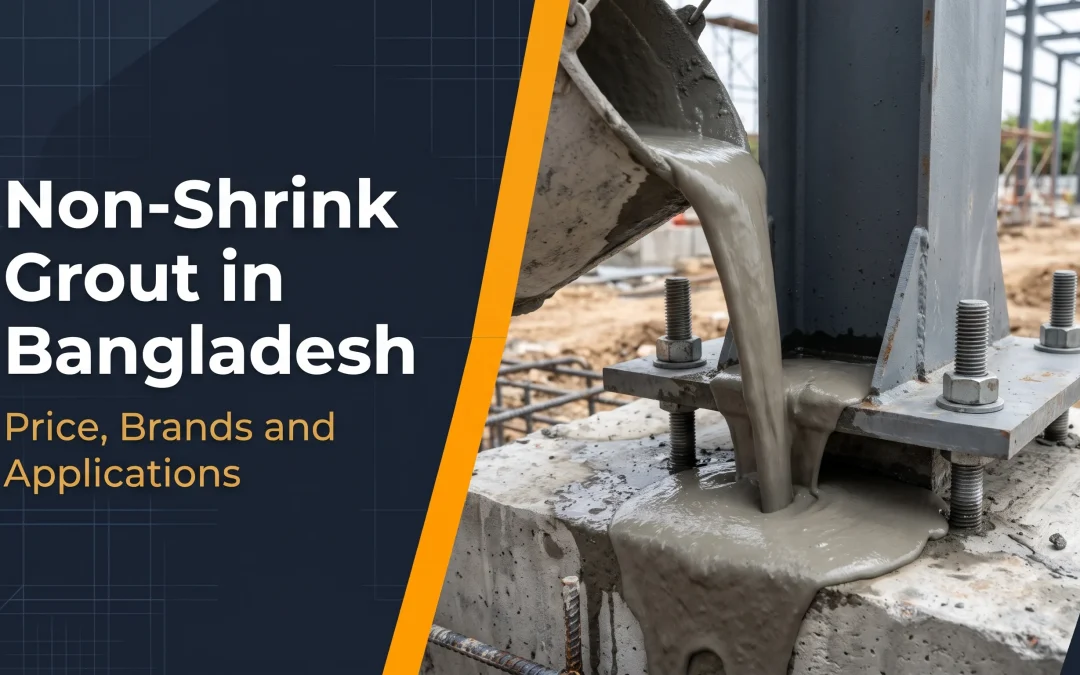
Non-shrink grout in Bangladesh costs ৳1,000–1,410 per 25–30 kg bag. Brands include Sika, Fosroc Conbextra GP2, Ducon, Emcekrete, MasterFlow 870, and ShaliGrout. Contractors buy it from distributors such as SS Corporation for machine foundations, base plates, anchor bolts, and structural voids.
What Is Non-Shrink Grout?
Non-shrink grout is a pre-blended, cement-based or epoxy grout that keeps or slightly exceeds its placed volume while hardening. It fills load-bearing gaps under base plates, machinery, anchor bolts, and precast joints without leaving voids or losing contact with the steel above.
Standard cement grout loses volume as water evaporates and cement hydrates. That shrinkage opens a gap under the steel plate. According to EMI Supply, the plate then bears on only part of the grout, stress concentrates, the grout cracks, and anchor bolts loosen over time.
Non-shrink grout controls volume with expansive agents and graded aggregates. Sika Bangladesh lists SikaGrout-214 BD as a two-stage expanding grout with expansion up to 4% under ASTM C1090. Fosroc reports 2–4% plastic-state expansion for Conbextra GP2 through a gaseous expansion system.
ASTM C1107 covers packaged dry hydraulic-cement grout and sorts non-shrink grouts into 3 grades. Grade A controls volume in the plastic stage, Grade B after hardening, and Grade C in both stages. EMI Supply states that cementitious grouts meeting ASTM C1107 reach at least 5,000 psi (about 34.5 MPa) at 28 days.
Non-shrink grout delivers 5 core properties, such as expansion, flowability, early strength, bond, and chloride-free chemistry:
- Expansion: Two-stage expanding systems offset plastic-stage and hardened-stage shrinkage. SikaGrout-214 BD expands up to 4% when tested under ASTM C1090 conditions.
- Flowability: Water content sets plastic, flowable, or fluid consistency. Sika’s flowable SikaGrout-214 BD mix uses 4.2–4.8 liters of water per 30 kg bag.
- Strength: SikaGrout-214 BD reaches at least 25 N/mm² at 1 day and 65 N/mm² at 28 days, which shortens equipment commissioning time.
- Bond: The grout adheres to steel and concrete. Sika reports tensile adhesion of at least 12 N/mm² at 7 days under ASTM C882.
- Chemistry: Chloride-free, non-metallic formulas protect anchor bolts and base plates from corrosion. Sika and Ducon both list chloride-free grout formulations.
Types of Non-Shrink Grout
The 3 main types of non-shrink grout are cementitious grout, epoxy grout, and high-strength precision grout. Cementitious grout handles static loads, epoxy grout resists vibration and chemicals, and precision grout delivers 55–69 MPa for machinery with tight alignment tolerances.
Cementitious Non-Shrink Grout
Cementitious non-shrink grout is a Portland cement-based powder that you mix with water on site. It suits static and light dynamic loads, such as pumps, compressors, generators, and column bases, and reaches 65–72 MPa at 28 days in grades like SikaGrout-214.
- Consistency: Water content sets the mix. Plastic grout packs shallow gaps, flowable grout fills base plates, and fluid grout travels long distances from a head box.
- Thickness: Most grades fill 10–100 mm gaps per pour. Thicker pours take coarse aggregate up to 40% of powder weight, per Sika, to control heat.
- Cost: Cementitious grades list at ৳40–54 per kilogram in Bangladesh, which sits far below the per-kilogram price of epoxy grout, so general base plates use cementitious grout.
Epoxy Grout
Epoxy grout is a multi-component resin system that resists heavy vibration, impact, and chemical attack. It suits turbines, heavy presses, and chemical plants, reaches 80–100+ MPa in compressive strength, and costs far more per kilogram than cementitious grout.
- Loading: Epoxy grout carries heavy dynamic loads from vibration and impact, according to Tremco Australia, while cementitious grout suits static or light dynamic loads.
- Creep: Epoxy grout shows near-zero creep, which keeps precision-aligned machinery stable under sustained load, according to ibeam, and it holds alignment on turbines and presses.
- Price: Fosroc Conbextra EP75 epoxy grout lists at ৳1,240 per 1 kg pack in Bangladesh, about 23–31 times the per-kilogram price of cementitious bags.
High-Strength Precision Grout
High-strength precision grout is a cementitious non-shrink grout engineered for tight volume control and 55–69 MPa compressive strength. Contractors choose it for pumps, compressors, turbines, crane rails, and bridge bearings that need exact alignment and long-term load transfer.
- Strength: EMI Supply puts precision grades at 8,000–10,000 psi or more at 28 days. Ducon NS Grout lists at least 70 MPa, and ShaliGrout 73 reaches about 72 MPa.
- Flow retention: Precision grouts hold fluid flow longer, which fills large base plates in one continuous placement.
- Sensitivity: These grouts react strongly to water and temperature. Sika limits ambient and substrate temperature to +5°C to +40°C and prohibits extra water.
Applications of Non-Shrink Grout
The 4 main applications of non-shrink grout are machine foundation grouting, base plate grouting, anchor bolt grouting, and structural void filling. Each application transfers load through a gap, so volume stability decides how long the installation performs at full capacity.
Machine Foundation Grouting
Machine foundation grouting fills the gap between a pre-aligned machine soleplate and the concrete foundation. Cementitious grout supports pumps, compressors, and generators, while epoxy grout supports turbines and heavy presses that carry high dynamic loads from vibration and impact.
- Align: Pre-align the soleplate on shims, then fill the space beneath it with grout so the foundation carries the machine load, as Tremco Australia describes.
- Select: Choose cementitious grout for static or light dynamic loads and epoxy grout for heavy vibration, impact, or chemical exposure.
- Match: Sika lists turbine, compressor, boiler, and pump base plates for SikaGrout-214. Fosroc lists turbines, compressors, and boiler feed pumps for Conbextra GP2.
Base Plate Grouting
Base plate grouting fills the space between a steel base plate and its concrete foundation so the load spreads evenly. Pour flowable grout continuously from one side, hold a steady head of pressure, and keep air from becoming trapped.
- Form: Build rigid, watertight formwork about 25 mm beyond the plate edge, with a head box on the pour side, as Laticrete and EMI Supply instruct.
- Pour: Place grout continuously from one side or corner so air escapes ahead of the flow. Pouring from two sides traps air under the plate.
- Finish: Cut the exposed grout shoulder at 45° from the plate base before final set so the load transfers uniformly to the foundation.
Anchor Bolt Grouting
Anchor bolt grouting fixes bolts, dowels, masts, and posts into concrete pockets and drilled holes with flowable non-shrink grout. Fosroc instructs installers to grout the bolt pockets first, before the space under the base plate, so the bolts hold position.
- Clean: Remove dust, oil, and loose material from bolt holes and pockets, then pre-soak the concrete and remove standing water, per the Ducon NS Grout data sheet.
- Grout: Fill the bolt pockets first, then grout between the plate and the foundation, following Fosroc’s Conbextra GP instructions, so the bolts stay locked before the plate load arrives.
- Specify: Pick a grade rated for fixings. Sika lists anchors and post fixings, Ducon lists bolts, dowels, masts, and fence posts, and Fosroc lists masts, anchor bolts, and fence posts.
Structural Void Filling
Structural void filling packs non-shrink grout into cavities, gaps, and joints in concrete, such as precast column joints, core-cut holes, and retrofit jackets. SikaGrout-214 fills voids from 10 mm to 100 mm in a single pour, per Sika Bangladesh.
- Fill: Grout precast column joints, cavities, gaps, and penetration seals with SikaGrout-214, matching the uses that Sika Bangladesh lists, and keep the pour between 10 mm and 100 mm.
- Retrofit: Pack grout into column jacketing, steel-frame bracing, beam jacketing, and beam insertion details, as a JICA retrofitting report shows.
- Avoid: Skip patch repair. Sika states that SikaGrout-214 serves grouting only, so choose a repair mortar for surface patches, spalls, and shallow defects in concrete.
Best Non-Shrink Grout Brands in Bangladesh
The 6 leading non-shrink grouts in Bangladesh are Sika Grout 214 IN, SikaGrout-214 BD, Emcekrete, Ducon NS Grout, MasterFlow 870, and ShaliGrout 73. Each product delivers high-strength, shrinkage-compensated grouting for machine bases, base plates, anchor bolts, and precast joints.
SS Corporation distributes Fosroc Conbextra GP2 as an authorized distributor of Berger Fosroc Limited. Conbextra GP2 reaches 65 N/mm² at 28 days in flowable consistency and fills gaps up to 100 mm, so the tables below include it as a reference grade.
Sika Grout 214 IN
SikaGrout-214 IN is a cement-based, one-component, two-stage expanding pouring grout in 30 kg bags. It reaches at least 65 N/mm² at 28 days, expands up to 4%, and grouts bearings, machine foundations, anchors, and voids up to 100 mm.
- Measure: Mix 4.5–4.8 liters of water per 30 kg bag for flowable consistency or 4.2 liters for pourable consistency, per the December 2025 Sika data sheet.
- Place: Pour within the 20-minute pot life at 30°C, and finish placing within 15 minutes to use the expansion system fully.
- Budget: Allow ৳1,200–1,410 per 30 kg bag, or ৳40–47 per kilogram, based on Bangladeshi distributor listings, and request a project quote for larger volumes.
SikaGrout-214 BD
SikaGrout-214 BD is Sika Bangladesh’s expanding pouring grout, documented in a September 2025 data sheet. It ships in 30 kg bags of gray powder, reaches at least 65 N/mm² at 28 days, and expands up to 4% under ASTM C1090 testing.
- Compare: Pot life reaches about 30 minutes at 30°C, versus about 20 minutes for the 214 IN grade, which gives crews more time on large base plates.
- Mix: Use 4.2–4.8 liters of water per 30 kg bag for flowable grout and 3.9–4.2 liters for pourable grout. Never add extra water.
- Specify: Sika rates the grade for temperatures from above 0°C to 200°C and recommends 20–100 mm per pour, with a 10 mm minimum.
Emcekrete
Emcekrete is MC-Bauchemie’s German range of ready-to-use, highly flowable, shrink-compensated grouting mortars that you mix with water only. The range spans 5 grades, such as Emcekrete 50 A, 60 F, 70 F, 100 F, and the fast-setting DBS 5-F.
- Choose: Pick Emcekrete 50 A for slow-hardening grouting concrete, 60 F for universal grouting, and 70 F or 100 F for high strength with outstanding flowability.
- Time: Plan 3–5 minutes of working time at 20°C for Emcekrete DBS 5-F, a flash grout with extremely high early strength.
- Verify: Request the technical data sheet from your importer, because each Emcekrete grade lists different working times and strength values.
Ducon Grout NS
Ducon NS Grout is a single-component, free-flow, non-shrink cementitious grout made by Ducon Construction Chemicals Industries Ltd. in Gazipur. Its data sheet lists at least 30 MPa at 1 day, at least 70 MPa at 28 days, and 25 kg bags.
- Mix: Combine each 25 kg bag with 4.5 liters of clean water, a water-to-powder ratio of 0.18, using a slow-speed mechanical mixer.
- Place: Work within the 25–30 minute working time, and pour within 15–20 minutes of mixing to gain the full controlled-expansion benefit.
- Price: Ducon lists NS Grout at ৳1,000 per 25 kg set on its product price page, which equals ৳40 per kilogram of grout.
MasterFlow 870
MasterFlow 870 is a cementitious, high-strength, non-shrink precision grout for clearances of 10 mm or more. Sika’s product site now lists it as SikaGrout-870, formerly MasterFlow 870, and states ASTM C1090 and CRD-C 621 compliance for non-shrink performance.
- Place: Pour the extended-working-time mix even at high ambient temperatures, often without a pump, because the grout stays flowable in large placements.
- Mix: Use a standard concrete mixer or a pail with a grout stirrer, since the product needs no special mixing equipment.
- Verify: Check the tested standards: ASTM C1090, CRD-C 621, and AS 1478.2. The grout adds no chloride to the structure.
ShaliGrout 73
ShaliGrout 73 is STP Limited’s single-component, free-flow, non-shrink, high-strength grout with a natural aggregate system and a shrinkage-compensating binder. Its 70 mm cube strength reaches 730 kg/cm² (about 72 MPa) at 28 days and ships in 30 kg bags.
- Mix: Blend 30 kg with 4.80 liters of water for flowable consistency or 4.50 liters for pourable consistency, according to the STP data sheet.
- Track: Expect 300 kg/cm² at 1 day, 550 at 3 days, and 650 at 7 days, which equals about 29, 54, and 64 MPa.
- Anchor: Use it for masts, anchor bolts, and fence posts as well as machinery grouting, as STP’s data sheet lists.
Non-Shrink Grout Price in Bangladesh
Cementitious non-shrink grout costs ৳1,000–1,410 per 25–30 kg bag in Bangladesh, or ৳40–54 per kilogram. Ducon NS Grout lists at ৳1,000, Sika Grout 214 IN at ৳1,200–1,410, and Fosroc Conbextra GP2 at ৳1,100–1,350, depending on distributor and order size.
| Product | Bag size | Listed price | Price per kg |
| Ducon NS Grout | 25 kg | ৳1,000 | ৳40 |
| Sika Grout 214 IN | 30 kg | ৳1,200–1,410 | ৳40–47 |
| Fosroc Conbextra GP2 | 25 kg | ৳1,100–1,350 | ৳44–54 |
| Fosroc Conbextra EP75 (epoxy) | 1 kg | ৳1,240 | ৳1,240 |
| SikaGrout-214 BD, Emcekrete, MasterFlow 870, ShaliGrout 73 | 25–30 kg | Quote on request | Quote on request |
Prices come from Ducon’s product price page and Bangladeshi distributor listings reviewed in November 2026. Importers revise prices with exchange rates, so confirm the current rate before ordering.
5 factors move non-shrink grout prices, such as grade, pack size, brand, performance level, and delivery location:
- Grade: Epoxy grout costs ৳1,240 per kilogram for Conbextra EP75, against ৳40–54 per kilogram for cementitious bags, a gap of roughly 23 to 31 times.
- Pack size: Ducon and Fosroc sell 25 kg bags, while Sika and ShaliGrout sell 30 kg bags, so compare the price per kilogram.
- Brand: Imported grades such as Sika 214 IN and Fosroc Conbextra GP2 price differently from Ducon, which manufactures in Gazipur.
- Performance: Precision grades with higher strength and longer flow retention carry higher prices than general-purpose cementitious grades, so match the grade to the equipment load.
- Delivery: SS Corporation delivers to Dhaka, Savar, Narayanganj, Gazipur, Chattogram, Cox’s Bazar, Khulna, Sylhet, and Barishal, so quotes include the destination.
3 supplier channels sell non-shrink grout in Bangladesh, such as manufacturers, authorized distributors, and online construction-chemical shops:
- Manufacturers: Sika Bangladesh Limited operates from Impetus Center, 242/B, Tejgaon-Gulshan Link Road, Dhaka-1208, and Ducon operates a Mirpur DOHS office with a Gazipur factory.
- Distributors: SS Corporation, an authorized distributor of Berger Fosroc Limited, supplies Conbextra GP2 and other Fosroc grouts from bulk quantities to small orders.
- Online shops: Bangladeshi construction-chemical websites list Sika, Fosroc, and ShaliGrout grades with prices, but stock and pack sizes change by seller.
Comparison of Non-Shrink Grout Products
ShaliGrout 73, Ducon NS Grout, SikaGrout-214 BD, and Fosroc Conbextra GP2 differ in 28-day strength (65–72 MPa), working time (25–30 minutes), and water demand (0.14–0.18 water-to-powder ratio). The table below compares all 5 grades, including Sika Grout 214 IN.
| Product | Bag | 1-day strength | 28-day strength | Water-to-powder ratio | Working time | Price per kg |
| SikaGrout-214 BD | 30 kg | ≥25 N/mm² | ≥65 N/mm² | 0.14–0.16 (flowable) | ~30 min at 30°C | Quote |
| Sika Grout 214 IN | 30 kg | ≥25 N/mm² | ≥65 N/mm² | 0.15–0.16 (flowable) | ~20 min at 30°C | ৳40–47 |
| Fosroc Conbextra GP2 | 25 kg | 24 N/mm² | 65 N/mm² | 0.18 (flowable) | Expansion starts at 20 min, ends at 120 min | ৳44–54 |
| Ducon NS Grout | 25 kg | ≥30 MPa | ≥70 MPa | 0.18 | 25–30 min | ৳40 |
| ShaliGrout 73 | 30 kg | ~29 MPa | ~72 MPa | 0.16 (flowable) | Not listed | Quote |
MasterFlow 870 and Emcekrete stay out of the table because public product pages list no strength figures for MasterFlow 870, and Emcekrete values differ by grade. MasterFlow 870 grouts clearances of 10 mm or more, and Emcekrete spans slow-hardening to flash-setting grades.
4 selection rules follow from the numbers, such as working time, early strength, cost per kilogram, and load type:
- Pick SikaGrout-214 BD or Ducon NS Grout for large base plates, since SikaGrout-214 BD gives about 30 minutes and Ducon NS Grout gives 25–30 minutes of working time.
- Pick Ducon NS Grout for the fastest return to service, since it lists at least 30 MPa at 1 day.
- Pick Ducon NS Grout or Sika Grout 214 IN for large volumes, since both start at ৳40 per kilogram, which cuts material cost on multi-bag pours.
- Pick epoxy grout, not cementitious grout, for turbines, heavy presses, and chemical exposure, since epoxy resists vibration, impact, and chemicals better than cement-based products.
Technical Specifications and Performance
Cementitious non-shrink grouts in Bangladesh reach 65–72 MPa at 28 days, expand up to 4%, fill 10–100 mm gaps, and need +5°C to +40°C working conditions. SikaGrout-214 BD adds 9 N/mm² flexural strength and 37,000 N/mm² elastic modulus.
| Property | SikaGrout-214 BD | Fosroc Conbextra GP2 | Ducon NS Grout |
| Compressive strength (1 / 3 / 7 / 28 days) | ≥25 / 35 / 45 / 65 N/mm² | 24 / 45 / 55 / 65 N/mm² | ≥30 MPa at 1 day, ≥70 MPa at 28 days |
| Flexural strength (28 days) | ≥9 N/mm² | 10 N/mm² | 10 MPa |
| Expansion | Up to 4% (ASTM C1090) | 2–4% in the plastic state | Gaseous expansion system |
| Layer thickness | 10–100 mm | Up to 100 mm | See data sheet |
| Fresh density | 2,000–2,300 kg/m³ | About 2,220 kg/m³ | See data sheet |
| Elastic modulus | About 37,000 N/mm² | 28 kN/mm² | See data sheet |
| Water | 4.2–4.8 L per 30 kg | W/P 0.18 | 4.5 L per 25 kg |
| Shelf life | 6 months | See data sheet | 12 months |
Water content controls strength. EMI Supply states that extra water improves flow but lowers strength, and water above the bag limit causes bleeding, segregation, and shrinkage. Don’t eyeball the water. Measure every bag.
6 standards define non-shrink grout performance, such as ASTM C1107, C1090, C109, C882, C469, and C230:
- ASTM C1107: Sets requirements for packaged dry hydraulic-cement non-shrink grout and defines Grades A, B, and C by when volume control occurs.
- ASTM C1090: Measures height change in cylindrical grout specimens, which verifies that the grout does not shrink after placement. Sika quotes expansion up to 4% for SikaGrout-214 BD.
- ASTM C109: Measures compressive strength on cube specimens. Sika reports SikaGrout-214 BD results on 70.6 mm and 50 mm cubes at 1, 3, 7, and 28 days.
- ASTM C882: Measures tensile adhesion, also called bond strength, between grout and substrate. Sika reports at least 12 N/mm² at 7 days for SikaGrout-214 BD.
- ASTM C469: Measures elastic modulus in compression, which describes how stiff the hardened grout is. Sika reports about 37,000 N/mm² for SikaGrout-214 BD.
- ASTM C230: Governs flow measurement for hydraulic cement mixtures. Sika reports a flow cone result of at least 200 mm for SikaGrout-214 and lists the method as ASTM C230/230M.
How to Apply Non-Shrink Grout
Apply non-shrink grout in 8 steps: prepare the surfaces, pre-soak the concrete, build the formwork, measure the water, mix for 3 minutes, pour from one side, cure with wet hessian, and trim the grout shoulder at a 45° angle.
- Prepare: Remove oil, grease, rust, laitance, and loose particles from concrete and steel. Sika requires concrete pull-off strength of at least 1.0 MPa.
- Pre-soak: Keep the concrete wet for 2–6 hours to reach a saturated surface-dry state, then remove all standing water from the formwork.
- Build: Set rigid, watertight formwork with a head box on the pour side and about 25 mm of clearance around the plate edge.
- Measure: Add exact water: 4.2–4.8 liters per 30 kg bag of SikaGrout-214 BD or 4.5 liters per 25 kg bag of Ducon NS Grout. Add no extra water.
- Mix: Put 80–90% of the water in the drum first, add the powder, then add the balance. Mix at least 3 minutes with a drill under 500 rpm.
- Pour: Place grout right after mixing, continuously from one side. Finish within 15 minutes to use the expansion, and let displaced air escape.
- Cure: Keep exposed grout surfaces small and moist right after placement. Cover them with wet hessian to stop premature drying.
- Trim: Cut the exposed grout shoulder at 45° just before final set so the load transfers uniformly from the plate to the foundation.
Weather and thickness change the method. Use chilled water in high ambient temperatures and hot water in very low temperatures, per Sika. Pours thicker than 100 mm need iced water, coarse aggregate up to 40% of powder weight, or both. For large bedding holes, mix 6 mm washed aggregate with the grout at a 2:1 weight ratio.
How to Calculate Non-Shrink Grout Quantity
Grout quantity equals length × width × thickness, multiplied by the product’s consumption rate and divided by bag weight. SikaGrout-214 BD consumes about 1,950 kg per m³, so one 30 kg bag fills roughly 0.0154 m³, or 15.4 liters.
5 steps produce a bag count, such as measuring, multiplying, converting, adding waste, and dividing:
- Measure: Record the length, width, and gap thickness of the grout space in meters, measured from the actual formwork rather than the drawing.
- Multiply: Calculate the volume in cubic meters as length × width × thickness, for example 0.6 m × 0.6 m × 0.05 m for one base plate.
- Convert: Multiply the volume by the consumption rate, 1,950 kg per m³ for SikaGrout-214 BD at a 0.15 water-to-powder ratio.
- Add: Include 10–20% waste for overflow, uneven surfaces, formwork leakage, and void filling, since calculators for base plate grouting apply the same range.
- Divide: Split the total weight by the bag weight, 30 kg for Sika or 25 kg for Fosroc and Ducon, then round up to whole bags.
Take a 600 mm × 600 mm base plate with a 50 mm gap. Volume equals 0.6 × 0.6 × 0.05, or 0.018 m³. Multiply by 1,950 kg per m³ for 35.1 kg. Add 15% waste for 40.4 kg. Divide by 30 kg for 1.35 bags. Order 2 bags.
| Gap thickness | Volume | Grout weight | With 15% waste | Bags (30 kg) |
| 25 mm | 0.009 m³ | 17.6 kg | 20.2 kg | 1 |
| 50 mm | 0.018 m³ | 35.1 kg | 40.4 kg | 2 |
| 100 mm | 0.036 m³ | 70.2 kg | 80.7 kg | 3 |
Fosroc Conbextra GP2 lists a fresh wet density of about 2,220 kg/m³ at a 0.18 water-to-powder ratio. Divide 2,220 by 1.18 to get about 1,881 kg of powder per m³, then follow the same steps with 25 kg bags.
Frequently Asked Questions
Non-shrink grout questions in Bangladesh center on use, price, pour thickness, water ratio, strength gain, and shelf life. The 8 answers below cover base plates, ৳40–54 per kilogram pricing, 100 mm pour limits, tile grout, epoxy grout, and curing.
What is non-shrink grout used for?
Non-shrink grout is used for filling load-bearing gaps under base plates, machine foundations, bearings, and precast column joints, and for fixing anchor bolts, masts, and fence posts. Sika Bangladesh lists these uses for SikaGrout-214. The grout keeps its volume, so the plate stays in full contact with the foundation.
How much does non-shrink grout cost in Bangladesh?
Non-shrink grout costs ৳1,000–1,410 per 25–30 kg bag, or ৳40–54 per kilogram. Ducon NS Grout lists at ৳1,000, Sika Grout 214 IN at ৳1,200–1,410, and Fosroc Conbextra GP2 at ৳1,100–1,350. Epoxy grouts cost far more per kilogram, and exchange rates change import prices.
How thick can you pour non-shrink grout?
Pour 10–100 mm of cementitious non-shrink grout per layer. Sika’s data sheet sets a 10 mm minimum, a 20–100 mm recommended range, and a 100 mm maximum. Thicker sections need iced water, coarse aggregate up to 40% of powder weight, or both to control the temperature rise.
What water-to-powder ratio does non-shrink grout use?
Water-to-powder ratio runs 0.13–0.18 by weight, depending on the product and consistency. SikaGrout-214 BD uses 0.14–0.16 for flowable grout, while Ducon NS Grout and Fosroc Conbextra GP2 use 0.18. Extra water lowers strength and causes bleeding, so measure each bag’s water exactly.
Is non-shrink grout the same as tile grout?
No. Non-shrink grout is a structural, load-transferring cement or epoxy product for base plates, machinery, and anchors, while tile grout fills joints between tiles. Tile grout is not formulated for the expansion system, the 65–72 MPa strength, or the ASTM C1107 compliance that structural non-shrink grout carries.
How long does non-shrink grout take to gain strength?
SikaGrout-214 BD reaches at least 25 N/mm² in 1 day, 45 N/mm² in 7 days, and 65 N/mm² in 28 days. Ducon NS Grout lists at least 30 MPa at 1 day. Keep exposed surfaces moist with wet hessian during curing to protect strength gain.
Which is better: cementitious or epoxy non-shrink grout?
Cementitious grout suits static and light dynamic loads, such as pumps, compressors, and column bases. Epoxy grout suits turbines, heavy presses, and chemical plants because it resists vibration, impact, and chemicals. Epoxy costs far more, so choose cementitious grout unless the load or exposure demands epoxy.
What is the shelf life of non-shrink grout?
Shelf life is 6 months for SikaGrout-214 BD and 12 months for Ducon NS Grout, counted from the production date. Store bags unopened and sealed in a dry place, because moisture starts cement hydration inside the bag and ruins the powder.