

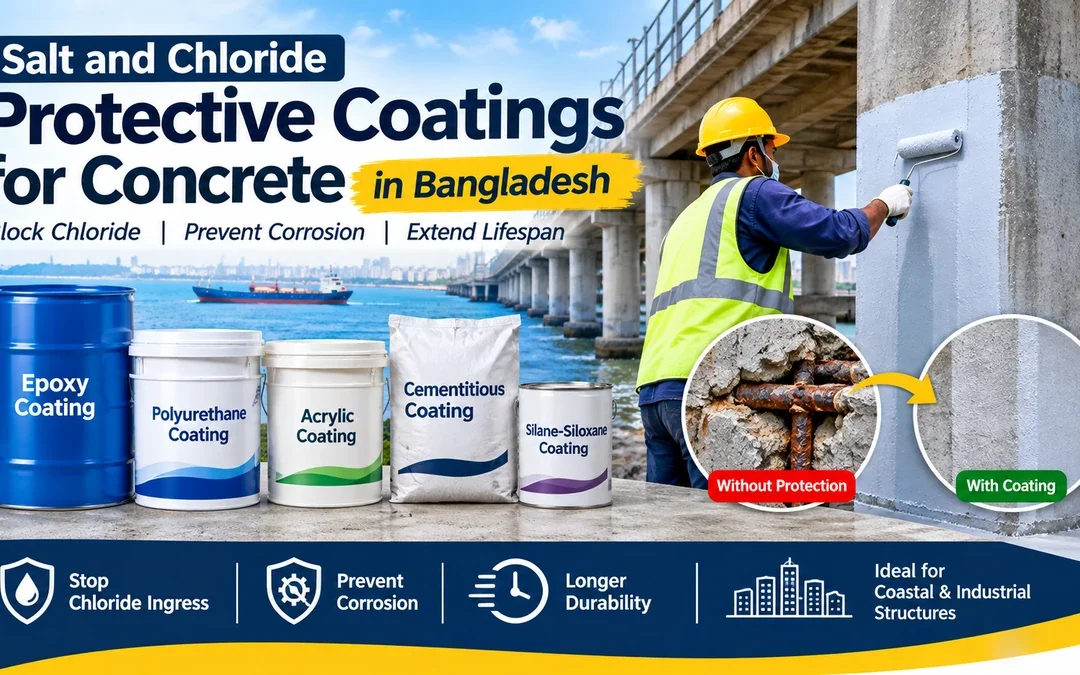
Salt and chloride protective coatings for concrete in Bangladesh are epoxy, polyurethane, acrylic, cementitious polymer-modified, and silane-siloxane systems that block chloride ions, water, and carbon dioxide from reaching rebar, stopping corrosion, cracking, and spalling in coastal, industrial, and monsoon-exposed structures.
What Are Salt and Chloride Protective Coatings for Concrete?
A salt and chloride protective coating is a surface-applied film or impregnation that blocks chloride ions, moisture, and carbon dioxide from entering concrete. Coatings form a barrier on the surface (epoxy, polyurethane, acrylic) or line the pores (silane, siloxane).
Understanding chloride-resistant coatings
Chloride-resistant coatings are polymer or polymer-modified cement products that reduce chloride diffusion into concrete. Manufacturers certify them under EN 1504-2, the European standard for surface protection systems on concrete. Film-forming coatings (epoxy, polyurethane, acrylic, polymer-modified cement) sit on the surface. Impregnations (silane, siloxane) penetrate the pores and repel water without forming a film.
How protective coatings prevent chloride ingress
Coatings stop chloride ingress through 3 mechanisms: a continuous film blocks ion transport, a water-repellent pore lining rejects chloride-bearing water, and added thickness increases the effective concrete cover. A 2024 MDPI review of surface-coated concrete calls coating an affordable, simple, and robust strategy. Fosroc Brushbond cut accelerated carbonation depth from 1.5 mm uncoated to 0 mm in NT Build 372 testing.
How Do Salt and Chlorides Damage Concrete Structures?
Chloride ions penetrate concrete through capillary pores, break down the passive oxide film on rebar once content reaches 0.2% to 0.4% by mass of cement, and start pitting corrosion. Corrosion products expand, crack the cover, and cause spalling and delamination.
Chloride penetration into concrete
Concrete is porous, and chloride ions travel through capillary pores and the free-water channels left after cement hydration, according to The Daily Star. Seawater supplies most chloride in Bangladesh. The same source reports that concrete made with burnt clay brick aggregate shows more chloride ingress than concrete made with stone chips, while slag cement forms a denser microstructure that slows ingress.
Reinforcement corrosion mechanism
Pore water in sound concrete holds a pH of 12 to 14, which keeps a passive oxide film on rebar (ACI). Chloride ions destroy that film once chloride reaches 0.2% to 0.4% by mass of cement, according to the Institute of Corrosion (ICorr). Corrosion then advances in 3 steps: depassivation, localized pitting at the bar surface, and rust expansion that pushes against the cover.
Concrete cracking, spalling and delamination
Rust occupies more volume than the steel it replaces. The expansion stresses the concrete cover and produces 3 damage patterns: cracks along the bar, spalls where cover pieces detach, and delamination where layers separate parallel to the surface. Delaminated areas sound hollow when tapped, according to a 2008 IIBEC Interface article, even where the surface looks intact.
Difference between chloride attack and carbonation
Chloride attack depassivates rebar through ions; carbonation depassivates rebar through pH loss. Sika names the two as the most common causes of reinforcement corrosion. Atmospheric carbon dioxide reacts with calcium hydroxide, lowers pore-water pH from 12-14 to about 9, and advances about 1 mm per year in typical concrete, according to ACI. Phenolphthalein turns pink above pH 9 and maps the carbonation front. Chloride attack leaves pH high and causes localized pitting. Carbonation also releases bound chlorides, so combined exposure corrodes rebar faster (World Stainless).
Why Is Concrete Protection Important in Bangladesh?
Bangladesh exposes concrete to seawater chlorides on the Bay of Bengal coast, saline groundwater, industrial effluents, and monsoon humidity. According to The Daily Star, airborne chlorides travel several kilometers inland, so coatings protect structures far beyond the shoreline.
Coastal and marine environments
The Daily Star identifies seawater as the main chloride source in Bangladesh. Researchers at the Chittagong University of Engineering and Technology (CUET) mapped chloride concentration in the submerged, tidal, and splash zones of the coast and classed severity with GIS. They compared international durability standards with the 2015 draft of the Bangladesh National Building Code (BNBC). Mott MacDonald’s 2018 coastal survey for the AsCAP program recommended concrete mix limits by exposure class.
Saline groundwater and coastal infrastructure
Saline groundwater in coastal districts such as Khulna, Satkhira, and Bagerhat wicks into foundations, plinths, and ground-floor walls. Capillary rise carries dissolved chlorides upward, and evaporation concentrates salt at the surface. Islamic University of Technology (IUT) researchers tested cement-coated steel bars and measured higher corrosion as seawater content in the coating increased, which indicates coating degradation from chloride damage.
Industrial and wastewater facilities
Industrial plants, effluent treatment plants, and sewage structures expose concrete to chlorides, sulfates, acid gases, and chemicals. Sikagard-62, a 2-part epoxy, forms a chemical-resistant layer on concrete and lines storage tanks and silos. MC-RIM Protect targets concrete surfaces in sewage structures. Sikagard-2406 Protection lists EN 1504-2 principle 6, resistance to chemicals.
Monsoon and humid environmental conditions
Bangladesh is a tropical country, so monsoon rain and humidity keep concrete pores wet for months. Wet pores carry chloride ions inward, and drying cycles concentrate salts near the surface. Manzur et al. (BUET and Ryerson University) report that strength-based design dominates Bangladeshi practice and that low-to-moderate strength reinforced concrete faces the highest corrosion risk. Their modeling shows Portland composite cement (PCC) resists chloride penetration better than ordinary Portland cement (OPC).
What Types of Salt and Chloride Resistant Coatings Exist?
Salt and chloride resistant coatings fall into 5 types: epoxy, polyurethane, cementitious polymer-modified, silane and siloxane impregnation, and anti-carbonation coatings. Each type blocks chloride transport by a different mechanism: a rigid film, an elastic film, a mineral layer, a pore lining, or a gas barrier.
- Epoxy protective coatings: Form a rigid, high-build film that nearly eliminated chloride penetration in Wisconsin DOT tests, but lose aesthetic durability outdoors, so pair epoxy primers with polyurethane topcoats.
- Polyurethane protective coatings: Deliver elastic, UV-stable protection; Kentucky Transportation Center tests ranked epoxy-primer plus polyurethane-topcoat systems best at retarding chloride transmission, and Sikagard-2406 Protection follows this primer-plus-topcoat structure.
- Cementitious polymer-modified coatings: Bond as a brushable acrylic-polymer cement layer; Fosroc Brushbond measured 0 mm carbonation depth versus 1.5 mm uncoated in NT Build 372 accelerated testing and applies to damp surfaces.
- Silane and siloxane impregnation: Penetrate pores and line them with a water-repellent layer without changing color; ICRI guidance gives 5 to 7 years of service life and no protection during prolonged immersion.
- Anti-carbonation coatings: Restrict carbon dioxide diffusion while allowing water vapor to escape; acrylic, methacrylate, and polymer-modified cementitious types also screen chloride ions per ACI 546.3R-14 and suit surfaces without traffic.
A 2024 MDPI review reports that Medeiros and Helene ranked polyurethane most effective against chloride diffusion among silane-siloxane, acrylic, and polyurethane coatings. Another study in the review found silane coatings age slower and resist chloride better in the long run, although organic coatings win in instantaneous tests.
Which Protective Coating Systems Suit Different Applications?
Match the coating to the structure: marine concrete takes silane impregnation plus a film coat, bridges take acrylic-siloxane hybrids, industrial floors take high-build epoxy, tanks and treatment plants take service-rated coatings, and rooftop slabs take cementitious polymer-modified coatings.
- Marine and coastal concrete structures: Apply a silane impregnation such as Sikagard-700 S beneath the coating, since Sika recommends impregnation for marine exposure; Fosroc Dekguard E2000 protects atmospherically exposed concrete above the splash zone.
- Bridges and flyovers: Use an acrylic-siloxane hybrid with a predominantly siloxane base coat and acrylic top coat, which achieved the best overall result in Wisconsin DOT testing of ten coating systems.
- Industrial concrete floors: Specify high-build epoxy for abrasion and chemical resistance, such as Fosroc Nitocote EP403, EP405, and EP410, and block moisture from getting trapped beneath the impermeable film.
- Water tanks and wastewater treatment plants: Match coatings to the service: MC-RIM Protect targets sewage structures, Nafufill KMH holds EN 1504-7 certification for drinking water tanks, and Brushbond FLX III suits potable water.
- Residential buildings and rooftop slabs: Brush on polymer-modified cementitious coatings such as Fosroc Brushbond RFX, which protects exposed reinforced concrete from chloride ions, acid gases, and water, then cover rooftops with screed after drying.
Which Protective Coating Brands Are Available in Bangladesh?
Sika, Fosroc, and MC-Bauchemie supply chloride protective coatings for Bangladesh projects. Sika Bangladesh Limited sells Sikagard, Berger Fosroc Limited sells Dekguard and Nitocote, and MC-Bauchemie supplies MC-Color and Nafufill systems regionally.
Sika protective coating products
Sika Bangladesh Limited sells the Sikagard range from its Dhaka office. Sikagard-300 is a single-component elastomeric acrylic coating that blocks chloride ion ingress and carbonation. Sikagard-62 is a 2-part, 100% solids epoxy. Sikagard-2406 Protection is an elastic polyurethane coating. Sikagard-680 MY is a methacrylate topcoat. Sika FerroGard-901 and CI 220 inhibit chloride-induced rebar corrosion.
Fosroc concrete protection systems
Berger Fosroc Limited formed on January 31, 2018 as a joint venture between Berger Paints Bangladesh and Fosroc International. Its protective brands are Dekguard and Nitocote. Dekguard S, E2000, A Plus, Elastic, and Clear handle anti-carbonation and chloride resistance. Dekguard S conforms to BS EN 1504-2 principles 1.3, 2.2, and 8.2. Brushbond adds polymer-modified cementitious coatings, and Nitocote EP403, EP405, and EP410 add chemical resistance.
MC-Bauchemie protective coatings
MC-Color, sold as EmceColor-Flex in India, is MC-Bauchemie’s flexible concrete protection coating. It protects the Mumbai Trans Harbour Link, India’s longest sea bridge. Nafufill KMH and Nafufill MK are mineral corrosion protection coats for rebar, and Nafufill fine fillers prepare surfaces before coating. Confirm Bangladesh supply with MC-Bauchemie before specifying.
How to select the right product
Product selection follows 5 checks:
- Match the exposure zone: Identify the exposure zone (submerged, tidal, splash, or atmospheric), because silane gives no protection under immersion and Dekguard E2000 covers only zones above the splash line.
- Verify the standard: Confirm EN 1504-2 conformity on the datasheet; Sikagard-62, Sikagard-2406, Dekguard S, and Dekguard A Plus list this European coating standard for concrete surface protection.
- Check the substrate: Measure substrate age and adhesion: Sika requires new concrete at least 28 days old and existing coatings averaging above 1.0 N/mm² pull-off adhesion, with no single value below 0.7.
- Compare film thickness: Compare required dry film thickness and coverage rates; Dekguard E2000 requires at least 200 microns total, and Dekguard primers cover 4.0 m² per liter.
- Request local support: Contact the distributor for technical data sheets, site trials, and application records; Fosroc offers technical support to specifiers and contractors, and Sika Bangladesh operates from Dhaka.
How Do You Apply Chloride Protective Coatings to Concrete?
Apply chloride protective coatings in 6 steps: inspect the concrete, prepare the surface, repair cracks and reinforcement, prime, apply the coating, and cure with inspection. According to The Daily Star, skipping cleaning, repairs, or priming almost guarantees problems.
- Concrete inspection and assessment: Test carbonation depth with phenolphthalein (pink means pH above 9), profile chloride content by depth, and sound the surface for hollow delamination before choosing a system.
- Surface preparation: Clean to sound, dry concrete free of loose particles using steam cleaning, high-pressure water jetting, or blast cleaning, per the Sikagard-680 MY datasheet; new concrete must cure 28 days first.
- Crack and reinforcement repair: Cut out chloride-contaminated concrete, clean the rebar, protect it with a mineral corrosion-protection coat such as Nafufill KMH, then restore the section with repair mortar.
- Primer application: Roll the system primer at the datasheet coverage rate (Dekguard primers cover 4.0 m² per liter) to seal pores and bond the first coat.
- Protective coating application: Brush, roll, or spray each coat at the specified rate; Dekguard E2000 requires at least 200 microns total film, and Sikagard-2406 uses a primer plus 1 to 2 topcoats.
- Curing and quality inspection: Measure dry film thickness, test adhesion, and keep a coating record; the Dekguard E2000 datasheet asks applicators to maintain a record of coating activities.
What Does Salt and Chloride Protective Coating Cost in Bangladesh?
Chloride protective coating cost in Bangladesh depends on system type, surface area, substrate condition, and labor. Installed costs run ৳490 to ৳1,480 per square foot, converted from HomeGuide benchmarks at ৳123 per dollar; Bangladesh contractors quote per square foot after inspecting the structure, so request itemized bids.
- Material costs: Budget ৳120 to ৳740 per square foot for materials; HomeGuide floor-coating benchmarks convert to ৳120 to ৳620 for epoxy, ৳250 to ৳490 for polyurea, and ৳250 to ৳740 for polyaspartic.
- Surface preparation costs: Include steam cleaning, water jetting, blasting, and pore-filler costs; HomeGuide states that cleaning, patching, and resurfacing raise the total price.
- Labor and application costs: Allow ৳370 to ৳740 per square foot for labor (HomeGuide, converted), and add scaffolding or access equipment for facades, bridges, and tanks.
- Factors affecting total project cost: Weigh coating type, coverage rate, coat count, area size, and substrate condition; SikaTop Armatec 110 EpoCem consumes about 2 kg per m² per layer, so thicker systems cost more.
How Do You Maintain and Inspect Protective Coatings?
Inspect coated concrete every 12 months and recoat when blistering, peeling, cracking, or rust staining appears. Early repair stops chloride from reaching rebar and limits the repair scope to the coating layer.
Signs of coating failure
- Blistering and peeling: Indicate lost adhesion where trapped moisture or a poor primer bond lifts the film; recoat after removing all loose material back to sound concrete.
- Cracking and crazing: Open direct paths for chloride ions; seal cracks and apply a crack-bridging elastomeric coating such as Sikagard-550 W Elastic before topcoating.
- Rust staining and spalling: Signal active rebar corrosion beneath the coating; cut out affected concrete, treat the rebar, and restore the section before recoating.
- Hollow sounds and delamination: Reveal debonded concrete; a hollow tone from hammer tapping exposes damage in areas that look sound, according to a 2008 IIBEC Interface article.
Inspection frequency
Inspect coastal, tidal, and splash-zone concrete every 12 months by visual survey and sounding. Run pull-off adhesion tests and chloride profiling every 3 to 5 years. Review silane and siloxane impregnations at year 5, the lower bound of their 5 to 7 year service life.
Repair and recoating
Recoat in 4 steps: remove the failed film by blasting or water jetting, repair the concrete, test the remaining coating, and reapply the system at specified thickness. Sika requires existing coatings to average above 1.0 N/mm² adhesion with no value below 0.7. Sikagard-680 MY applies over sound existing coating without priming in normal situations.
Which coating is best for chloride protection?
According to Kentucky Transportation Center tests, epoxy primer with polyurethane topcoat gave the strongest barrier against chloride transmission. A 2024 MDPI review finds silane-siloxane impregnation ages slower, and acrylic-siloxane hybrids led Wisconsin DOT bridge testing. Match the system to exposure zone, movement, and aesthetics.
Does epoxy prevent chloride penetration?
Epoxy nearly eliminates chloride penetration, according to Wisconsin DOT testing of ten coating systems, because its dense, impermeable film blocks ion transport. Pinholes and cracks reopen entry paths. Epoxy lacks aesthetic durability outdoors, so apply a polyurethane topcoat.
Can saltwater damage reinforced concrete?
Saltwater damages reinforced concrete because chloride ions reach the rebar, destroy its passive oxide film at 0.2% to 0.4% chloride by mass of cement, and trigger pitting corrosion. Rust expands, cracks the concrete cover, and causes spalling, which exposes more steel to salt-laden air and water.
How long does protective coating last?
Service life depends on coating type and exposure. The ICRI guide, summarized by Ouellet-Plamondon, gives silane and siloxane sealers 5 to 7 years. HomeGuide lists epoxy floor coatings at 3 to 20 years and polyurea at 10 to 20+ years. Marine and splash-zone exposure shortens these ranges.
What is the cost per square foot in Bangladesh?
Bangladesh contractors price chloride protective coatings per square foot after a site survey. Installed costs run ৳490 to ৳1,480 per square foot, converted from HomeGuide benchmarks at ৳123 per doller, with ৳120 to ৳740 for materials and ৳370 to ৳740 for labor. Request itemized quotes covering preparation, repair, primer, coats, and application.
Can protective coatings be applied to old concrete?
Protective coatings apply to old concrete after inspection, cleaning, and repair. Sika requires sound surfaces free of loose particles and existing coatings with average adhesion above 1.0 N/mm², with no value below 0.7. Remove carbonated or chloride-contaminated concrete around rebar and restore the section first.