

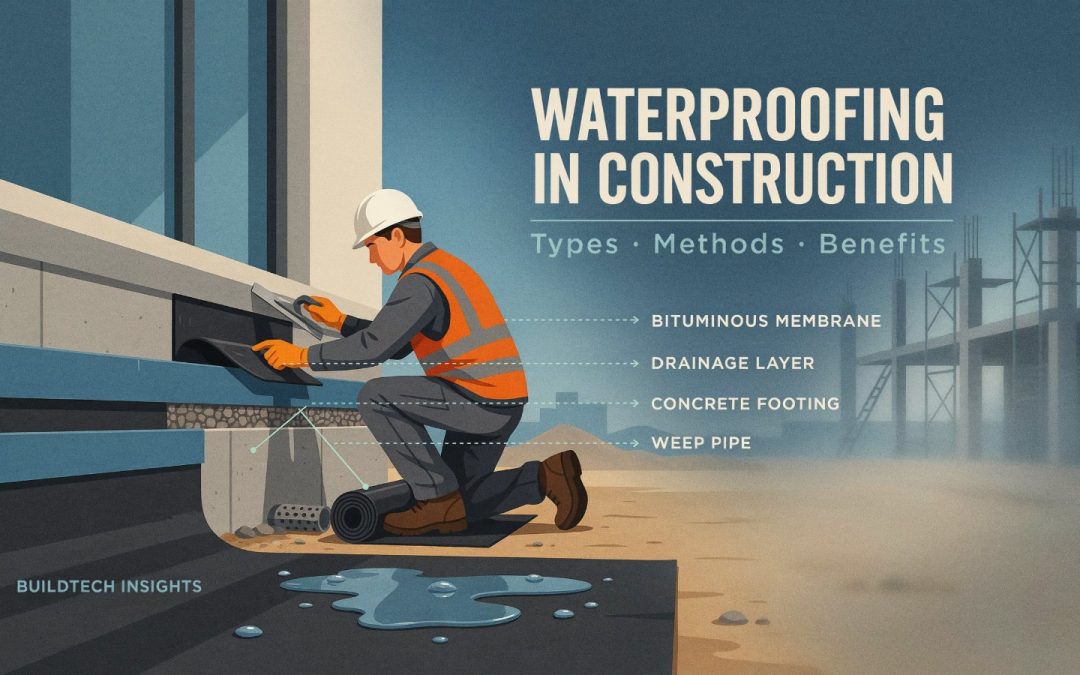
Waterproofing in construction blocks water from entering foundations, walls, roofs, basements, and other exposed areas. It uses membranes, coatings, sealants, and chemical systems to protect concrete and reinforcement from moisture and hydrostatic pressure.
Waterproofing helps prevent leaks, corrosion, cracking, mold, and moisture damage, which can increase repair costs and shorten a building’s service life. Common systems include cementitious coatings, liquid-applied membranes, bituminous membranes, polyurethane membranes, crystalline waterproofing, and sheet membranes.
Different waterproofing methods suit different construction conditions. Membrane, liquid-applied, integral, injection, and coating methods address new construction and existing structures in different ways. Foundations and basements need systems that handle groundwater pressure, while roofs and terraces need flexible systems that withstand rain, sunlight, and temperature changes.
A proper waterproofing job starts with surface inspection and cleaning, followed by priming, membrane or coating application, joint treatment, curing, protection, and testing. Choosing the right system also requires checking the substrate, water exposure, movement, UV and chemical exposure, drainage, budget, and expected service life.
Good waterproofing can protect a building for decades, while poor preparation, weak joints, damaged membranes, drainage problems, or the wrong material can cause leaks and early failure. Protecting the building from water early with the right waterproofing system can save years of trouble and costly repairs.
What Is Waterproofing in Construction?
Waterproofing in construction is the process of treating a surface or structure so it resists water infiltration, even under hydrostatic pressure, using membranes, coatings, and sealants applied to key structural elements. It creates a continuous, impermeable barrier that keeps water out of foundations, walls, roofs, and below-grade spaces.
The purpose of waterproofing goes beyond blocking rainfall. Concrete is a porous material that absorbs water through capillary action, and groundwater exerts hydrostatic pressure against foundation walls and basement floors. Waterproofing stops pressurized water from passing through the structure, protecting steel reinforcement from corrosion and concrete from cracking.
Waterproofing differs from water resistance in one measurable way: the American Concrete Institute (ACI 515.1) defines waterproofing as resisting water infiltration under hydrostatic pressure, while water-resistant or damp-proof materials only slow moisture absorption in the absence of that pressure. Damp-proofing coatings run about 10 mils thick; waterproofing materials run 40 mils or more and stay flexible enough to bridge small cracks.
Waterproofing is applied throughout a building, not just below ground. Common locations include foundations, basements, roofs, balconies, bathrooms, kitchens, swimming pools, water tanks, and any concrete structure exposed to standing or pressurized water.
Why Is Waterproofing Important in Construction?
Waterproofing is important in construction because it prevents leakage, protects concrete and steel reinforcement from corrosion, stops mold growth, and lowers long-term repair costs. Without it, water infiltration is one of the leading causes of structural deterioration in buildings.
Water that penetrates concrete corrodes embedded steel reinforcement, causing it to expand and crack the surrounding concrete from the inside out. This process, known as spalling, weakens structural elements and accelerates deterioration in foundations, columns, and slabs. Waterproofing blocks infiltration before it starts, protecting the structural integrity the building depends on.
Beyond structural protection, waterproofing controls indoor humidity and prevents the mold and mildew that come with prolonged dampness. Waterproofing accounts for roughly 1.8% of a building’s total construction cost, yet it represents 83% of all building defect complaints when it fails or is skipped, making it one of the highest-return investments in a construction budget. The core reasons waterproofing matters are given below:
- Prevent water leakage and seepage: a continuous membrane or coating stops water from entering through foundations, roofs, and wall penetrations.
- Protect concrete and reinforcement: waterproofing blocks the moisture that corrodes embedded steel and causes concrete spalling over time.
- Prevent cracks and structural deterioration: keeping water out reduces the freeze-thaw cycling and pressure that cause concrete to crack and weaken.
- Reduce mold and dampness: a dry building envelope controls indoor humidity, cutting the conditions mold and mildew need to grow.
- Lower repair and maintenance costs: preventing water damage avoids the far larger expense of structural repair, remediation, and reinforcement replacement.
- Extend building service life: a properly waterproofed structure resists degradation for decades longer than an unprotected one.
What Are the Main Types of Waterproofing in Construction?
The main types of waterproofing in construction are cementitious waterproofing, liquid-applied membranes, bituminous coatings, bituminous membranes, polyurethane liquid membranes, polymer-modified cementitious systems, crystalline waterproofing, and sheet-based membranes. Each type suits different substrates, movement conditions, and exposure levels.
Selecting the right type depends on the surface, the water exposure level, and whether the structure will experience movement or cracking over time. The main types are given below:
- Cementitious waterproofing: a Portland cement-based slurry applied as a coating; low-cost and easy to apply but rigid, so it performs poorly on surfaces with movement or vibration.
- Liquid-applied membrane: a roller-, spray-, or trowel-applied liquid that cures into a seamless, rubber-like layer; ideal for roofs, balconies, and wet areas because it forms a joint-free barrier.
- Bituminous coating: an asphalt-based flexible coating used on foundations and below-grade walls; offers strong water resistance but degrades under prolonged UV exposure.
- Bituminous membrane: factory-made bitumen sheets applied by torch-on or self-adhesive methods; considered one of the most reliable waterproofing types for roofs and podium decks.
- Polyurethane liquid membrane: a flexible, seamless membrane suited to flat roofs and areas needing elasticity; requires careful moisture evaluation in the substrate to prevent peeling.
- Polymer-modified cementitious waterproofing: cement waterproofing enhanced with acrylic or polymer additives for improved flexibility over standard cementitious systems.
- Crystalline waterproofing: a coating or admixture that reacts with water inside concrete to form insoluble crystals, permanently sealing pores from within.
- Sheet-based membranes: pre-formed rolls, often PVC or EPDM, installed with overlapping seams; durable and consistent in thickness but require skilled seam-sealing to avoid leaks.
What Are the Common Waterproofing Methods?
The common waterproofing methods are membrane waterproofing, liquid-applied waterproofing, integral waterproofing, injection waterproofing, and coating systems. A method describes how waterproofing is applied or incorporated into the structure, while a type or material describes what the waterproofing system is made from.
This distinction matters because the same material can be applied through different methods, and choosing the wrong method for a given condition causes failure even when the material itself is high quality. The main methods are given below:
- Membrane waterproofing: applies sheet or roll-form materials, torch-applied or self-adhesive, to create a continuous physical barrier over the substrate.
- Liquid-applied waterproofing: spreads a liquid polymer or resin by roller, spray, or trowel, curing into a seamless membrane that molds to irregular surfaces and penetrations.
- Integral waterproofing: mixes chemical admixtures directly into the concrete batch, making the concrete itself resistant to water without a separate applied layer.
- Injection waterproofing: pumps polyurethane or epoxy resin under pressure into cracks and joints, sealing existing leaks in already-built structures.
- Coating systems: brushes or sprays a cementitious or bituminous coating directly onto the substrate surface as a standalone barrier or preparatory layer.
Where Is Waterproofing Used in Buildings?
Waterproofing is used throughout a building wherever water exposure threatens the structure foundations, basements, roofs, terraces, balconies, bathrooms, kitchens, swimming pools, water tanks, and other concrete structures. Each area faces a different water source and requires a matched waterproofing approach.
- Foundations: face constant groundwater contact and hydrostatic pressure, requiring robust membrane or coating systems capable of withstanding sustained pressure.
- Basements: sit below grade where high water tables push moisture through walls and floors, making below-grade waterproofing and drainage systems essential.
- Roofs and terraces: take direct rainfall and UV exposure, favoring liquid-applied or bituminous membranes with strong weathering resistance.
- Balconies and decks: combine water exposure with foot traffic and thermal movement, suiting flexible liquid membranes that resist cracking.
- Bathrooms and kitchens: see frequent standing water on floors and walls, typically treated with cementitious or liquid membrane systems under tile.
- Swimming pools: hold constant water pressure against the structure, requiring crystalline or cementitious systems rated for permanent submersion.
- Water tanks: store potable or non-potable water under pressure, often using crystalline waterproofing since it doesn’t leach chemicals into stored water.
- Concrete structures: including parking garages and tunnels, face combined moisture, chemical, and traffic exposure suited to polyurethane or sheet membrane systems.
How Is Waterproofing Done in Construction?
Waterproofing in construction follows a sequence: inspect and prepare the surface, apply a primer, install the membrane or coating, treat joints and penetrations, cure the material, protect the finished layer, and test the completed system. Skipping any step, especially surface preparation, is the leading cause of waterproofing failure.
Surface preparation removes dust, oil, and loose debris from the substrate, since a contaminated surface prevents proper bonding and leads to debonding, where water travels underneath the layer and causes hidden leaks. Primer follows immediately after cleaning, sealing the substrate’s pores and creating a high-grip surface for the membrane to adhere to. The full sequence is given below:
- Inspect and prepare the surface: remove dust, oil, loose debris, and protruding concrete so the membrane can bond properly to the substrate.
- Clean and dry the substrate: ensure the surface is fully dry before proceeding, since trapped moisture causes blistering or bubbling under the finished layer.
- Apply a compatible primer: brush or spray a bonding primer matched to the substrate material, whether concrete, metal, or wood.
- Apply the membrane or coating: install the chosen waterproofing system at a controlled, even thickness across the full surface.
- Treat joints, corners, and penetrations: reinforce pipes, drains, and expansion joints with sealant or mesh, since these are the weakest points in any system.
- Allow proper curing: let the material harden undisturbed for the manufacturer’s specified time before adding protective layers or traffic.
- Protect the waterproofing layer: install protection boards over the finished system to prevent punctures during backfilling or foot traffic.
- Inspect and test the system: perform thickness checks and flood testing, often over 48 hours, to confirm the waterproofing holds under real conditions.
How Do You Choose the Right Waterproofing Method?
Choosing the right waterproofing method depends on building location, substrate type, water exposure level, hydrostatic pressure, crack and movement conditions, UV exposure, chemical exposure, drainage, climate, budget, expected service life, and accessibility for future maintenance. No single method works for every construction condition.
A below-grade foundation facing constant hydrostatic pressure needs a fundamentally different system than a rooftop terrace facing UV degradation and thermal cycling. Structures prone to cracking or movement need flexible, elastic membranes, while static, low-movement surfaces can use rigid cementitious systems at lower cost. Accessibility matters just as much as performance, since exterior below-grade waterproofing that fails years later requires expensive excavation to repair, while interior systems remain accessible for maintenance.
| Factor | Favors Rigid Systems (Cementitious) | Favors Flexible Systems (Liquid/Membrane) |
| Movement/cracking | Low movement, static structures | High movement, thermal cycling |
| Hydrostatic pressure | Low to moderate pressure | High, sustained pressure |
| UV exposure | Not exposed, covered surfaces | Exposed roofs and terraces |
| Accessibility for repair | Interior, easily accessible | Below-grade, hard to re-access |
What Are the Common Waterproofing Problems and Benefits?
Waterproofing delivers structural protection, reduced moisture damage, corrosion prevention, mold prevention, lower maintenance costs, and longer building life, while its most common failures are leakage, seepage, cracking, poor adhesion, joint failure, improper surface preparation, drainage problems, and incorrect system selection. Most failures trace back to preparation or selection errors rather than material defects.
The benefits compound over a building’s lifespan: a properly waterproofed structure avoids the corrosion, spalling, and mold remediation that come with water intrusion, while the failures below almost always stem from skipped steps rather than defective products.
- Structural protection: a functioning waterproofing system shields reinforcement and concrete from the corrosion and spalling water intrusion causes.
- Reduced moisture damage: blocking infiltration prevents warped finishes, damaged insulation, and degraded interior materials.
- Corrosion prevention: keeping water off embedded steel stops the rust expansion that cracks surrounding concrete from within.
- Mold prevention: a dry building envelope removes the moisture mold and mildew need to establish and spread.
- Lower maintenance costs: preventing water damage avoids the far higher cost of structural repair and remediation later.
- Leakage and seepage: the most common failure, usually caused by debonding, membrane punctures, or untreated penetrations.
- Cracking and poor adhesion: rigid materials applied to moving substrates crack, while contaminated surfaces prevent proper bonding entirely.
- Incorrect system selection: applying a damp-proofing-grade material where hydrostatic pressure exists guarantees premature failure.
How long does waterproofing last in a building?
Most professionally installed waterproofing systems last 10 to 30 years, with exterior membranes reaching 20 to 30 years and interior drainage systems lasting 25 years or more when properly maintained. Sealants and coatings degrade faster and typically need resealing every 5 to 10 years, while crack injections remain permanent for that specific crack.
What are the best waterproofing materials for construction?
The best waterproofing material depends on the application: crystalline waterproofing suits water tanks and below-grade concrete, bituminous membranes suit roofs and podium decks, and polyurethane liquid membranes suit flat roofs needing flexibility. No single material outperforms every other material across all conditions, exposure levels, and budgets.
What is the difference between waterproofing and dampproofing?
Waterproofing resists water infiltration under hydrostatic pressure, while damping only slows moisture absorption in the absence of that pressure. The American Concrete Institute defines this distinction directly: dampproofing coatings run about 10 mils thick, while waterproofing materials run 40 mils or more and can bridge cracks up to 1/16 inch.
Can waterproofing be applied to an existing building?
Yes, waterproofing can be applied to existing buildings through both interior and exterior retrofit methods, including injection waterproofing for existing cracks and interior drainage systems that don’t require excavation. Exterior retrofits require excavation around the foundation, making interior solutions the faster and less disruptive option for most existing structures.
How often should waterproofing be inspected or repaired?
Waterproofing systems should be inspected annually, with sealants and coatings typically needing resealing every 5 to 10 years and sump pumps needing replacement every 7 to 10 years. Below-grade membranes are harder to inspect without excavation, so catching early leak signs through interior monitoring matters more for those systems.
How much does waterproofing cost in construction?
Waterproofing typically costs $3 to $10 per square foot depending on the material and method, with cementitious coatings running $3 to $6 per square foot, liquid or sheet membranes running $4 to $7 per square foot, and polyurethane injection reaching roughly $10 per square foot for crack repair. A full basement waterproofing project commonly totals $4,000 to $15,000 depending on size and severity.